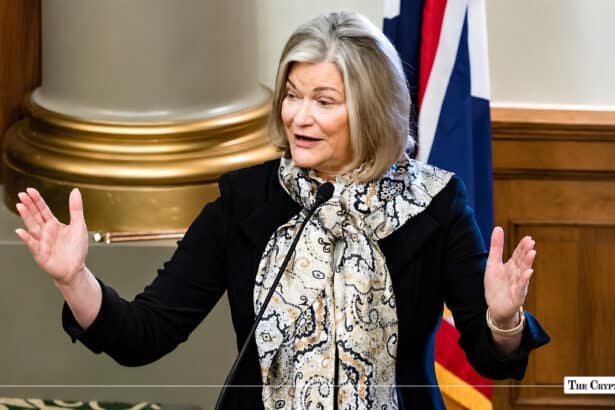
Actor and crypto critic Ben McKenzie joined a group of Senate Democrats at a Capitol Hill press conference on July 14, urging the chamber to reject the CLARITY Act unless it adds a provision barring public officials from profiting off crypto.
The event, organized by Senator Chris Murphy of Connecticut, brought together lawmakers and the advocacy groups Indivisible and Americans for Financial Reform to argue that the digital asset market-structure bill fails to address what they called President Trump’s crypto corruption.
The timing was deliberate. The Senate is expected to take up the CLARITY Act as early as the week of July 20, and the ethics section remains one of the last unresolved pieces of the negotiation. The press conference moved a fight that had largely played out behind closed doors into public view days before a floor vote.
Murphy, who has not been among the Democrats negotiating the bill with Republicans, framed his objection in structural terms. He argued there is no reason to pass a new regulatory system for crypto if that system does not stop Trump’s corruption of the industry and said a bill that protects the president’s dominance over an industry he regulates would be, in his words, “a fundamental corruption.”
McKenzie Presses the Ethics Case
McKenzie, best known for his role on “The OC” and now one of the industry’s most prominent critics, has spent recent years documenting crypto fraud. He released the documentary “Everyone Is Lying to You for Money” last year and testified before the Senate Banking Committee after the collapse of FTX in 2022.
He tied his argument directly to the bill’s silence on ethics. The CLARITY Act is meant to provide regulatory clarity, McKenzie said, yet contains no provision to prevent or even diminish the president’s crypto profits.
He directed his sharpest appeal at undecided senators, arguing, “If you vote against Clarity, you will be on the right side of history. If you vote for Clarity, you can be damn sure we will not forget the truth. Voting against Clarity offers every senator an opportunity to go on the record and do the right thing.”
What the Democrats Are Demanding
The objection is specific. A bloc of Senate Democrats, including Senators Kirsten Gillibrand, Elizabeth Warren, and Jeff Merkley, and the lawmakers at Tuesday’s event have conditioned support on an ethics provision that would make it illegal for the president, members of Congress, and their families to issue, sponsor, own, or profit from digital assets.
The demand hardened after Trump’s financial disclosures showed roughly $1.4 billion in crypto-related gains, with his single largest 2025 income stream, about $636 million, coming from the TRUMP memecoin. Gillibrand has cited that figure in pushing to bar sitting presidents from issuing digital assets, and Warren has called the situation brazen financial corruption.
Senator Chris Van Hollen, who sits on the Banking Committee and helped push for an ethics title in committee, called the measure a corrupt piece of legislation that would do significant harm. The White House has said it will accept ethics rules that apply across the board but will reject any language singling out a specific office, official, or family—the gap that has kept the section unresolved.
Why the Math Makes This Matter
The public whip operation carries weight because of the arithmetic. The bill needs 60 votes to clear a filibuster, and the Republican majority narrowed to 52-47 following the death of Senator Lindsey Graham on July 11. That leaves the bill needing at least eight Democratic votes, assuming every Republican votes yes—not a certainty, given that Senators Josh Hawley and Rand Paul both opposed the GENIUS Act.
Every Democrat who publicly commits to opposing the bill without an ethics fix raises the price of passage. A merged draft combining the Senate Banking and Agriculture texts is expected imminently, with Senator Cynthia Lummis having set out a timeline for the bill text, though people familiar with the talks have said it is not expected to contain finalized ethics language.
The Other Side of the Fight
The bill’s backers are pushing in the opposite direction. Senate Majority Leader John Thune has pledged to bring the CLARITY Act to the floor before the August recess, and Senator Bill Hagerty said this week that the legislation still has the momentum to pass. President Trump publicly urged the Senate to approve it on Monday, framing the bill as a national-security priority against China.
The bill also retains institutional support beyond the industry. The National Organization of Black Law Enforcement Executives and the Federal Law Enforcement Officers Association have both backed it, arguing it would help address digital asset-related crime.
Whether that momentum survives the ethics standoff is the question the next several days will answer. For now, the opposition has a public face, a bloc of senators willing to withhold their votes, and a calendar working against the bill’s supporters.
Also Read: CLARITY Act: 5 Fights Still Unresolved Before the Merged Draft Drops