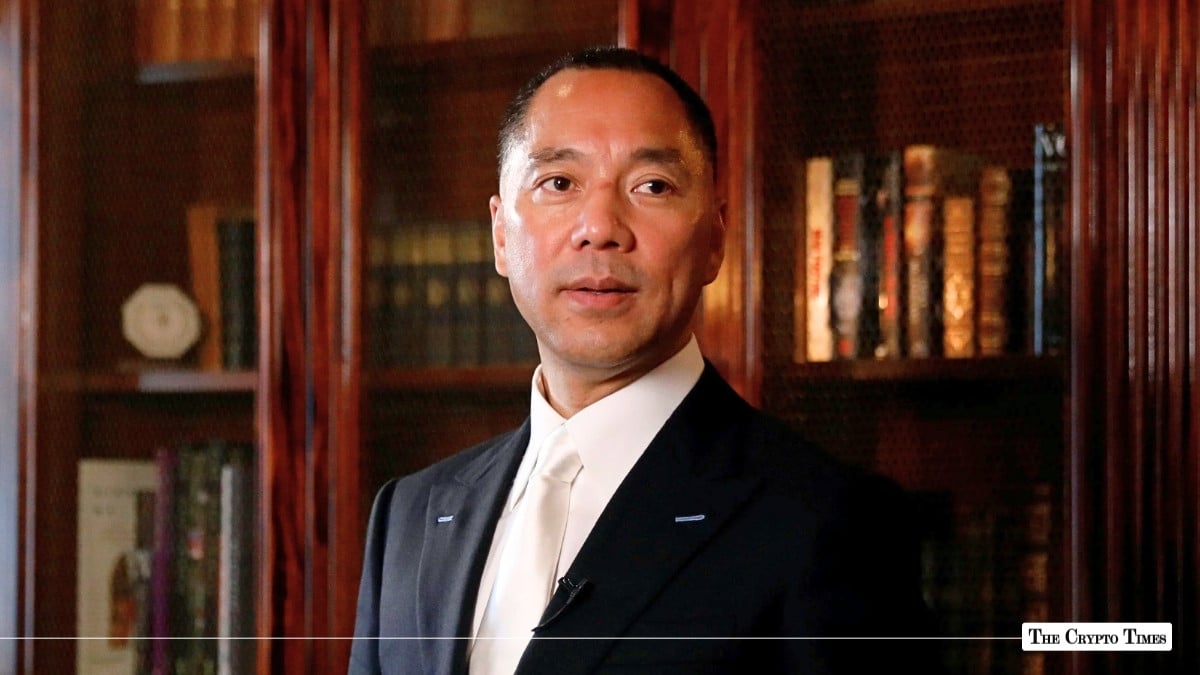
Self-exiled Chinese businessman Guo Wengui, also known as Miles Guo and Ho Wan Kwok, was sentenced to 30 years in prison by a Manhattan federal court after being convicted of defrauding thousands of investors of more than $1 billion between 2018 and 2023. The schemes involved entities including GTV Media Group, the Himalaya Farm Alliance, and the Himalaya Exchange, a purported cryptocurrency platform.
Prosecutors alleged that Guo and associates promoted investments in these vehicles, including the sale of Himalaya Coin (H-Coin/HCN), falsely described as a cryptocurrency partially backed by gold, and Himalaya Dollar (HDO), presented as a stablecoin. These were traded on the Himalaya Exchange, which authorities described as a fraudulent ecosystem designed to extract additional funds from Guo’s online followers. The DOJ specifically noted that approximately $262 million was fraudulently obtained through the Himalaya Exchange alone.
Judge Analisa Torres delivered the sentence in a Manhattan courtroom filled with Guo’s supporters. She ruled that Guo “preyed on those seeking to bring Democracy to China,” while financing an extravagant lifestyle with investor funds. The court also ordered him to forfeit $889 million and pay restitution. Before sentencing, Guo defended his motives and said, “The reason I came to the U.S. was to destroy the CCP.”
Victims describe heavy financial losses
The court also heard emotional statements from victims who said they lost their life savings through Guo’s investment schemes. Judge Analisa Torres said Guo “takes no responsibility for his actions and instead insists incredibly his conduct caused no loss and harmed no one.” She also said he “has called upon supporters to harass and intimidate those who dare to speak out against him.”
Victim Wei Chen told the court that Guo’s fraud “destroyed my life” and devastated the family. Prosecutors said Guo used investor money to buy mansions, yachts, race cars, designer clothing, and luxury furnishings instead of making legitimate investments. They described the fraud as “astonishing” and said it “destroyed hundreds of lives” between 2018 and 2023.
This case illustrates how fraudulent cryptocurrency offerings can be packaged with political or ideological appeals to attract investors. Guo’s followers were solicited for what were presented as revolutionary digital assets tied to his movement, but the offerings were vehicles for misappropriation rather than legitimate blockchain projects. The Himalaya Exchange was not a functional, decentralized crypto platform but a tool in a larger fraud conspiracy involving wire fraud, securities fraud, and money laundering.
Global crypto crime faces rising pressure
Authorities have continued stepping up enforcement against crypto-related financial crime across multiple regions. Earlier this year, Cambodia extradited former Huione Pay chairman Li Xiong to China over alleged fraud and money laundering offenses. Indian police also arrested two suspects accused of channeling cybercrime proceeds through cryptocurrency networks linked to operators in China.
The crackdown has also expanded through international cooperation. Dubai Police led a joint operation with the FBI and China’s Ministry of Public Security that dismantled nine cryptocurrency scam centers and arrested 276 suspects. U.S. prosecutors also brought wire fraud and money laundering charges against several people linked to the network, underscoring growing efforts to disrupt cross-border crypto crime.
Blockchain analytics strengthen investigations
Blockchain analytics firms are strengthening the tools they use to help investigators track illicit cryptocurrency activity. Chainalysis recently introduced a new framework designed to improve how investigators trace blockchain transactions and identify wallet clusters during financial crime investigations.
TRM Labs also reported that illicit cryptocurrency wallets received an estimated $158 billion in 2025, up sharply from the previous year. Even so, illicit activity accounted for just 1.2% of attributed on-chain volume, down from 1.3% in 2024. The figures suggest that while the value of illegal transactions increased, they represented a smaller share of the cryptocurrency market as the industry continued to grow.
Also Read: FCA Finalizes Final UK Crypto Framework with Eased Stablecoin Capital