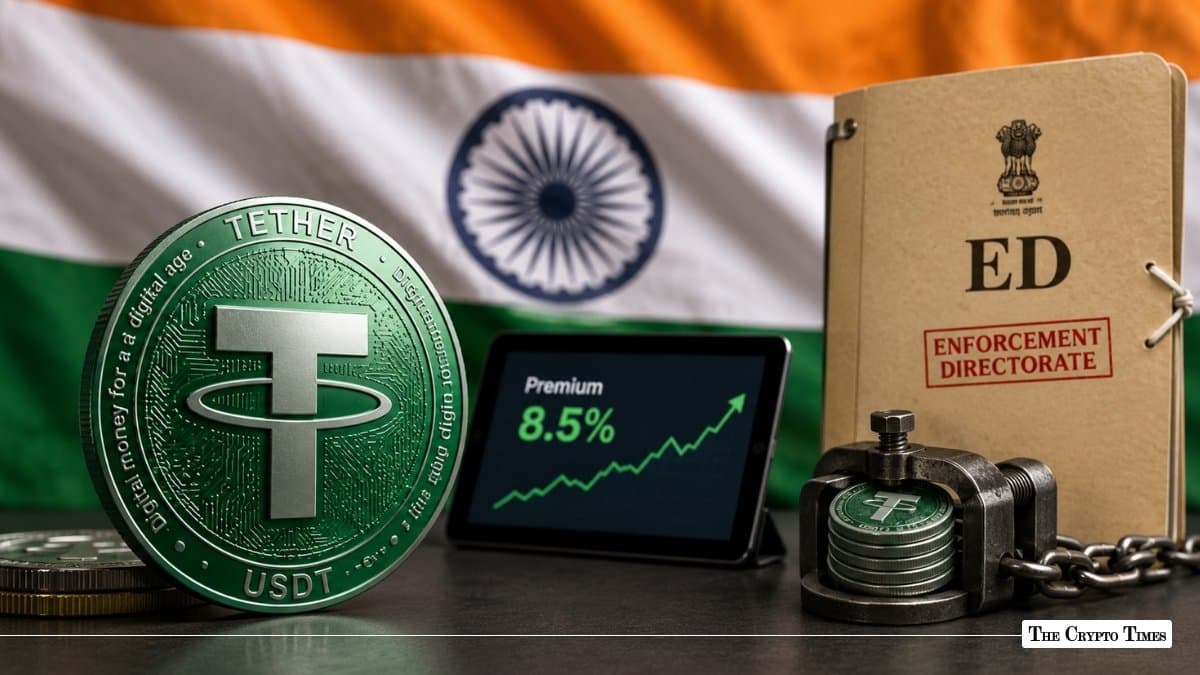
India’s stablecoin market is in the grip of a supply crunch. The price of Tether (USDT), the world’s largest stablecoin by market capitalization, surged to ₹102.88 on Indian platforms over the weekend, trading at an 8.5% premium over the USD-INR interbank closing rate of ₹94.65.
The premium, which should typically hover between an average of 3% to 6%, has been climbing steadily since the Enforcement Directorate (ED) launched a sweeping crackdown on entities that facilitated unauthorized cross-border crypto transfers.
As per a report by The Economic Times, the widening gap underscores a structural shift in India’s crypto liquidity landscape, one that is being shaped in real time by regulatory enforcement, shrinking supply pipelines, and mounting global pressure on stablecoin oversight.
ED’s ₹2,500 Crore Probe: The Trigger
The premium started hardening in the weeks following the ED’s June 17 raids on five Bengaluru-based crypto companies. The agency, operating under Section 37 of the Foreign Exchange Management Act (FEMA), searched six premises and alleged that unauthorized cross-border transfers exceeding ₹2,500 crore had been routed through virtual digital assets (VDAs).
The firms under investigation include Transak Technology India, Carretx Technologies (Carret), Mokshagna Technologies (Onmeta), Buyhatke Internet (Onramp.money), and Xpat Technologies.
According to the ED’s official statement posted on X on June 19, the companies offered on-ramp and off-ramp services that allowed users to convert Indian rupees into stablecoins like USDT. Those coins were then transferred through crypto platforms and sold via over-the-counter (OTC) deals, with proceeds distributed to recipients, effectively bypassing traditional remittance channels governed by FEMA.
The ED also restrained bank accounts holding approximately ₹6 crore linked to the suspected transactions.
How the Remittance Pipeline Worked
For the past two years, a parallel remittance model has been flourishing in India. Instead of wiring dollars through banking channels, many Non-Resident Indians (NRIs) had been sending USDT to families back home.
The process was quicker, cheaper, and generated more rupees when sold on Indian exchanges compared to the conversion rates offered by banks. The USDT premium itself, combined with the fees that banks typically impose on international wire transfers, made the stablecoin route significantly more attractive.
This model also attracted some questionable money movements, with parties using USDT to move funds in and out of India while avoiding banks and the documentation requirements that come with regulated remittance channels.
The ED, which administers both FEMA and the Prevention of Money Laundering Act (PMLA), has taken the position that such cross-border USDT transfers violate FEMA even when the underlying funds are not tainted or linked to criminal proceeds.
Supply Squeeze Pushes Premium Higher, Bleeding Indian Users
The dip in USDT inflows and the fear of further enforcement action have had a direct impact on supply. Crypto market-makers and liquidity generators operating in India have reportedly scaled back their USDT purchases from abroad following the ED’s statement. With fewer stablecoins entering the Indian market, demand has outstripped supply, pushing the premium to levels not seen in recent memory.
To put the current spike in perspective, India’s USDT premium has historically been reported to average between 3% and 6%. The premium exists because of structural frictions in moving dollars into India, including capital controls, banking restrictions on crypto-related transactions, and compliance costs that make easy arbitrage nearly impossible. As a result, local P2P prices remain elevated most of the time. However, The Crypto Times recent independent investigation exposed a harsh reality that Indian crypto buyers actually routinely pay up to 7% to 8% more than the real USD rate for stablecoins, a hidden cost that has driven an estimated 90% of Indian trading volume offshore.
Furthermore, the premium tends to spike well above that baseline during regulatory crackdowns, bull runs, new token launches, or supply disruptions, frequently jumping to 8% to 12% or higher. The current reading of 8.5% falls squarely into crisis territory. Anything consistently above the 7% to 8% mark signals either tight supply or heightened demand driven by risk, and in this case, the ED’s enforcement actions have triggered both simultaneously.
In the crypto ecosystem, USDT functions as the primary currency for swapping into other tokens. The premium also tends to inch up when Indian traders buy stablecoins to acquire top cryptocurrencies like Bitcoin or Solana. However, market observers say that trading demand alone cannot fully explain the sharp spike. The enforcement-driven supply crunch is the dominant factor.
Parliamentary Panel Moves to Address Regulatory Gaps
The timing of the supply crisis coincides with a critical moment in India’s crypto policy trajectory. The Parliamentary Standing Committee on Finance, chaired by BJP MP Bhartruhari Mahtab, is scheduled to meet representatives from the Reserve Bank of India (RBI) and the Institute of Chartered Accountants of India (ICAI) on July 2 at Parliament House Annexe in New Delhi. The agenda: “A Study on Virtual Digital Assets (VDAs) and Way Forward.”
This will be the committee’s eighth stakeholder consultation. Previous sittings heard from exchanges including Binance, Coinbase, CoinDCX, CoinSwitch, and WazirX, as well as government agencies like the Financial Intelligence Unit (FIU-IND), the Central Board of Direct Taxes (CBDT), the International Financial Services Centres Authority (IFSCA), and the Ministry of Corporate Affairs.
During earlier hearings, tax authorities told the panel they had identified nearly ₹888.82 crore in undisclosed crypto-related income and had issued notices to more than 44,000 taxpayers.
The RBI has consistently maintained a cautious stance. Committee chair Mahtab has previously revealed that the central bank remains opposed to allowing or formally regulating crypto activities in India. RBI Governor Sanjay Malhotra has publicly stated that stablecoins and cryptos carry significant risks and that the central bank is adopting a cautious approach.
Global Spotlight on India’s Crypto Flows
India’s domestic regulatory reckoning is unfolding against significant international scrutiny. The OECD’s Asia Capital Markets Report 2026, released earlier this month, flagged India as the top country in Asia for crypto asset inflows, with $340 billion recorded between June 2024 and June 2025, roughly 9% of GDP. South Korea ranked second, followed by Vietnam and Indonesia. In terms of GDP share, Vietnam led the continent at nearly 50%.
The OECD report noted that Asia saw a 69% year-on-year growth in blockchain-based crypto transactions during the same period, the highest among all global regions, and warned about growing interconnectedness between crypto markets and traditional financial systems.
Meanwhile, India’s FIU has also intensified its scrutiny of crypto OTC deals, with exchanges reportedly asked to preserve OTC records dating back to January 2026 and provide data on transactions exceeding $10,000.
FATF Raises Red Flags on Stablecoins
The enforcement push in India mirrors growing global concern about stablecoin misuse. The Financial Action Task Force (FATF), in its Targeted Report on Stablecoins and Unhosted Wallets published in March 2026, cited Chainalysis data showing that stablecoins accounted for 84% of the $154 billion in illicit virtual asset transaction volume in 2025.
The report highlighted how stablecoins’ price stability, liquidity, and interoperability make them attractive for criminal misuse, including sanctions evasion by state-linked groups from North Korea and Iran.
The FATF identified peer-to-peer transfers via unhosted wallets as a key vulnerability, since such transactions can bypass anti-money laundering (AML) controls entirely. The watchdog urged countries to impose AML obligations on stablecoin issuers and to consider requiring wallet freezing capabilities and restrictions on certain smart contract functionalities.
Separately, TRM Labs reported that illicit entities received $141 billion in stablecoins in 2025, the highest level observed in five years, with sanctions-related activity accounting for 86% of illicit crypto flows.
Industry Calls for Clarity
Sudhakar Lakshmanaraja, founder of Digital South Trust, a Web3 policy advocacy body, stressed that regulation is no longer optional. He pointed to the OECD’s findings on India’s massive crypto flows, the ED’s enforcement actions, and the FIU’s scrutiny of OTC deals as converging signals. With the FATF data highlighting the scale of illicit stablecoin activity, Lakshmanaraja described New Delhi’s focus on VDA regulation as both welcome and urgent.
The crypto industry in India now finds itself at a crossroads. The ED’s crackdown has disrupted a remittance model that many relied upon. The supply squeeze has made stablecoins more expensive. And the regulatory framework that could provide clarity remains a work in progress, with the RBI resistant to formal recognition and Parliament still gathering evidence.
What happens at the July 2 meeting and the regulatory direction that follows could define whether India’s crypto ecosystem operates within a clear legal framework or continues to navigate the costly uncertainty that, as Anand put it, the market is currently bearing.
Also Read: India’s Crypto Inflows Hit $340B in One Year, Now Equal to 9% of GDP: OECD Report