Key Highlights
- Speculation around a potential Base airdrop surged after developers discovered new code in an official Base GitHub repository.
- Some community members view the updates as a technical signal of a possible future token distribution.
- Others argue the repository is primarily a developer demo showcasing user verification and anti-bot infrastructure.
Speculation about a potential Base airdrop has resurfaced after community members discovered new activity in an official GitHub repository belonging to Base, Coinbase’s Layer-2 blockchain.
The repository, base-verify-demo, recently added code referencing a “Sybil-Resistant Airdrop” claim contract, an on-chain verification registry, and a full claim flow on the Base Sepolia testnet.
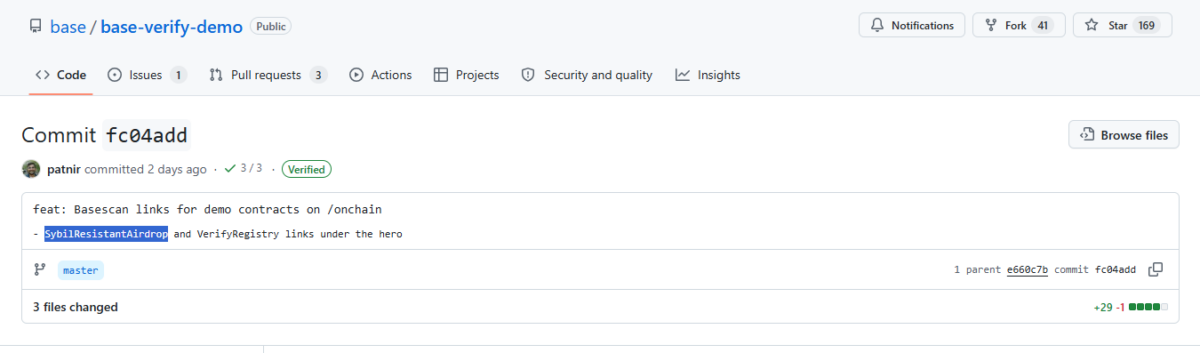
The repo is a reference implementation that shows teams building on base how to gate token claims and stop multi-wallet abuse. It leans on Base Verify, which lets users prove ownership of verified X, Coinbase, Instagram, or TikTok accounts without sharing credentials, to issue one deterministic token per account, so the same person can’t claim twice across different wallets
What the code does and doesn’t show
Since the repository is maintained by the official Base team, some community members interpreted the changes as a potential signal that an airdrop could be on the horizon. However, Base has not announced any plans to launch a token or conduct an airdrop.
The current code appears to be part of a developer demonstration project showcasing how projects on Base can implement user verification and Sybil resistance using Base Verify.
Many crypto users see this as the clearest technical signal yet. The presence of dedicated airdrop claim contracts and mainnet migration references in an official repo has fueled excitement. Some users speculate that Base could eventually reward early users and active developers on the network, although no evidence currently confirms such plans.
Community urges caution
Others, including accounts like @Sukanto018, have urged the community not to overinterpret the updates. They noted that the repository appears to be a developer demonstration designed to showcase Base Verify, including identity verification and Sybil-resistance mechanisms that ecosystem projects can integrate into their own applications.
As of now, the situation remains speculative. While the code changes are genuine, they do not constitute confirmation of an airdrop from the Base team. Similar hype cycles in the past have led to both legitimate rewards and community disappointment when expectations were not met.
Base users are advised to remain vigilant against phishing attempts and fake claim sites that often emerge during such speculation. The Crypto Times team reached out to Base for clarification on the speculation, but hasn’t received any comment yet.
Base records over 100 million agentic payments
Separately, Base recently recorded more than 100 million agentic payments in just three quarters, according to a new Chainalysis report. Activity exploded from nearly zero in Q3 2025, driven largely by meme coin farming, especially around the PING token. While usage grew sharply through late 2025, it has started to moderate in early 2026.
In a separate development, Amazon Web Services (AWS) recently added support for Base through its AWS WAF Bot Control service, enabling publishers to monetize AI-generated traffic via automated USDC micropayments.
What to expect
If Base eventually launches a token and conducts an airdrop, early ecosystem participants could potentially benefit, although the eligibility criteria would depend entirely on the project’s future decisions.
If the repository remains solely a developer demonstration, it still highlights Base’s focus on user verification, Sybil resistance, and developer tooling rather than signaling an imminent token launch.
Until Base provides official guidance, the GitHub activity should be viewed as technical development rather than confirmation of an airdrop. Users should also remain cautious of phishing websites and fake claim portals that often emerge during periods of heightened speculation.
Also Read: Arthur Hayes Sells 6,000 ETH at Loss as Ethereum Trades Sideways