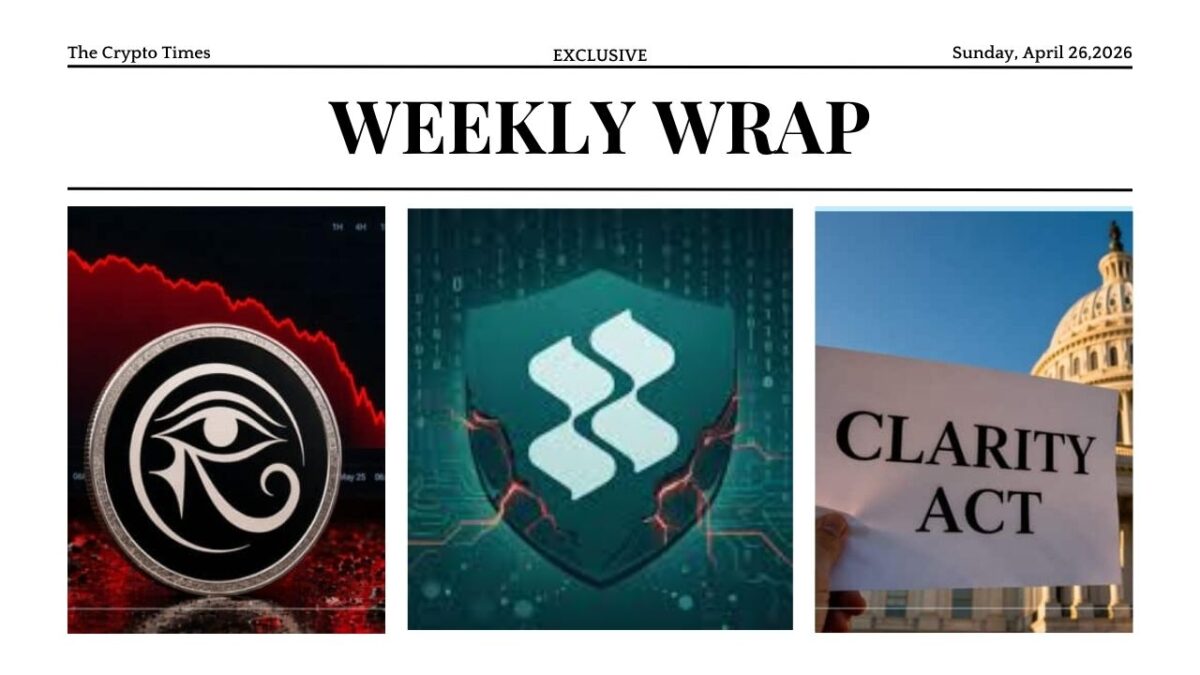
Key Highlights
- KelpDAO was exploited for $292 million in one of the largest DeFi attacks of 2026, with LayerZero linking the breach to North Korea’s Lazarus Group and Aave left absorbing the bulk of the bad debt.
- RaveDAO’s MemeCore-backed token round-tripped a 6,000% pump into a 95% crash inside 48 hours, wiping roughly $6 billion in market value and putting insider supply allocations back under the microscope.
- The CLARITY Act stablecoin compromise stalled yet again over yield language, even as Senator Bernie Moreno set a hard May deadline and Coinbase shares felt the pressure.
Welcome to this week’s cryptocurrency market update. If the previous weeks were defined by Bitcoin’s monthly recovery and France’s on-chain IPO milestone, this week was defined by one of the worst stretches DeFi has seen all year. A $292 million exploit, a multi-billion-dollar memecoin implosion, a stalled stablecoin bill, and a quiet but accelerating rotation of capital into Bitcoin and Ethereum treasuries.
In this edition, we cover the KelpDAO hack and its ripple effects on Aave, the RaveDAO collapse and MemeCore scrutiny, regulatory developments around the CLARITY Act and India, fresh corporate Bitcoin and Ethereum buys, Coinbase’s India and UK expansion, and the quantum security debate that is starting to feel a lot less theoretical. Let’s get into it.
Top headlines for this week
Below are the major headlines, giving an overview of what happened in the crypto market this week.
KelpDAO Exploited for $292M, Aave left holding the bag
The biggest story of the week, and arguably the worst DeFi event of the quarter, was the exploitation of KelpDAO for $292 million. The liquid restaking protocol’s vulnerability allowed an attacker to mint rsETH without a corresponding deposit, then loop the inflated collateral through Aave to drain real liquidity. The result was a cascading bad debt event that has left Aave absorbing the heaviest blow of any lending protocol in the cycle.
What makes this one sting is that the vulnerability was flagged 15 months ago by independent researchers and never patched. DeFi had over a year of advance notice and still failed to act. LayerZero went a step further and publicly blamed the KelpDAO team for the exploit, tying the attacker’s wallet patterns to North Korea’s Lazarus Group, the same outfit linked to the Drift hack earlier this month.
Arbitrum then made a decision that has split the industry. The L2 froze roughly $71 million of the attacker’s funds at the sequencer level, recovering value but reigniting the debate over whether L2s are decentralized in any meaningful sense. Ledger’s CTO was among the loudest critics, arguing that the freeze exposes how much control L2s actually retain over user funds.
The recovery effort has continued into the weekend. Fourteen DeFi contributors stepped in to back Aave with $161 million to plug the bad debt hole, a coordinated rescue that mirrors the kind of backstop normally seen in traditional finance. Separately, the Balancer attacker from a prior incident moved $11.3 million to BTC via THORChain, apparently watching the KelpDAO precedent and accelerating their own laundering before more L2s follow Arbitrum’s lead.
This is the second North Korea-linked DeFi exploit in three weeks. The pattern is no longer ambiguous.
RaveDAO’s 6,000% Pump Becomes a 95% Crash, $6B Gone
While the KelpDAO story dominated headlines, RaveDAO quietly produced one of the fastest wealth destructions of 2026. The MemeCore-ecosystem token pumped 6,000% before crashing 95% inside 48 hours, wiping roughly $6 billion in paper market cap and leaving thousands of late buyers underwater.
ZachXBT followed up with a detailed look at MemeCore’s supply structure, highlighting how heavily insider-allocated the token was and how the crash bore the hallmarks of a coordinated distribution. The pattern is by now familiar, but the scale here was unusual, and it lands at a moment when retail trust in low-float launches is already paper-thin.
CLARITY Act stalls in April, Moreno sets May deadline
The stablecoin regulation fight took another step backward this week. The CLARITY Act hit an April roadblock as the yield compromise between banks and crypto firms collapsed once again, undoing the optimism Coinbase’s CLO had floated earlier this month about a 48-hour deal.
Senator Bernie Moreno responded by drawing a hard line. He set a May deadline for the CLARITY Act and dismissed bank lobby resistance as “noise,” signaling that Senate Republicans are losing patience with the back-and-forth. SEC Chair Paul Atkins also began signaling a policy shift, pivoting to an “ACT” strategy that emphasizes a clearer rulemaking framework over the previous enforcement-heavy posture.
The market noticed. Coinbase shares had been rallying toward $220 on expectations of legislative progress, but the rally stalled as the April delay became official. Roughly half the U.S. crypto policy agenda for 2026 still hinges on this single bill.
Bitcoin treasury buying picks up, Ethereum joins the trade
Corporate Bitcoin accumulation kept rolling through the week even as price action stayed muted. Strategy posted a fresh weekly Bitcoin purchase, continuing its pattern of large weekly hauls, and Capital B added 12 BTC to push its treasury to 2,937 BTC. Metaplanet kept the Asian flank busy with a fresh $50 million bond sale earmarked entirely for more Bitcoin.
Bitcoin’s on-chain signals are starting to align for a push toward $80,000, with accumulation addresses growing and exchange reserves continuing to drain, even though the spot price has stayed range-bound.
The bigger surprise was on the Ethereum side. Bitmine scooped up 101,000 ETH in its largest single buy since 2025, signaling that the ETH treasury trade is no longer just a Bitcoin-only narrative. The shift matters because Bitmine had been a Bitcoin-first accumulator until now.
India sees a political shake-up and Coinbase expansion
India produced two of the more interesting non-hack stories of the week. Pro-crypto MP Raghav Chadha joined the BJP after years of vocal crypto advocacy, a move that puts a known crypto-friendly voice inside the ruling party at a moment when the country’s regulatory framework is finally heading for a real debate.
CoinDCX’s CEO used the opening to propose specific fixes to India’s RBI fraud rules, targeting the provisions that have been used to freeze user accounts on flimsy grounds. A new CoinSwitch report added the data point most observers have been waiting for: India’s crypto user base is getting older, slower, and smarter, with average ages climbing and speculative activity dropping in favor of long-term holding.
Coinbase responded to the shifting mood by adding USDC-INR support, giving Indian users direct rupee on-ramps to the second-largest stablecoin. The exchange also expanded its crypto lending business to the UK with instant Bitcoin-backed loans, a product that has been a regulatory minefield in the U.S. but is finding cleaner ground across the Atlantic.
News you might have missed
- Quantum risk goes mainstream: Ledger’s CTO warned that crypto faces a Y2K-scale crisis as quantum computing inches closer to breaking elliptic curve signatures.
- Satoshi theories get a refresh: A new “Finding Satoshi” investigation named Hal Finney and Len Sassaman as the most plausible candidates, pushing back against the long-running Adam Back theory.
- Trump hosts another $TRUMP gala: The president hosted another Mar-a-Lago dinner for top $TRUMP token holders, the second such event this year.
- WLFI rumor debunked: Reports that WLFI co-founder Zack Witkoff was arrested were confirmed false after circulating on X.
Buzz of the Week
The buzz this week belonged entirely to one number: $292 million. The KelpDAO exploit, what it revealed about Aave’s risk exposure, what Arbitrum’s response said about L2 decentralization, and what LayerZero’s attribution said about who is actually targeting DeFi at scale.
The uncomfortable through-line is that DeFi keeps absorbing North Korean attacks. Drift earlier this month, KelpDAO this week, and a Balancer-linked actor laundering funds in the background. The Lazarus Group has reportedly extracted hundreds of millions from DeFi in 2026 alone, and most of the breaches have not involved smart contract bugs at all. They have involved social engineering, ignored audits, and trust assumptions that were never stress-tested.
Aave is the institution that emerges from this week most changed. The protocol has long marketed itself as the safest, most conservatively risk-managed lender in DeFi, and now it is dependent on a $161 million backstop from contributors to absorb damage caused by a vulnerability in another protocol entirely. That is a structural lesson, not a one-off. Composability is a feature until it becomes a transmission mechanism for someone else’s failure.
The RaveDAO crash on the other end of the week is the same story in a different costume. Both events are about insiders, asymmetric information, and retail catching the wrong end of a structure that was never built to protect them.
What to expect for next week?
Next week comes down to three things: whether Senator Moreno’s May deadline forces real CLARITY Act movement, whether Aave’s bad debt situation is fully contained or whether more contagion shows up, and whether Bitcoin can finally clear the upper end of its current range and confirm the on-chain setup pointing toward $80,000.
If the Aave backstop holds and no further protocols reveal hidden KelpDAO exposure, DeFi gets a chance to reset and move on. If more bad debt surfaces, the conversation shifts very quickly from “isolated exploit” to “systemic risk.” Watch lending protocol TVL closely.
On the policy side, Moreno’s May deadline either delivers the most consequential crypto legislation of 2026 or it slips and the bill effectively dies for the summer. The yield compromise is the entire fight. Expect intense lobbying from both sides over the next ten days.
And the quantum conversation is no longer abstract. Ledger’s warning combined with the broader industry’s slow response is going to keep this on the agenda. Whoever moves first on quantum-resistant signature schemes, whether that is Ethereum, Bitcoin, or a new chain entirely, may end up with a structural advantage that nobody is pricing in yet.