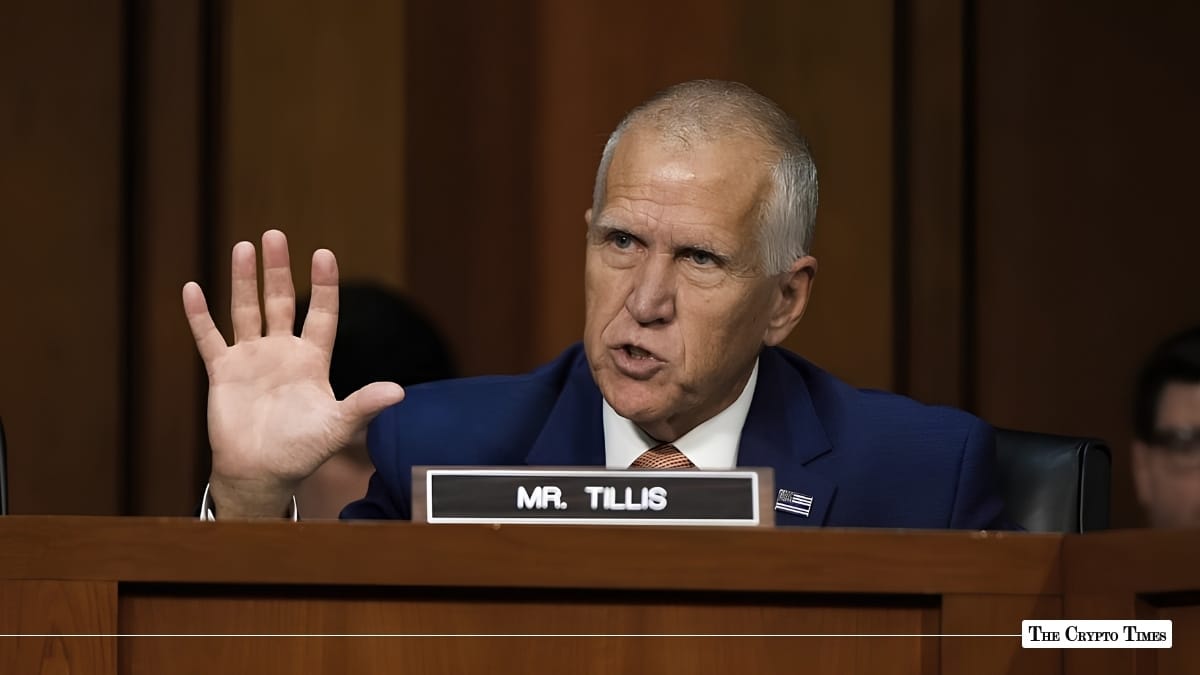
The U.S. Senate Banking Committee is unlikely to advance its long-awaited Digital Asset Market Clarity Act (CLARITY Act) this month. Senator Thom Tillis (R-N.C.) advised Chairman Tim Scott (R-S.C.) to hold off on a markup. Negotiators still need more time to nail down a compromise between traditional banks and the crypto industry over whether platforms can offer yields or rewards on stablecoins, Tillis told Scott, pointing instead to a potential markup in May.
The delay marks a pivot from a content dispute to a procedural one. While the “Tillis-Alsobrooks” compromise has largely won over crypto giants like Coinbase, a coordinated pressure campaign from the North Carolina Bankers Association has forced a tactical retreat. Tillis told reporters on Monday that he does not expect a markup in April, recommending that Scott schedule it for May to ensure all stakeholders have “a rational basis” for the final text.
The timing compounds an already crowded committee calendar. The Senate Banking Committee’s only scheduled item for this week is the nomination hearing for Kevin Warsh, President Donald Trump’s pick to replace outgoing Fed Chair Jerome Powell. As of April 21, 2026, the Banking Committee is fully engaged in Warsh’s confirmation hearing. This high-stakes transition has effectively sidelined all other market structure legislation. And Tillis’s request to push the CLARITY Act into May removes the slim remaining possibility of a vote before the Senate’s next recess.
The Digital Chamber’s final push
In response to the stalling tactics, The Digital Chamber (TDC) issued a formal letter to the Senate Banking Committee on April 20, 2026. The letter urges the committee to move the bill to a markup “as soon as the calendar allows,” arguing that the US cannot afford to remain in a state of regulatory ambiguity.
TDC’s advocacy specifically targets the banking industry’s “deposit flight” narrative. The Chamber argued that eliminating stablecoin activity-based rewards would “severely undermine dollar dominance in the digital asset ecosystem,” effectively handing the future of the global payments system to foreign currencies and unregulated offshore entities.
Why stablecoin yield is still the sticking point
The stablecoin yield dispute has been the single obstacle that has derailed the CLARITY Act twice this year — first in January, when Coinbase pulled support the night before a scheduled markup, and again in March, when the exchange rejected revised draft language it considered too restrictive.
A compromise brokered by Tillis and Senator Angela Alsobrooks (D-MD) in late March would ban passive yield on stablecoin balances while permitting activity-based rewards tied to payments, transfers, and platform engagement. The crypto industry largely accepted the deal, with Coinbase CEO Brian Armstrong publicly reversing his opposition on April 10.
But banks did not. In the days following a White House Council of Economic Advisers report on April 8 — which found a full yield ban would boost bank lending by only $2.1 billion, a 0.02% effect, while costing consumers $800 million — banking trade groups escalated their opposition rather than accepting the data. Industry groups have expanded their lobbying beyond Tillis and Alsobrooks to other members of the Banking Committee, broadening what had been a bilateral negotiation into a wider committee-level dispute.
White House Crypto Council Executive Director Patrick Witt responded sharply, writing on X that it is “hard to explain any further lobbying by banks on this issue as motivated by anything other than greed or ignorance.”
The May deadline problem
The delay adds urgency to an already tight legislative calendar. Senator Bernie Moreno (R-OH) has stated publicly that if the CLARITY Act does not reach the full Senate floor by May, digital asset legislation is unlikely to pass before the November 2026 midterms. Senator Cynthia Lummis (R-WY) has warned the next opportunity could be as far out as 2030.
Even after a committee markup, the bill faces four additional steps before it can become law: a 60-vote Senate floor threshold, reconciliation with the Senate Agriculture Committee version, reconciliation with the House version that passed 294–134 in July 2025, and presidential signature.
Tillis himself struck a cautiously optimistic tone last week, telling reporters he expects to schedule a markup “in the coming weeks” and floating a so-called “crypto palooza” — a joint meeting of bank and crypto representatives with senators rather than staff — to resolve outstanding issues. Whether that meeting materializes remains unclear, and it would likely add time to a process many stakeholders want concluded.