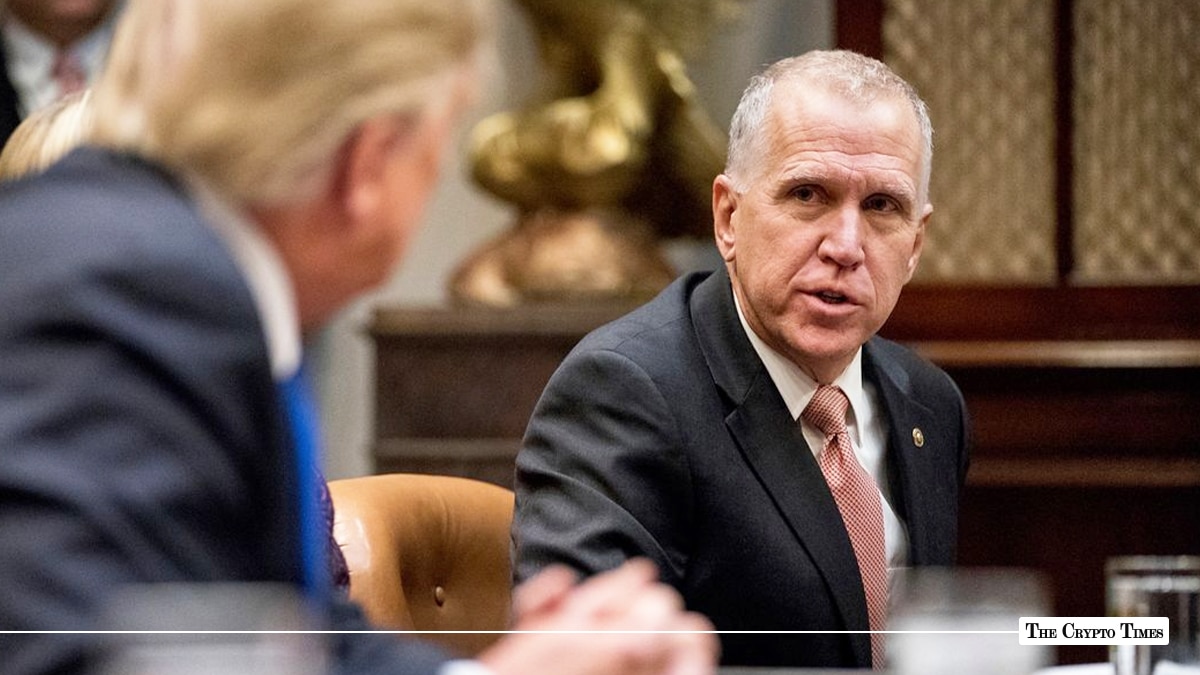
Senator Thom Tillis walked into the Capitol Hill hallway Wednesday afternoon with a message the crypto industry did not want to hear.
The long-awaited revised stablecoin yield text—the final piece of legislative language holding up a Senate Banking Committee markup of the CLARITY Act—may not drop this week after all. Speaking to reporters, Tillis said he’s still “going back and forth” with stakeholders, citing “some open switches that may require some more negotiation.” The North Carolina Republican reframed the markup timeline from the late-April target he and other senators had floated just days earlier to a looser projection of “the coming weeks.”
First reported by journalist Eleanor Terrett, the comments mark a notable softening from Tillis’s own framing on Monday, when he said that “the language has come together well” and that public release was expected this week if discussions proceeded smoothly.
Something has shifted between Monday and Wednesday. What hasn’t been made fully public is what.
The “crypto palooza” proposal
Alongside the timeline adjustment, Tillis floated a procedural curiosity: a “crypto palooza” format in which banking industry representatives and crypto policy experts would be brought into a single Capitol Hill forum, with senators “calling balls and strikes” as disputed issues are litigated in the open.
It’s an unusual suggestion for a bill that has already spent over a year in negotiation. The framing implies that the outstanding disagreements—ethics language, DeFi provisions, and the final stablecoin yield text—are substantive enough that closed-door negotiation may no longer be producing forward motion. Bringing the warring camps into a public forum is a mechanism senators typically reserve for when private compromise has stalled.
Tillis described himself as “guardedly optimistic” about the bill’s eventual passage, pointing specifically to progress on enforcement language and the ethics provisions that Senate Democrats have insisted on. But “guardedly optimistic” is a notably more hedged formulation than the confident projections of “late April” that had dominated the prior week’s news cycle.
What changed
The industry alignment that greeted the Senate’s return from Easter recess on April 13 looked decisive. Coinbase CEO Brian Armstrong had publicly endorsed the bill on April 10 after withdrawing support twice earlier in the year. Treasury Secretary Scott Bessent had used a WSJ op-ed to frame CLARITY Act passage as a national security issue.
The White House Council of Economic Advisers had released a 21-page report concluding that a full passive-yield ban would shift only $2.1 billion in lending across a $12 trillion market — a finding that directly undercut the banking lobby’s core argument. SEC Chair Paul Atkins had called for fast-track approval.
Everything pointed toward a clean markup window.
Yet the public posture from Tillis on Wednesday suggests that the banking industry’s response to the latest draft has introduced new friction. Banking representatives reviewed the proposal during early April and have pushed back on provisions they see as still too permissive of yield-adjacent reward structures. The American Bankers Association formally objected to the CEA report’s findings on April 13, the same day senators returned from recess.
The quiet read: banks are not accepting the compromise. And Tillis, who has been the primary architect of that compromise alongside Senator Angela Alsobrooks, is now signaling that more negotiation may be required before text can be finalized.
The calendar math tightens further
Every week of delay compresses a legislative window that was already tight. Under Senate Banking Committee rules, the bill text must be published at least 48 hours before any markup hearing. If Tillis’s text slips from “this week” into a later “coming weeks” timeframe, the realistic Banking Committee markup window contracts correspondingly.
Senator Bernie Moreno has publicly stated that if the CLARITY Act does not reach the full Senate floor by May, it likely does not move at all this Congress before the midterm cycle consumes the calendar.
The Senate’s August recess runs from August 10 to September 11. The midterm campaign recess begins October 5. Between those two markers, bipartisan cooperation on major legislation historically collapses.
For the crypto industry — which spent hundreds of millions of dollars through super PACs like Fairshake on the explicit promise of securing a comprehensive market structure framework — the combination of “going back and forth,” “guardedly optimistic,” and “coming weeks” is not the language of legislative momentum. It is the language of drift.
What to watch this week
Three signals will determine whether the CLARITY Act retains a realistic path to May passage:
First, whether Tillis actually releases the stablecoin yield text before the Senate leaves Washington this weekend. A release this week keeps a late-April markup mathematically possible. A slip into next week narrows that window sharply.
Second, whether Senate Banking Committee Chairman Tim Scott announces a markup date. He has not done so, and his silence remains the fundamental procedural bottleneck regardless of what Tillis does with the text.
Third, whether the “crypto palooza” materializes as anything more than a rhetorical device. If Tillis convenes such a forum, it suggests closed-door negotiation has genuinely stalled. If he doesn’t, it was likely a signal to banking and crypto lobbyists that the open-forum option exists—and that further obstruction could force them into a public venue neither side wants.
The industry got everything it asked for on April 9. One week later, the bill still doesn’t have a date — and the senator closest to the compromise is no longer sure when his own text will be ready.
Also Read: The CLARITY Act Countdown: Will the Senate Deliver a Crypto Win or Run Out the Clock?