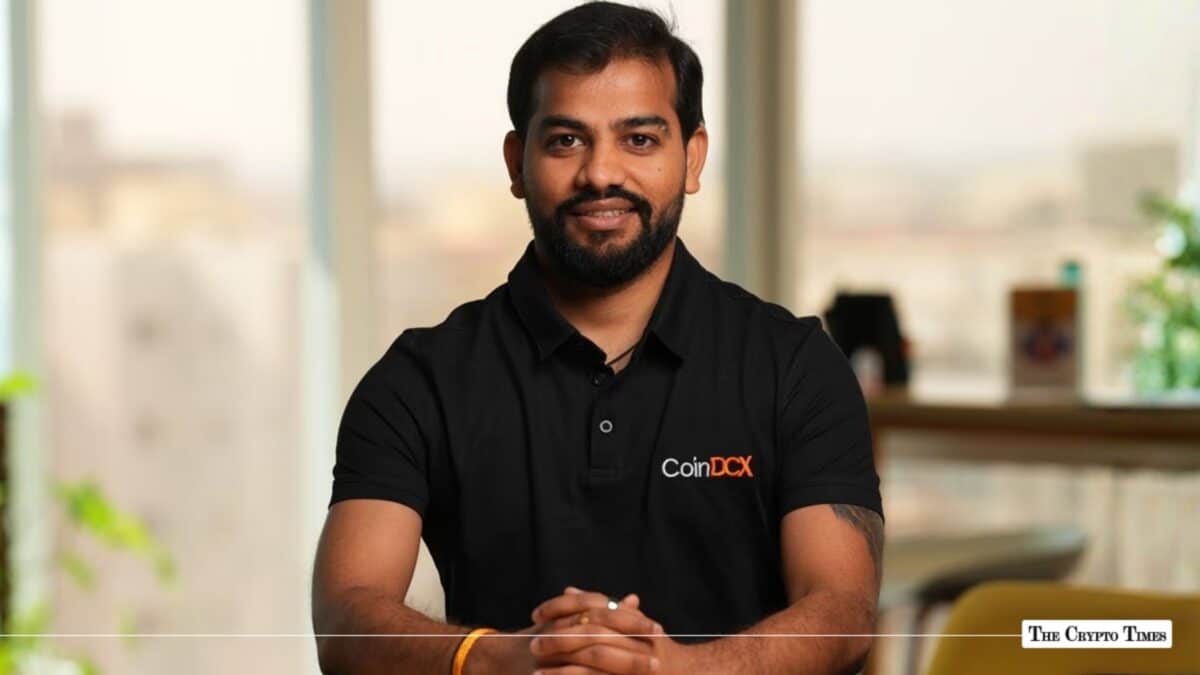
Sumit Gupta, Co-Founder and CEO of CoinDCX—one of India’s largest crypto exchanges—has been selected for the World Economic Forum’s Young Global Leaders Class of 2026, he announced on X on Wednesday.
The selection places Gupta in a cohort of leaders drawn from finance, technology, policy, and social impact across multiple countries and grants him access to the structured World Economic Forum (WEF) networks that typically shape global policy conversations at the Davos and multilateral-forum levels.
For an Indian crypto industry that has spent four years pushing against one of the world’s strictest digital asset tax regimes, the selection matters for reasons beyond personal recognition. It is the first meaningful elevation of a domestic crypto industry voice into the formal infrastructure of global economic policymaking.
“Honoured to be selected for @wef’s Young Global Leaders Class of 2026,” Gupta wrote on X. “Excited to learn from leaders from multiple countries across finance, tech, policy, and social impact all solving very different problems in very different contexts. This is the kind of exposure that helps you innovate, build better products, and drive more impact.”
Gupta’s public statement explicitly framed his YGL role through India’s digital public infrastructure story—citing UPI, Aadhaar, and what he called India’s “Digital Public Infrastructures” as evidence that the country has shown “what’s possible when a nation builds at scale.” He said his goal with the Young Global Leaders (YGL) platform is to help “put India’s story on the global stage” and contribute to the Viksit Bharat vision articulated by Prime Minister Narendra Modi.
Why the selection is a policy story, not an awards story
The temptation with a WEF Young Global Leader selection is to cover it as personal recognition—a nice career milestone for an executive. For Gupta specifically, that framing undersells what the selection actually enables.
Over the past two years, Gupta has been the single most consistent public voice arguing for reform of India’s crypto tax regime. In January 2026, ahead of the Union Budget, he laid out three specific reforms: reducing TDS from 1% to 0.01%, aligning the 30% flat tax with income slabs, and allowing loss set-offs that the current framework explicitly prohibits. He has warned publicly that the existing regime pushed over 90% of Indian crypto trading offshore, eroding both revenue and regulatory visibility.
The budget 2026-27 left that tax regime unchanged. What it did introduce was a new penalty framework for reporting lapses—compliance escalation without the reform industry groups had lobbied for. For Gupta and the domestic crypto industry, the budget represented another year of the same structural problem.
The YGL selection gives that lobbying effort a structurally different platform. Young Global Leader status provides five years of formal WEF engagement, direct peer relationships with global policymakers, and regular Davos access. For an Indian executive whose public comments have been confined largely to domestic media and trade publications, the cohort membership converts those arguments from “industry lobbying” to “global peer commentary” in the way policy audiences hear them.
The timing
Gupta’s selection arrives at a genuinely important moment for Indian crypto policy.
On Wednesday, the same day Gupta announced his YGL selection, participants at a separate Washington policy discussion (reported by news agency IANS) identified India as “central” to the future architecture of global crypto regulation, citing the country’s scale, digital infrastructure experience, and remittance flows. The US policy community is actively positioning India as a co-designer of global frameworks being written now—even as Indian domestic policy remains constrained by RBI caution and an unchanged tax structure.
That gap between how the US sees India’s potential role and how Delhi is currently regulating its own crypto industry is the exact terrain Gupta has been arguing to close. His YGL platform gives him a credible venue to make that case in front of people who write the rules.
Separately, Circle CEO Jeremy Allaire used an interview with Reuters in Hong Kong this week to describe stablecoins as “technological competition” between currencies—framing the global digital asset conversation explicitly in geopolitical terms. India, notably, remains outside most of the Asian stablecoin frameworks being built in Hong Kong, Singapore, Japan, and Korea. The country is also the world’s largest remittance recipient, a use case where stablecoin adoption has accelerated globally.
For an Indian crypto voice entering the WEF policy network, the arguments almost write themselves: India cannot simultaneously be central to global crypto standard-setting and absent from the frameworks being actively built around it.
The Indian crypto industry context
CoinDCX is India’s largest domestic crypto exchange by trading volume, competing against offshore platforms that have captured the majority of Indian trading flows under the 30% tax regime. Gupta co-founded the company with Neeraj Khandelwal in 2018.
The exchange has been central to the industry’s policy engagement, including the “Block by Block” research compendium CoinSwitch released earlier this year in collaboration with Trilegal and NUJS Law Review—a coordinated industry effort to provide the Indian government with a peer-reviewed regulatory blueprint.
The broader Indian crypto industry has spent 2025 and 2026 shifting strategy from direct advocacy to structured policy work—commissioning research, engaging academic institutions, and producing compliance-forward frameworks. Gupta’s YGL selection complements that strategy by providing an international dimension: a credentialed global platform from which Indian reform arguments can be made to audiences that shape multilateral frameworks.
What to watch
Three things are worth tracking over the next 12 months.
First, whether Gupta uses the YGL platform to make specific policy arguments for Indian crypto reform at international venues — or whether his engagement stays general. The former is a meaningful amplification of domestic lobbying. The latter is a career milestone.
Second, whether other Indian crypto or Web3 figures are among the 2026 YGL class. A single selection is recognition; a cluster would signal a category shift in how WEF treats Indian digital asset leadership.
Third, whether the selection translates into tangible policy access. YGL members regularly interact with finance ministers, central bank governors, and multilateral officials through structured WEF convenings.
For Indian crypto reform, the meaningful test will be whether those interactions produce measurable movement in the domestic conversation — or whether, as has happened before, global engagement produces recognition without results.
Also Read: India’s Crypto Tax Net Widens but Regulation Still Missing, Jaideep Reddy