
In the high-stakes world of decentralized finance (DeFi), where billions flow across chains in seconds, one vulnerability can unravel months—or even years—of careful risk management.
On April 18, 2026, that vulnerability struck KelpDAO, a prominent liquid restaking protocol, through its cross-chain bridge. In the exploit, roughly 116,500 rsETH tokens—the liquid restaking derivative token of the DAO—were effectively minted out of thin air and funneled into major lending platforms.
The amount for these ghost tokens, at the time, was worth about $292 million and represented nearly 18% of the token’s circulating supply.
Given DeFi’s interconnectivity and trustlessness, the fallout of the KelpDAO exploit hit Aave—DeFi’s largest lending protocol—hardest. Attackers used the unbacked rsETH as collateral to borrow real wrapped ether (WETH), leaving Aave saddled with an estimated $177 million to $200 million—or even up to $236 million in some analyses—in unrecoverable “bad debt.”
Just as exploiter’s funds hit Aave, panic withdrawals followed, with over $5.4 billion in ETH fleeing the platform and its total value locked (TVL) plunging by roughly $9 billion, from $26.4 billion to $17.7 billion, in just two days. The AAVE token dropped ~15% amid the chaos.
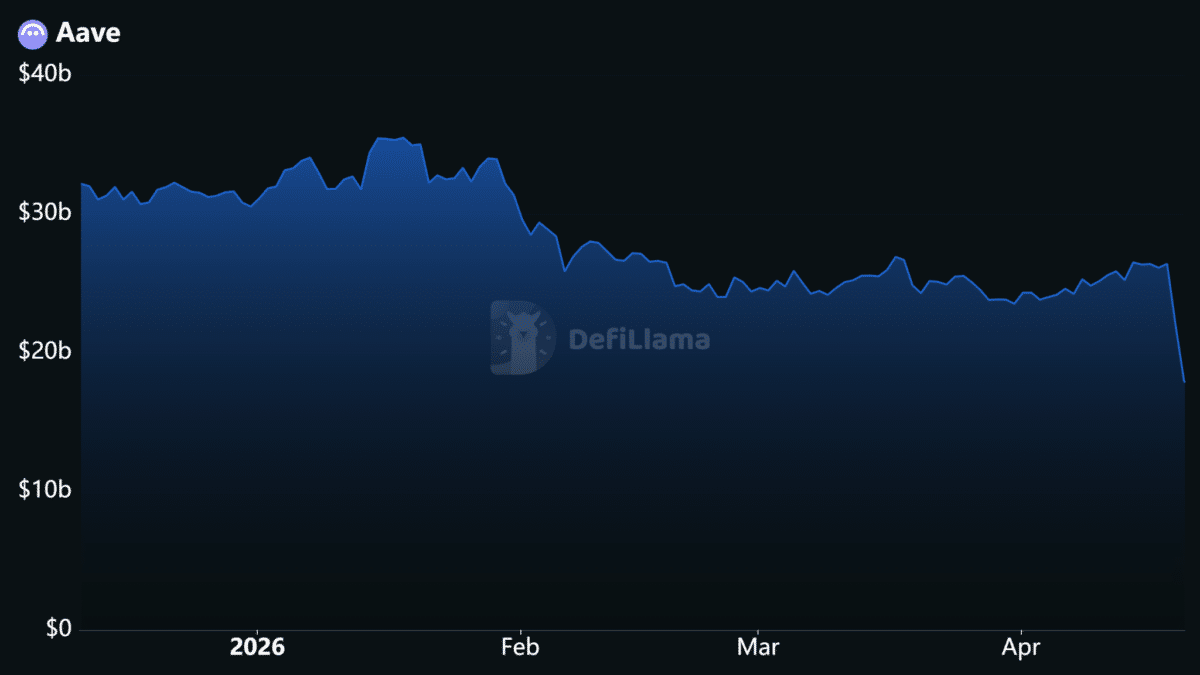
This isn’t just another isolated hack. It exposes the fragile interconnections in DeFi’s multi-chain ecosystem, where a bridge failure on one protocol can cascade into liquidity crunches and governance headaches for even the most battle-tested platforms like Aave.
The Exploit: How a Bridge Became a Minting Machine
The KelpDAO exploit is primarily tied to rsETH, a liquid restaking token tied to ether (ETH) staked through EigenLayer and other protocols. Users deposit ETH, receive rsETH, and earn yields while maintaining liquidity.
To enable this across Ethereum mainnet and numerous Layer 2 networks, Kelp relied on a LayerZero-powered bridge—a cross-chain messaging system designed to move assets securely between chains.
At approximately 17:35 UTC on April 18, an attacker exploited a weakness in this setup. Reports point to issues involving LayerZero’s EndpointV2 contract, possibly a misconfigured or single-signer decentralized verifier network (DVN) or a compromised peer contract on chains like Unichain.
The attacker, who had pre-funded a wallet via Tornado Cash, crafted a forged cross-chain message that tricked the bridge into believing legitimate assets were locked on a source chain.
No real ETH backed the release. Instead, the bridge released 116,500 rsETH directly to attacker-controlled addresses. Two follow-up attempts for another ~80,000 rsETH were thwarted when KelpDAO’s emergency multisig triggered a pauseAll function just 46 minutes later. Still, the initial haul stood at around $292–293 million — the largest DeFi exploit of 2026 so far.
KelpDAO quickly paused rsETH contracts across mainnet and L2s, coordinated with LayerZero, auditors, and security firms, and launched a root cause analysis. On-chain sleuths noted the rsETH was never sold on open markets; it was deployed as collateral almost immediately.
Ripple Effects: Unbacked Collateral Floods Lending Markets
The attacker’s strategy was surgical. Rather than dumping the fake rsETH for ETH on decentralized exchanges — which might have triggered immediate depegs and liquidations — they deposited it as collateral on Aave V3 (and to a lesser extent V4), as well as other platforms including Compound V3, Euler, SparkLend, and Fluid.
On Aave, the unbacked rsETH allowed massive WETH borrows — estimates suggest over $236 million across positions, with Aave absorbing the bulk. Because the collateral was now verifiably worthless (especially bridged/L2 versions lacking real backing), these positions became unliquidatable. Normal liquidation mechanisms failed, stranding the borrowed WETH as bad debt on Aave’s balance sheet.
Aave’s WETH pools saw utilization spike to 100%, freezing liquidity for suppliers. Whales moved fast: reports highlighted large outflows, including moves linked to figures like Justin Sun. Broader DeFi TVL dropped over $13 billion in the immediate aftermath, with contagion whispers reaching Solana lending markets where utilization also hit extremes.
While ETH derivatives remain at risk, many turned to borrowing stablecoins as an alternative exit, pushing utilization rates on major pools like USDC and USDT to nearly 100%. This has severely restricted available liquidity, with some stablecoin markets dropping to just thousands of dollars, temporarily limiting withdrawals across affected pools.
The withdrawal chain has put a severe liquidity risk on Aave as a number of pools are hitting full utilization as users figure out strategic exits from the protocol. “Stable depositors cannot withdraw, so they’ll probably borrow other assets, and those lenders won’t be able to withdraw either,” noted an analyst.
As of now, mainnet rsETH remains fully backed, per Aave’s analysis — the problem centers on the fake, bridged variants. But the distinction offered little comfort to users watching their aWETH positions amid frozen reserves.
Aave’s Swift Containment and Lingering Questions
Aave responded with characteristic speed. Starting around 18:52 UTC on April 18, the Aave Guardian froze rsETH and wrsETH markets across V3 and V4 deployments.
This halted new deposits, borrowing against rsETH, and further exposure. WETH reserves were also frozen in key markets on Ethereum, Arbitrum, Base, Mantle, and Linea as a precaution.
“Freezing the rsETH markets prevents new deposits and borrowing against rsETH collateral while the situation is assessed,” the official Aave account posted. The team began reviewing post-exploit borrows and validating data.
In an April 19 update, Aave confirmed mainnet rsETH backing and stated exposure was “capped.” However, WETH freezes remain in place. The protocol is “actively validating information and assessing potential resolutions.”
If bad debt materializes, Aave pointed to its Umbrella safety module, where staked AAVE can be slashed to absorb losses. Early statements mentioned this directly; later ones adopted more cautious language: “If the protocol accumulates bad debt… we’ll explore paths to offset the deficit.” This shift fueled community speculation about potential haircuts, governance votes, or socialization of losses among suppliers.
Compared to Aave V3, V4 saw a lighter impact, and stablecoin markets continued operating normally. Still, the event tested Aave’s risk framework, which had accepted rsETH as collateral — a decision now under fresh scrutiny in DeFi circles.
The Human and Market Toll
For a broader community of DeFi users, the freeze translates to frustration. WETH suppliers in affected pools face blocked or severely limited withdrawals while utilization hovers at extremes. Some explored workarounds like routing through aggregators (e.g., 1inch to Fluid) for partial exits into wstETH or weETH, often at a cost of slippage.
rsETH holders, particularly on L2s, confront depegs and uncertainty. Broader restaking yields paused in related products. The AAVE token’s dip reflected not just immediate losses but deeper fears: if a top-tier protocol like Aave can inherit nine-figure bad debt from a single dependency, what does that say about systemic resilience?
Community reactions on X mixed anger, calls for transparency on exact bad debt figures and timelines, and debates over whether L2 rsETH holders should “eat the loss” to protect mainnet integrity.
Broader Lessons for DeFi’s Multi-Chain Future
This incident underscores persistent risks in cross-chain infrastructure. LayerZero bridges have faced prior scrutiny; here, apparent issues with verifier setups or single points of failure allowed forged messages to bypass checks. KelpDAO’s rapid pause prevented a worse outcome — potentially $390 million total — but couldn’t undo the initial drain.
It also reignites questions about collateral risk parameters. Liquid restaking tokens (LRTs) like rsETH offer yield but introduce layered dependencies: staking, restaking, bridging, and now lending. Aave and peers may tighten LTV ratios, impose isolation modes, or reconsider LRTs altogether.
For Aave, the path forward involves governance. Proposals could address debt via Umbrella slashing, targeted haircuts, or even coordination with KelpDAO for any recovery. Timelines remain vague, frustrating users demanding specifics.
KelpDAO has yet to detail compensation or re-backing plans beyond the ongoing investigation. LayerZero and auditors continue root cause work.
Outlook: Containment or Contagion?
As of 4:45 AM UTC, April 20, 2026, the situation remains fluid. Aave’s freezes have capped further damage, demonstrating the value of guardian mechanisms and quick risk response. Yet unresolved bad debt poses a test for decentralized governance: can token holders and stakers align on fair loss absorption without fracturing trust?
DeFi has weathered hacks before—Drift exploit and the Grinex hack happening just days before in the same week, often emerging with improved audits and standards. Now this KelpDAO exploit—2026’s largest so far—may accelerate calls for better bridge designs, oracle-independent verifications, and more conservative collateral policies.
In the meantime, participants face a familiar DeFi refrain: your keys, your coins—but also, your collateral’s dependencies are your risk.
This developing story draws from on-chain data, official statements, and reporting as of April 20, 2026. DeFi events evolve rapidly; users should verify updates directly from Aave governance forums, KelpDAO announcements, and trusted analytics dashboards.
Also read: Pump.fun Instagram Account Hacked, Platforms Remain Safe