


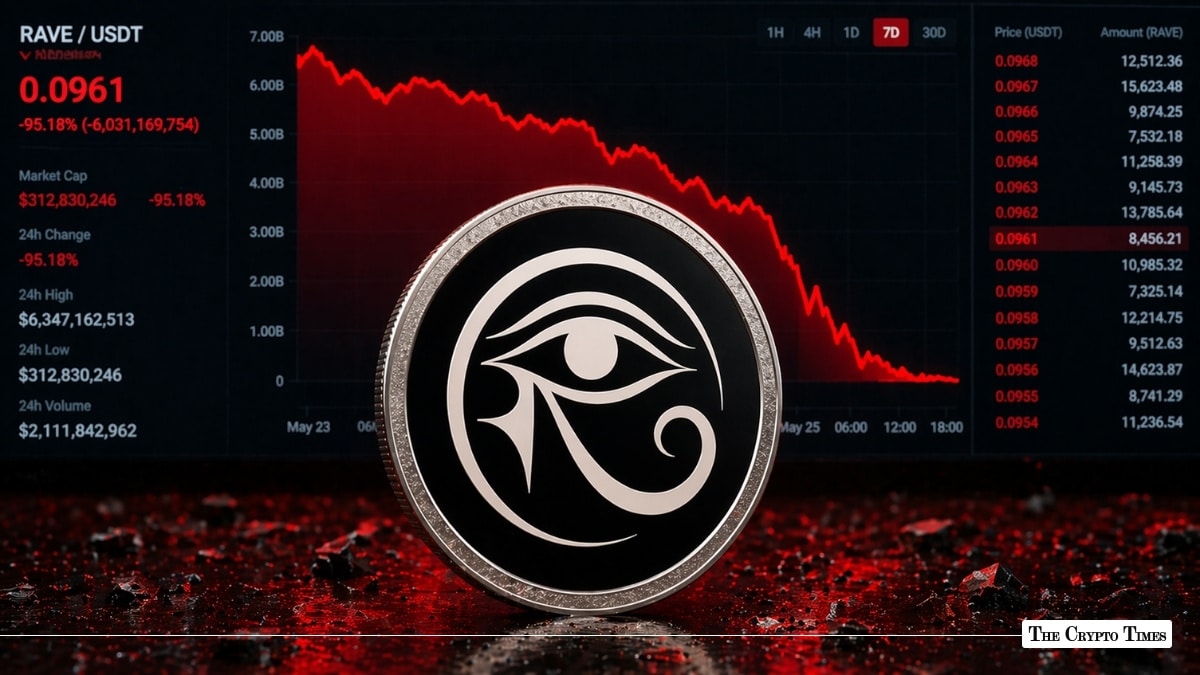
In the high-energy world of Web3 music, where beats drop and NFTs prove you were actually there, RaveDAO promised something revolutionary: a global rave movement that blended underground electronic culture with blockchain ownership, real events, and philanthropy. Fans didn’t just buy tickets—they joined a DAO, governed the vibe, and even funded eye surgeries in Nepal through event proceeds.
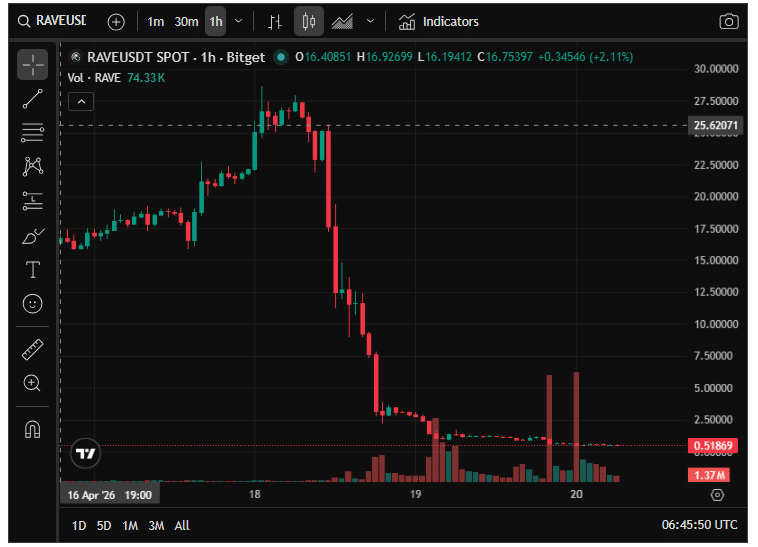
Then came April 2026. The $RAVE token launched on Binance Alpha in late 2025 with a 1 billion supply and low circulating float. It quietly traded around $0.25. Suddenly, it exploded—rocketing over 6000% to a peak of nearly $28 in days, briefly flirting with a $6 billion market cap and cracking the top 15 cryptocurrencies by market cap. Retail FOMO hit hard. Traders piled in across Binance, Bitget, and Gate.io. It looked like the ultimate party token had arrived.
Forty-eight hours later, it was over. The token plunged 90-95% in a single 24-hour candle, erasing roughly $5.7–6.3 billion in market value. As of April 20, 2026, $RAVE hovers near $0.57, with trading volume spiking to hundreds of millions amid the panic sell-off, as per CoinMarketCap data.
The Bombshell Allegations That Killed the Vibe
On-chain investigator ZachXBT didn’t wait for the dust to settle. In a detailed April 19 thread that racked up millions of views, he laid out a timeline that reads like a textbook pump-and-dump case:
- Extreme concentration: Low float + insider-held supply = perfect setup for a manufactured short squeeze, then the dump. A handful of wallets linked to RaveDAO’s initial token distribution (including addresses tied to team or early distribution) controlled ~95% of the supply.
- Suspicious flows: Millions of RAVE moved to Bitget and other CEXs right before the parabolic move, followed by massive sells into retail liquidity.
- Timeline overlap: ZachXBT had publicly confronted a RaveDAO co-founder days earlier. After his April 18 call-to-action (with a $25K bounty for whistleblowers), exchanges quickly confirmed investigations. RaveDAO’s six-part denial thread landed after the allegations went viral—but the price kept free-falling. OKX Founder & CEO also pledged an additional $25K bounty to ZachXBT’s ongoing $25K reward.
RaveDAO’s official response? A firm denial: the team is “not engaged in, nor responsible for” the price action. They pointed to external factors and volatility warnings they had issued earlier. Yet ZachXBT highlighted on-chain ties that, at minimum, suggest the team knew who controlled the wallets. Three hours after his update, another multisig linked to initial distribution dumped 23 million RAVE ($23M at the time), sending the price another 40% lower.
Exchanges are now probing. Binance and Bitget opened formal reviews. The ratio says it all: $6B+ in market cap vaporized on just ~$52M in liquidations. In a real organic market, that math doesn’t add up.
The Cruel Irony: Real Raves, Fake Token Economics
RaveDAO wasn’t some vaporware meme coin. It started as a 200-person crypto-conference afterparty in November 2023. By 2025-2026 it was selling out 3,000+ attendee events in Singapore, Amsterdam, Dubai, and beyond. NFT tickets doubled as on-chain proof-of-attendance. 20% of proceeds went straight to community-voted causes—like funding eye surgeries via Nepal’s Tilganga Eye Center and global wellness programs. VIP tables sold 95% in crypto. Warner Music Group and Tomorrowland-level partners were in the mix. It genuinely onboarded normie ravers to Web3.
The project lived its “By Ravers, For Ravers” ethos offline. Yet its tokenomics screamed classic crypto trap: low float, no public audit mentioned in early coverage, heavy insider concentration, and heavy CEX listing hype. The very thing that made the real-world events authentic—community, scarcity of tickets, real revenue—made the token a powder keg for speculation.
This isn’t just a token crash. It’s a cultural collision. Rave culture has always been about PLUR (Peace, Love, Unity, Respect). Pump-and-dump schemes are the opposite: extractive, anonymous, and retail-hostile. When insiders (allegedly) cash out at $28 while the community that built the brand watches their bags evaporate, the trust fracture runs deeper than any single chart.
What This Means for Web3 Music—and Every Niche DAO
RaveDAO’s meltdown is a brutal case study for every “real-world utility” project in 2026:
- Tokenomics still rule. You can host the sickest parties and donate real money to charity, but if 95% of supply sits in a few wallets with no transparent vesting or lockups, the token becomes a casino chip, not governance.
- CEXs are still the wild west. Major platforms collected fees on hundreds of millions in volume during the pump and the dump. Their investigations are welcome—but reactive. ZachXBT’s public pressure forced speed. Retail shouldn’t need bounty-hunting sleuths as market police.
- Hype cycles punish the believers. The same retail traders who showed up to events, bought NFTs, and spread the PLUR gospel are the ones left holding the bag. Events may continue (upcoming Amsterdam and Lisbon dates are still listed), but the brand damage is real. Will future ravers trust RaveDAO NFTs or governance when the token just rug-pulled the narrative?
- The ZachXBT effect is now table stakes. One investigator with screenshots just torched a top-20 market cap project in hours. Projects ignoring on-chain transparency do so at their peril.
The Morning After
RaveDAO still has its community, its events, its philanthropy track record, and its “TEDx for music” chapter model. The token? It’s in intensive care. Recovery would require radical transparency—full wallet disclosures, supply burns or locks, independent audits, and perhaps even a community vote to restructure tokenomics.
For the broader Web3 music and entertainment sector, the lesson is louder than any bass drop: real culture can’t be tokenized without real accountability. You can build the most immersive rave on earth, but if your token behaves like a 2021 meme coin, the hangover will be legendary.
The party isn’t over for decentralized entertainment. But after RaveDAO’s crash, the guest list just got a lot more skeptical—and that might be the healthiest thing to happen to the scene all year.
What do you think—pure manipulation or just crypto being crypto? Drop your take below. And if you’re still holding RAVE… PLUR to you.
Also Read: LayerZero Blames KelpDAO Team for Exploit, Links to DPRK’s Lazarus Group





