Key Highlights
- BTC is pinned below the $90,000–$93,000 ceiling as sellers defend the zone.
- ETH is struggling to reclaim $3,200, with $3,400 emerging as the cleaner trend reset level.
- U.S. crypto ETFs saw about $1.8B in weekly outflows, signaling broad de-risking, not rotation.
Bitcoin (BTC) and Ethereum (ETH) are stalling near $89,000 and $2,900 as institutional capital continues to exit the market. Both assets remain capped by key resistance levels, with price stability masking a broader shift toward risk reduction.
Between January 19 and 23, roughly $1.8 billion flowed out of U.S. crypto ETFs, the largest weekly outflow since late 2025. At the same time, on-chain data shows rising exchange inflows, increasing realized losses, and falling derivatives leverage, pointing to a market moving decisively from profit-taking into active de-risking.
A market stabilizing, not recovering
Bitcoin’s slide toward $89,782 reflects sustained selling pressure. Repeated failures in the $90,000–$93,000 range confirm that demand has not been strong enough to reclaim higher ground.

From its October 2025 all-time high (ATH) of approximately $125,000, BTC has seen a significant drop of 30%. The Relative Strength Index (RSI) is currently sitting at 46.56, indicating a neutral-to-bearish momentum that lacks the “oversold” signal needed for a sharp reversal.
On the other hand, Ethereum is hovering near $3,000, but failing to reclaim the $3,300 area that would signal real momentum returning.
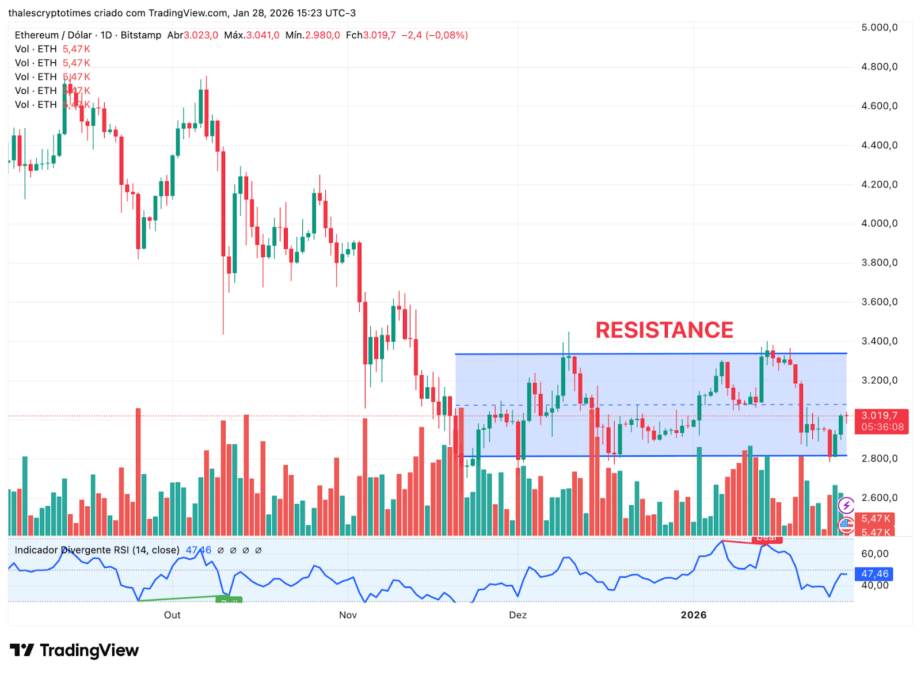
Ethereum is down about 42% from its ATH near $4,800. Its Relative Strength Index (RSI) of 46.34 confirms a similar lack of buying pressure at these local resistance zones.
Both assets are now sitting in a “dead zone” where buyers are present, but not aggressive, and sellers don’t need to do much to keep the lid on.
Technically, momentum has cooled. The RSIs of BTC and ETH read neutral-to-soft rather than “washed out.” Markets typically need either fresh demand or true exhaustion selling to reverse cleanly. Right now, neither is obvious.
The ceiling is technical, and the pressure is flow
The $1.8 billion weekly outflow from U.S. ETFs suggests institutions aren’t simply trimming profits. They are reducing risk exposure into strength and using liquidity windows to exit.
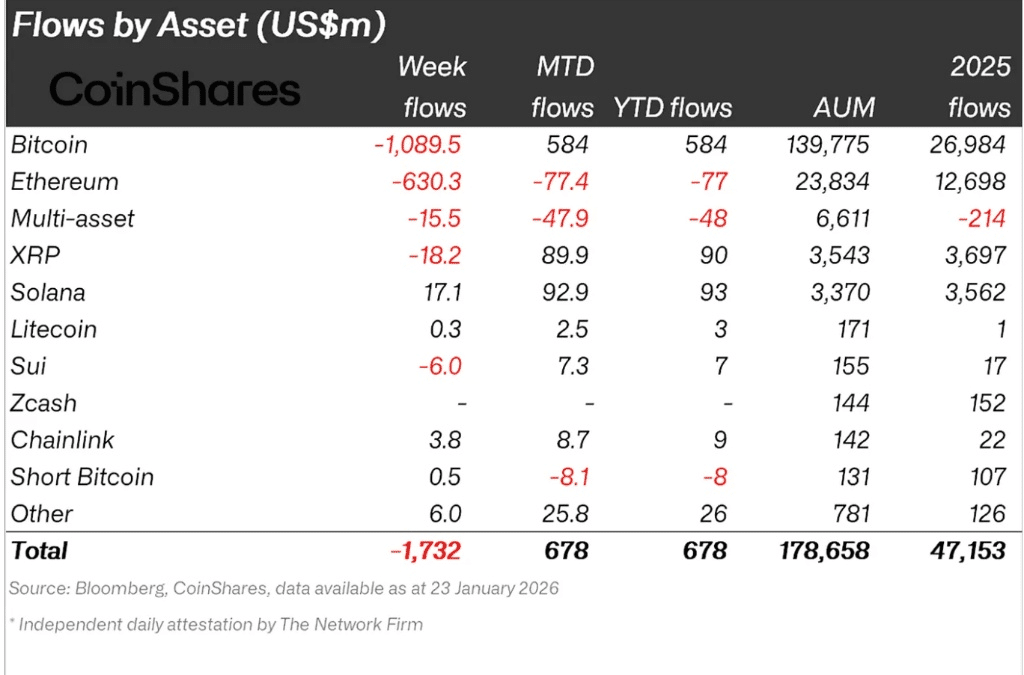
That’s a classic “loss-realization” phase: prices can stop falling fast, but money is still walking out the door.
Despite the recent weekly crash, 2026 started on a high note for Ethereum, which reached $11 billion in YTD inflows by mid-January, outperforming Bitcoin on a proportional basis relative to assets under management.
Stabilization after tough Q4, but momentum still lags
Bitcoin has started 2026 on a steadier footing after a brutal end to last year. Following sharp losses in November and December, BTC is up about 2% in January, signaling stabilization rather than a rebound.
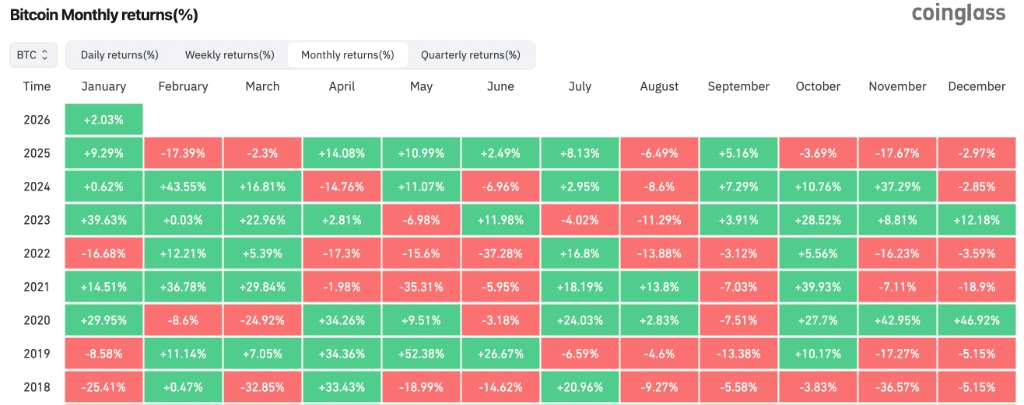
While Bitcoin remains roughly 30% below its late-2025 peak near $128,000, year-to-date inflows of around $678 million suggest institutional support is still stronger than in prior bear markets.
Ethereum is seeing a similar, weaker recovery. After a 28% drop in Q4 2025, ETH is up just 0.9% in January, with choppy price action and about $630 million in recent weekly outflows. The market continues to struggle to reclaim the $3,000 level.
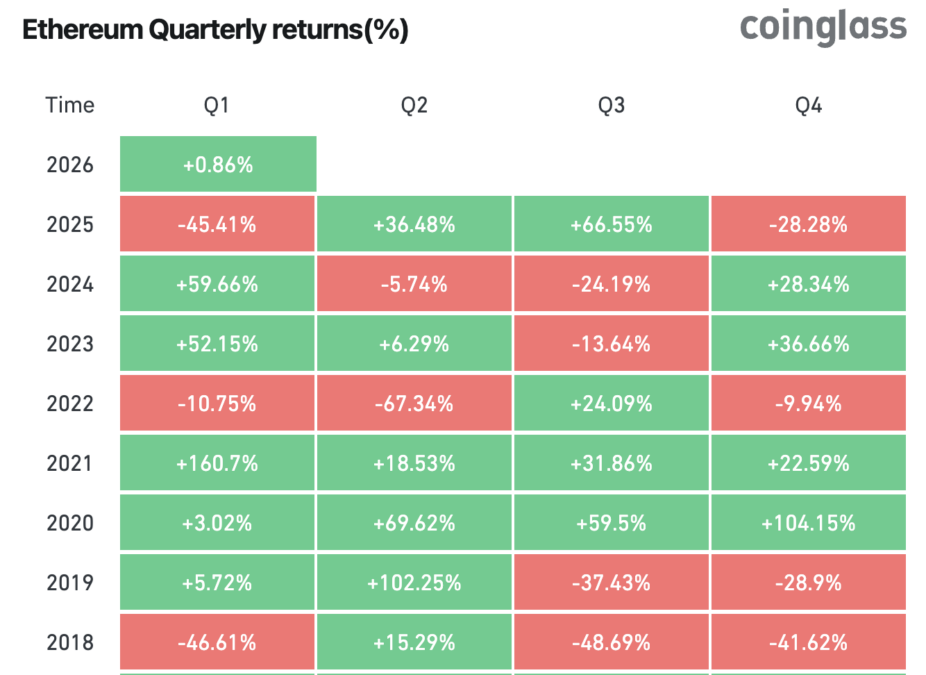
Despite being roughly 42% off its highs, Ethereum pulled in about $12.6 billion of inflows over 2025, pointing to lingering institutional interest, just not enough yet to drive a sustained breakout.
ETF flows turn risk-off in January
U.S. spot Bitcoin ETFs reversed sharply in January, posting about $1.33 billion in net outflows for the week ending January 23, the worst since early 2025 and a sharp flip from the prior week’s inflows. The sell-off peaked on January 21 with a $709 million single-day redemption, signaling broad institutional de-risking.

BlackRock’s IBIT showed late-month resilience with a $15.9 million inflow on January 26 and still leads with $63.4 billion in cumulative inflows. Meanwhile, Fidelity’s FBTC and Grayscale’s GBTC saw the heaviest exits, highlighting how ETF demand remains fragile as Bitcoin trades below key resistance.
Ethereum spot ETFs followed Bitcoin into risk-off mode, logging $611 million in net outflows for the week of January 19–23. The pullback erased much of January’s early gains after a $229.9 million single-day redemption on January 20, underscoring choppy institutional positioning around current price levels.
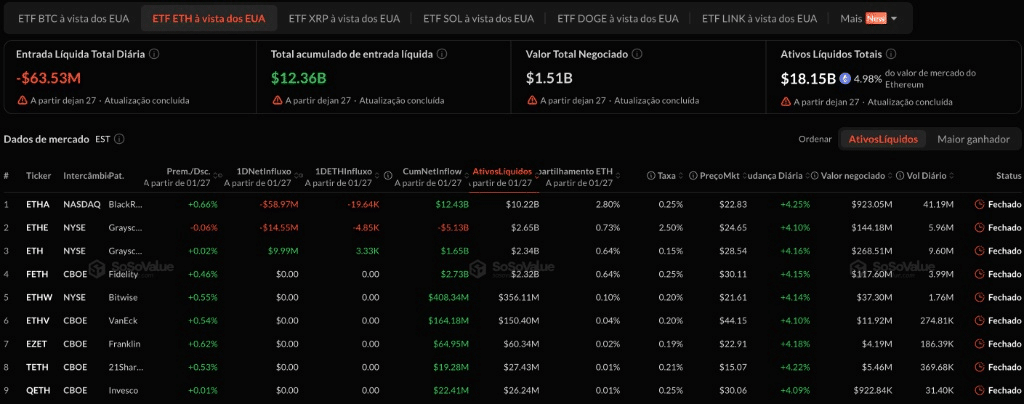
BlackRock’s ETHA led withdrawals with $432 million exiting over the week, though it still holds $12.4 billion in cumulative inflows. Fidelity’s FETH and Grayscale’s ETHE also saw steady redemptions, while Grayscale’s mini ETH product was a rare bright spot. Despite the volatility, total ETH ETF AUM sits near $18.1 billion, suggesting long-term institutional interest remains intact even as short-term risk is trimmed.
What would change the setup
Bitcoin and Ethereum are no longer just consolidating; they are being stress-tested. With BTC pinned near $89,000 and ETH struggling around $2,900, both assets remain trapped beneath heavy resistance as institutional flows turn decisively defensive.
The $1.8 billion pulled from U.S. crypto ETFs in a single week signals a shift from passive profit-taking to active risk reduction, marking a broader loss-realization phase. Until flows stabilize and these core ceilings are reclaimed, rallies are likely to fade quickly, leaving the market in a fragile balance between consolidation and deeper downside.
Also read: Ethereum Stakers Wait 61 Days for 2.8% Yield: Why Demand Is Rising