
Key Highlights
- BlackRock’s IBIT recorded 10 consecutive days of Bitcoin outflows.
- The ETF saw roughly 35,980 BTC leave the fund during the streak.
- Net outflows totaled approximately $2.24 billion by July 2, 2026.
BlackRock’s iShares Bitcoin Trust (IBIT), a spot Bitcoin exchange-traded fund (ETF), recorded 10 consecutive trading days of net outflows, contributing to broader pressure across U.S. spot Bitcoin ETFs.
In an X post on Friday, blockchain analytics platform Lookonchain said BlackRock recorded net outflows of 35,980 BTC, valued at approximately $2.24 billion, across the streak continuing till July 2, 2026.
What the IBIT data shows
On July 2, IBIT recorded a net outflow of $40.43 million. Cumulative net inflows remained positive at $59.99 billion overall, but recent daily bars in the charts predominantly show outflows in the $100M–$400M range during late June.
The net total assets stood at $44.91 billion with a cash holding ratio of 3.64% as of July 2. The premium/discount was minimal at 0.05%, indicating prices closely tracked NAV. Daily trading volume reached $46.69 million.
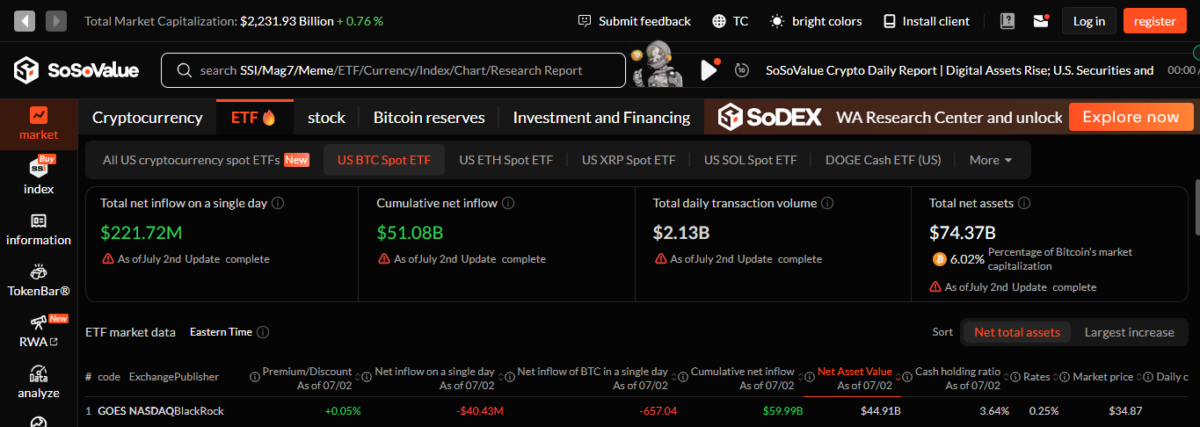
Despite the streak, broader US spot Bitcoin ETFs saw a reversal on July 3, attracting $221.72 million in net inflows, the largest single-day inflow in nearly two months, per SoSoValue. This helped snap the sector-wide outflow trend that had totaled around $2.73 billion over the prior period.
What factors pushed the outflows
Several factors likely contributed to the outflows. Bitcoin’s price action in 2026 has been volatile, with the asset experiencing a correction from previous all-time highs near $126,000 in late 2025.
In early July 2026, BTC traded in the $60,000–$62,000 range, hovering around $61,500 following modest recoveries from sub-$58,000 levels earlier in the period. This price stagnation or decline prompted profit-taking, portfolio rebalancing, and risk reduction among institutional investors.
Macroeconomic pressures played a key role. Elevated interest rates, a strong U.S. dollar, and expectations around Federal Reserve policy encouraged capital rotation into traditional assets like equities (particularly AI and tech stocks), Treasuries, or other yield-bearing instruments.
Geopolitical tensions and broader risk-off sentiment further exacerbated outflows, as investors unwound leveraged positions and reduced exposure to non-yielding assets like Bitcoin during uncertainty. Historical patterns show outflows often accelerate during drawdowns, with short-term holders and momentum players exiting while long-term accumulators may step in at lower levels.
BlackRock expanded its Bitcoin product lineup
BlackRock launched a new product on June 16, 2026, but it didn’t contribute to prolonged inflows. The iShares Bitcoin Premium Income ETF ($BITA) began trading on Nasdaq after its Form 8-A filing with the SEC.
Bloomberg ETF analyst Eric Balchunas previously confirmed the launch after BlackRock filed a Form 8-A with the U.S. Securities and Exchange Commission (SEC) on June 11, registering the ETF for trading under Section 12(b) of the Securities Exchange Act of 1934.
BITA offers investors a premium-income strategy tied to Bitcoin exposure and complements BlackRock’s existing spot Bitcoin ETF offerings.
BTC outlook remains constructive
At the time of this writing, Bitcoin is currently trading in the $61,976 range, up around 0.86% in the last 24 hours and 3.31% in the past week, according to CoinMarketCap.
Despite 10 consecutive days of institutional outflows totaling over $2.2 billion, spot buying and long-term holder accumulation have prevented a deeper correction. Resistance remains at $65,000. Short-term sentiment is cautious amid ETF flow volatility, but the overall outlook stays constructive.
Institutional conviction faces increased concerns
While the July 3 inflows provide some relief, the 10-day outflow streak from BlackRock raises concerns about institutional conviction. Such flows often signal waning enthusiasm among large players, potentially foreshadowing weaker demand if macroeconomic conditions deteriorate.
Heavy reliance on ETF products for Bitcoin exposure means redemption waves can amplify volatility. If outflows resume, it could challenge Bitcoin’s price stability and question the narrative of seamless institutional adoption.
The episode highlights that even major funds like IBIT are not immune to sentiment shifts, underscoring risks for retail and institutional investors alike in a still-maturing asset class.
Also Read: Moonbeam Exits Polkadot, Migrates GLMR to Base for AI Pivot