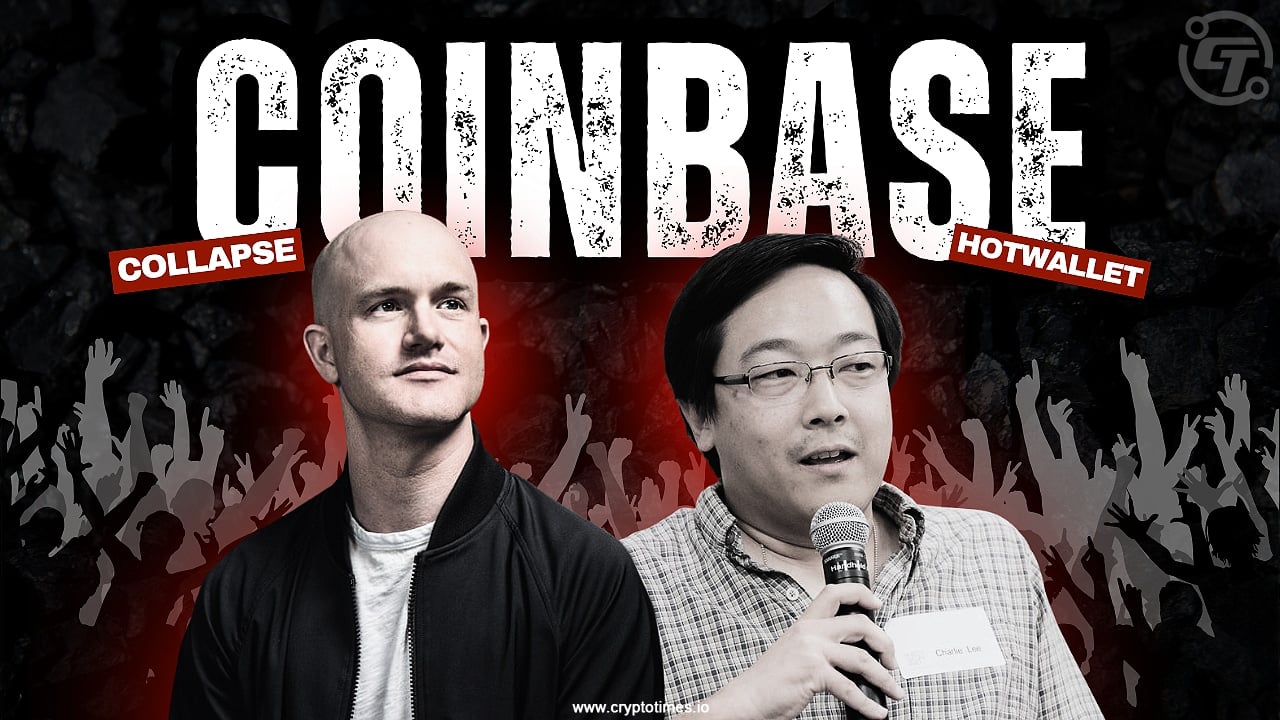
In the early days of Coinbase, the world’s most popular cryptocurrency exchange was just one breach away from complete collapse. The company, still in beta testing and largely unknown to the mainstream, was operating on a risky infrastructure setup.
It had no cold storage. Just a single hot wallet that was handling all customer funds. This was something that could’ve ended the company before it even began.
This revelation didn’t come from a documentary or a tell-all podcast. It came from a post on X. In response to a viral meme asking people to “share a piece of lore about yourself,” Coinbase CEO Brian Armstrong shared an intense chapter from the company’s early history that few outside the team had ever heard.
He wrote, “The first version of Coinbase launched with just a hot wallet – a risky proposition.” He also mentioned that at the time, the platform came with a clear warning, “We were in beta, and the app prominently told people not to store any money there they couldn’t afford to lose.”
But warnings don’t always slow down user adoption. Deposits started growing steadily, rapidly, and beyond what anyone had predicted. Armstrong soon realized the danger. If someone compromised the hot wallet, they “were insolvent and the company would die.”
The urgency of the situation was abundantly clear. With funds mounting and no secure infrastructure in place, Armstrong made a quick decision. He reached out to two experts he trusted most—Zooko Wilcox and Octal, both highly respected in the cryptography and security world.
“They were super helpful and gave me a crash course,” Armstrong recalled. But their advice came with a harsh reality check. Building a proper, production-ready cold storage system from scratch wasn’t going to be easy. The experts estimated it would take a team of 10 people at least 18 months to complete the project.
That timeline simply wasn’t an option.
“We had about 8 weeks until the total deposits on the platform would exceed the total assets of the company, and only 2 engineers (including myself) to build it.” Hackers had already begun testing the platform, and Armstrong knew it was only a matter of time before someone tried something serious.
Enter Charlie Lee, the creator of Litecoin. Lee wasn’t originally part of Coinbase’s founding team, but he swiftly became a crucial player in this do-or-die moment. The two joined forces and began developing Coinbase’s first cold storage system from scratch.
They worked under extreme time pressure and slept little during those weeks. But security remained their top priority.
Armstrong revealed, “We even unboxed some new laptops for key generation, stored backup material across several safe deposit boxes and locations.”
The process was slow, deliberate, and painful. They tested the system one transaction at a time, starting small and gradually scaling as confidence grew. He further added, “We were both extremely sleep deprived (how mistakes happen!), and paired up to double-check each other’s work.”
With about a week left on the countdown clock, they initiated the final transfer. Every coin, every key, and every backup had to be handled with precision.
They succeeded.
“We breathed a sigh of relief and went home to sleep for about 12 hours.”
Armstrong considers this chapter one of the proudest moments of his career. What should have taken over a year with a full team was accomplished in two months by just two people. He shared, “This was one of my proudest technical accomplishments from the early days of Coinbase.”
The system they built would go on to support Coinbase for years, serving as the foundation of the exchange’s key storage infrastructure until version five was rolled out. Looking back, Armstrong admits, “If we hadn’t gotten it out in time, Coinbase very well may not exist today.”
For him, the experience is a testament to grit under pressure. “Constraints breed creativity, top talent matters in startups, and teams are often capable of more than they think when there is no other option.”
He ended his thread with a powerful observation, “Most products which succeed have early moments like this, where someone has to step up and make a play on the field that defies all the odds.”
While Armstrong’s version of the story took X by storm, Charlie Lee responded with his Coinbase lore—equally honest, equally revealing.
“I first contacted Coinbase initially not about a job but, of course, to ask if they would support Litecoin.”
At the time, Coinbase wasn’t ready to support anything beyond Bitcoin. Olaf Carlson-Wee, the company’s first employee, replied to Lee — “Olaf @zxocw responded and said they are Bitcoin-only for now as they have limited resources, which made a lot of sense.”
What happened next wasn’t planned. Lee’s sister happened to be looking for a job, so he introduced her to Olaf. She passed on the opportunity, but the conversation left a door open for Charlie.
“But my conversation with Olaf eventually led to him asking why don’t I go in for an interview.”
Lee was still working at Google then — comfortable, secure, but craving more involvement in the crypto movement. Google had no roadmap for blockchain or crypto. Coinbase did.
“Google had no interest in doing anything with crypto. So I decided why not.”
He went in for the interview, met with both Brian Armstrong and Fred Ehrsam, and was put through a series of tough technical and logic tests.
He remarked, “They didn’t know I could do brain teasers in my sleep.”
Lee aced the interview, but something unexpected happened. The tone of the conversation shifted quickly.
“The interview quickly went from trying to test me to trying to sell me on Coinbase.”
It didn’t take much convincing. The opportunity to work on crypto full-time with a smart, driven team was too good to pass up. Coinbase extended an offer. It was a good one, but not great in comparison to Google. Lee divulged, “Coinbase made me a decent offer, but the pay was a lot less than my pay at Google.”
So, Lee made a decision that would later haunt him financially.
“I decided to negotiate for more salary instead of more stock, because I wanted Coinbase to at least match my Google salary of $150k.”
In hindsight, that choice proved costly. Coinbase’s later success and IPO meant its early equity holders walked away with life-changing sums. Lee’s salary-focused negotiation cost him dearly.
“Not negotiating for more COIN stock was the single worst financial decision of my life!”
It’s a truth many in tech understand.
Brian Armstrong’s fight to keep Coinbase alive and Charlie Lee’s unexpected arrival coalesced at a moment when speed, trust, and talent were everything. They weren’t just building software—they were building the backbone of what would go on to become one of the most reliable crypto exchanges.
This wasn’t just about code. It was instinct, risk, and a tiny team with no safety net.
Before the headlines and IPO, the two engineers shared a small room, coding all day and reviewing each other’s work at night. They were driven by a belief that they were building something that could reshape finance.
In eight intense weeks, they didn’t just create cold storage.
They built Coinbase.
Also Read: Crypto is Popular among Gen Z in India, Says Mudrex CEO