If you have been following the rapid developments in the decentralized finance (DeFi) space in 2026, you have likely encountered the Vanguard Digital Oil Reserve (VDOR). Amidst the current global macroeconomic tensions and high oil prices, this Solana-based token has surged in popularity, leaving many retail investors wondering where to buy VDOR and how the acquisition process works.
Because VDOR operates entirely on decentralized infrastructure, you cannot simply log into traditional stock brokerages or centralized crypto exchanges to buy it. Acquiring this token requires a specific set of tools: a self-custodial wallet, Solana (SOL) for gas fees, and a decentralized exchange (DEX).
This comprehensive guide covers the story behind VDOR coin’s explosive rise, explains exactly where to buy VDOR, and provides a detailed, step-by-step tutorial for securing your assets.
Quick Answer: How to Buy VDOR
For those looking for a rapid summary, here is the immediate process for buying Vanguard Digital Oil Reserve (VDOR) on the Solana blockchain:
- Download a Solana Wallet: Install a secure, self-custodial wallet like Phantom, Solflare, or Bitget Wallet.
- Purchase Base Capital (SOL): Buy Solana (SOL) on a regulated, centralized exchange (such as Coinbase, Kraken, or an FIU-registered platform).
- Transfer SOL to Your Wallet: Send the purchased SOL to your new decentralized wallet address via the Solana network.
- Connect to a DEX Aggregator: Navigate to a decentralized exchange like Jupiter (jup.ag) or Raydium and connect your wallet.
- Verify the Contract Address: Search for VDOR using its official immutable contract address (VDoRrZix72Er41foJAdKrwFqYNozPbktuPa4Xy1A7Au) to avoid scam tokens.
- Swap and Adjust Slippage: Set your slippage tolerance between 1% and 3%, enter your swap amount, and execute the trade.
What is Vanguard Digital Oil Reserve (VDOR)?
Vanguard Digital Oil Reserve (VDOR) is a cryptocurrency token built on the high-speed Solana blockchain. Launched in late 2025, the project features a total fixed supply of one billion tokens.
The project’s marketing materials boldly position the token as an “on-chain energy reserve” that bridges the gap between traditional energy finance and decentralized Web3 infrastructure. However, this is marketing language, not technical reality.
From a strict technical perspective, VDOR functions as a standard Solana Program Library (SPL) token. There are no complex smart contracts tying the value of the token to physical commodities, no proof-of-reserve audits for real-world barrels of oil, and no yield-generating mechanisms.
Even the name “Vanguard” has no connection to The Vanguard Group, the $9 trillion traditional asset manager. Its value is entirely dictated by the supply and demand dynamics of decentralized trading pools.
Where to Buy VDOR: Centralized vs. Decentralized Exchanges
A common mistake made by new investors is attempting to find “VDOR” on traditional exchanges like Robinhood or Charles Schwab or searching for the token on Tier-1 centralized cryptocurrency exchanges (CEXs) like Binance or Kraken.
VDOR is not listed on any centralized exchange.
Centralized platforms require rigorous due diligence, KYC verification for founders, security audits, and deep liquidity pools. Because VDOR was created by an anonymous team and has a highly volatile sub-$10 million market capitalization, it does not meet the compliance frameworks of these regulated platforms.
You must purchase VDOR on a Decentralized Exchange (DEX) operating on the Solana network, such as Raydium, Orca, or Jupiter. (Note: Coinbase users in select jurisdictions can use the Coinbase Web3 wallet integration to execute a DEX trade through the Coinbase app, but this is a decentralized routing feature, not a centralized exchange listing).
Warning: Beware of Ticker Confusion
When searching for the asset, traders must be incredibly cautious regarding ticker confusion. There is a completely separate, older cryptocurrency project known as Vodra, which trades under the ticker symbol VDR. Vodra (VDR) is not affiliated with the Vanguard Digital Oil Reserve (VDOR). Always ensure you are targeting the correct multi-letter ticker symbol to avoid purchasing the wrong asset.
| Platform Type | Can You Buy VDOR Here? | Examples |
|---|---|---|
| Traditional Brokerages | No | Robinhood, E*TRADE, Fidelity |
| Centralized Crypto Exchanges | No | Binance, Kraken, KuCoin (Except Bitget) |
| Decentralized Exchanges (DEX) | Yes | Jupiter (jup.ag), Raydium |
Step-by-Step Guide: How to Buy VDOR in 2026
Purchasing a decentralized asset requires technical precision. Follow this exact protocol to securely acquire Vanguard Digital Oil Reserve tokens.
Step 1: Set Up a Solana-Compatible Wallet
You need a non-custodial digital wallet that acts as your bridge to the Solana blockchain.
- Download a reputable wallet extension or mobile app, such as Phantom, Solflare, or Bitget Wallet.
- Follow the on-screen instructions to initialize a new wallet.
- Crucial Security Step: The software will generate a multi-word “seed phrase” (recovery phrase). Write this down on physical paper and store it offline. Never share this phrase, as anyone who possesses it controls your funds.
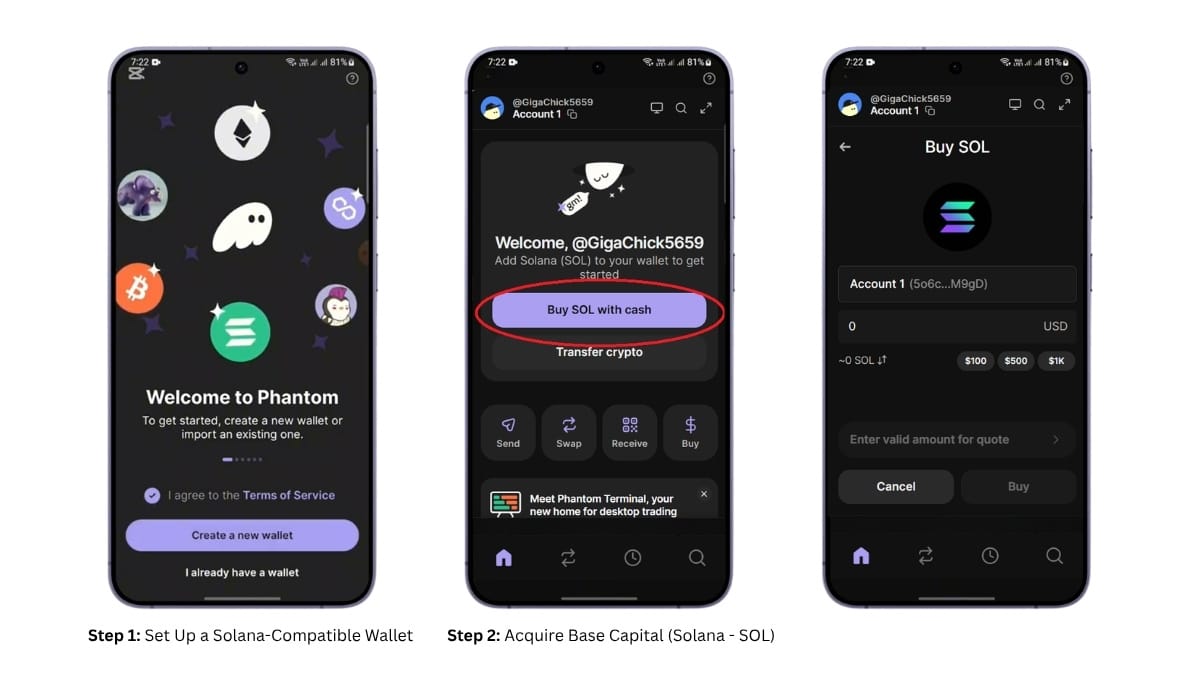
Step 2: Acquire Base Capital (Solana – SOL)
Because VDOR trades exclusively on Solana DEXs, you cannot buy it directly with US Dollars or Euros. You must use the network’s native currency, Solana (SOL), to execute the trade and pay for network fees.
- Log into a regulated fiat-on-ramp exchange (like Coinbase or Kraken).
- Purchase the desired amount of SOL.
Step 3: Transfer SOL to Your Decentralized Wallet
- Open your newly created self-custodial wallet (e.g., Phantom) and copy your public receiving address.
- Go to your centralized exchange, select “Withdraw,” and paste your Phantom address.
- Important: Ensure the transfer network is explicitly set to the Solana (SOL) network. Selecting the wrong network will result in permanently lost funds.
Step 4: Connect to a Decentralized Exchange (DEX) Aggregator
While you can use singular liquidity pools like Raydium, using a DEX aggregator like Jupiter ensures the best execution price by scanning multiple pools instantly.
- Navigate to the official Jupiter exchange website.
- Click “Connect Wallet” and authorize the connection with your Phantom or Solflare wallet. Your SOL balance will now be visible on the trading interface.
Step 5: Verify the Exact Contract Address
Because anyone can create a token on Solana, scammers frequently launch fake “honeypot” tokens named VDOR. Never simply type “VDOR” into the search bar.
- In the “Output” dialogue box of the DEX, paste the official, verified cryptographic contract address:
VDoRrZix72Er41foJAdKrwFqYNozPbktuPa4Xy1A7Au - The interface will display the authentic Vanguard Digital Oil Reserve token. Select it.
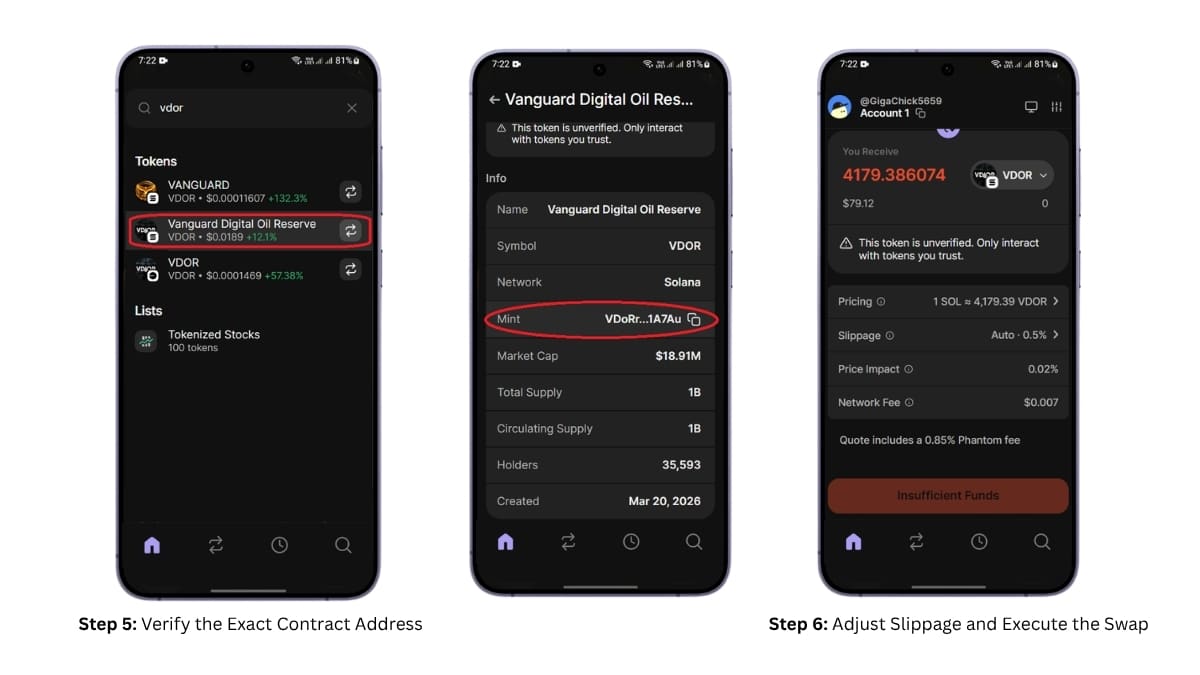
Step 6: Adjust Slippage and Execute the Swap
- Input the amount of SOL you wish to convert into VDOR.
- Because low-cap meme coins are highly volatile, standard transaction parameters often fail. You must access the DEX settings and manually adjust your Slippage Tolerance to between 1.0% and 3.0%. This allows the trade to execute even if the price fluctuates slightly during the 2-second processing time.
- Click “Swap” and approve the transaction prompt that appears in your wallet software. The newly acquired VDOR tokens will populate in your wallet balance moments later.
Why VDOR Surged in 2026
To truly understand VDOR, you must look at the macroeconomic environment of early 2026. The story of VDOR is not one of technological innovation, but rather a story of market psychology and the “narrative machine” of the crypto industry.
The Hormuz Crisis and the “Oil” Narrative
U.S. and Israeli military strikes on Iran beginning February 28 prompted Iran to close the Strait of Hormuz — a critical waterway through which roughly 20% of the world’s daily oil supply passes. WTI crude, which opened 2026 at approximately $57 per barrel, spiked to intraday highs near $120 per barrel before settling in the $90–$102 range in late March.
As traditional oil prices skyrocketed, crypto retail algorithms and speculative traders aggressively hunted for assets that offered exposure to energy markets. VDOR, bearing a highly institutional-sounding name, became a massive Google Trends breakout asset. The token surged over 130% in a single week.
However, market data shows VDOR’s price action did not actually correlate with the physical oil dynamics. Instead, the token surged simply because retail traders bought anything with the word “oil” or “reserve” in its name during a period of peak macroeconomic anxiety.
The Caribbean Refinery Myth
The hype was further fueled by ambitious roadmap promises. The anonymous development team behind VDOR teased a “Phase 2” roadmap that allegedly included a partnership with a major Caribbean oil refinery designed to provide on-chain audits of physical commodities.
To date, absolutely no public documentation, regulatory filings, or independent audits have been produced to verify this Caribbean refinery partnership. Furthermore, an explicit disclaimer on the project’s own website legally categorizes all its institutional claims as being for “illustrative purposes only.”
A History of Failed Oil Cryptocurrencies
VDOR is not the first project to attempt merging cryptocurrency with the oil narrative. Historically, oil-backed cryptocurrencies have faced massive structural hurdles and a high failure rate.
Past projects like OilCoin, the PetroDollar (XPD), and Blur Energy attempted to create oil-backed digital currencies but ultimately failed to gain widespread appeal, largely due to a severe lack of institutional support and unverified redeemability. Even state-backed attempts, such as Venezuela’s highly publicized “Petro” token launched in 2018, were shut down on January 15, 2024 after becoming embroiled in a corruption scandal and failing to gain domestic or international acceptance. This historical precedent serves as a stark warning for traders evaluating VDOR’s long-term viability.
Also Read: Is VDOR Coin a Scam? The Truth About Vanguard Digital Oil Reserve in 2026
Troubleshooting Common Solana DEX Errors
Trading on decentralized networks can occasionally result in frustrating error messages. If your VDOR purchase fails, it is likely due to one of these common Solana DEX issues:
| Error Message | Meaning & Solution |
|---|---|
| Slippage Exceeding Threshold | The price of VDOR moved too quickly while your transaction was processing. Fix: Increase your slippage tolerance by 0.5% to 1.0% in the DEX settings and try again. |
| ComputeBudgetExceeded | The network was highly congested, or the smart contract required more computational power than allotted. Fix: Many wallets allow you to manually increase the “Priority Fee” to force the transaction through. |
| Insufficient Funds (Rent Error) | You do not have enough SOL to cover both the token cost and the network fees required to open a new token account. Fix: Never swap 100% of your SOL. Always leave at least 0.05 SOL in your wallet to cover base network fees. |
| Transaction Expired | Common on congested Solana. Simply resubmit the transaction. No funds are lost. |
Frequently Asked Questions (FAQs)
Is Vanguard Digital Oil Reserve (VDOR) backed by physical oil
No. Despite the institutional marketing language and its roadmap claims, there is no verifiable evidence, independent audit, or oracle mechanism linking the VDOR token to the physical reserves of crude oil. It operates purely as a narrative-driven speculative asset.
Is VDOR related to The Vanguard Group?
Absolutely not. The Vanguard Group, a legitimate $9 trillion traditional asset manager, has zero affiliation with the VDOR token. The token’s developers utilize the name to project a false aura of institutional credibility.
Can I buy VDOR on Binance or Robinhood?
No. VDOR is an unverified, highly volatile asset with anonymous founders. It does not meet the strict regulatory and liquidity requirements necessary for listing on centralized stock brokerages or Tier-1 crypto exchanges. It is exclusively available on Solana decentralized exchanges.
Why did my Phantom wallet transaction fail when trying to buy VDOR?
The most common reasons for transaction failure on a Solana DEX are network congestion or inadequate slippage. Because the token’s price changes rapidly, if your slippage is set too low (e.g., 0.1%), the smart contract will abort the trade to protect you. Adjusting slippage to 1% – 3% usually resolves the issue.
Is VDOR a safe investment?
No. VDOR carries an extreme risk profile. Its liquidity is thin, its developers are completely anonymous, and its price action is driven entirely by social media momentum rather than fundamental utility. Market participants should treat it as a highly speculative venture and practice strict operational security.
Disclaimer:
Some elements of this content may have been enhanced with the help of our artificial intelligence (AI) assistants for purposes such as basic refinement, review, image generation, and translation to deliver high-quality news in a shorter time frame. However, all AI-assisted content is reviewed and approved by our team to ensure accuracy, fairness, and editorial integrity.