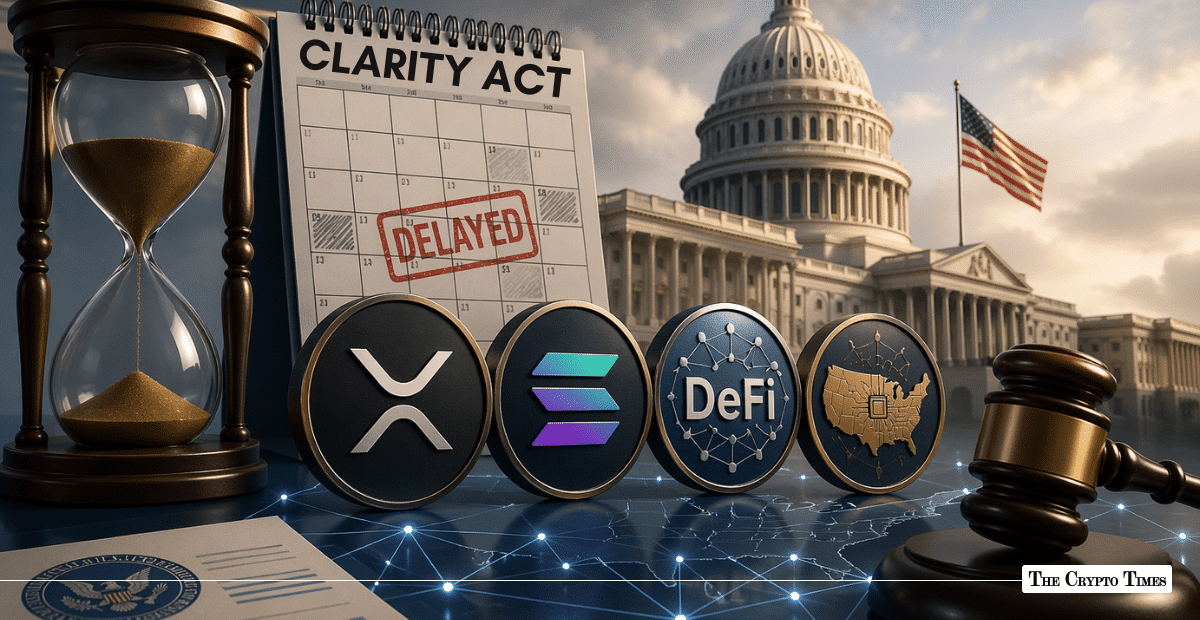
On July 17, 2025, the U.S. House of Representatives passed the Digital Asset Market Clarity Act (H.R. 3633) by a decisive 294–134 vote, the most bipartisan crypto legislation in American history. Nine months later, the bill sits frozen in the Senate Banking Committee, one procedural vote short of a floor debate that could fundamentally reshape how XRP, Solana (SOL), decentralized finance protocols, and the broader U.S. crypto industry are regulated for the next decade.
As of April 20, 2026, the CLARITY Act has still not been marked up by Chairman Tim Scott’s (R-SC) committee. Three fault lines: stablecoin yield, Trump-family ethics provisions, and DeFi treatment have stalled progress repeatedly. Polymarket odds of 2026 enactment have dropped from 82% in January to roughly 55–65% in mid-April. Galaxy Research calculates that if Banking misses an early-May markup window, the five-step legislative sequence cannot realistically finish before the November 3 midterms.
Senator Cynthia Lummis (R-WY) put it bluntly on X on April 10: “This is our last chance to pass the Clarity Act until at least 2030. We can’t afford to surrender America’s financial future.”
The delay’s consequences are already surfacing in ETF flows, developer migration, venture capital patterns, and the regulatory status of assets worth hundreds of billions of dollars. This analysis breaks down what’s actually at stake, asset by asset, protocol by protocol, with the trade-offs clearly separated.
What the CLARITY Act actually does
The House-passed CLARITY Act gives the Commodity Futures Trading Commission (CFTC) exclusive jurisdiction over spot markets in “digital commodities” — digital assets whose value is “intrinsically linked” to a blockchain and which are not securities, derivatives, or stablecoins. The Securities and Exchange Commission (SEC) retains authority over “investment contract assets.”
Core Provisions
- “Mature blockchain system” test (Section 205): Seven objective criteria including open-source code, absence of any person or group controlling 20%+ of tokens, and transparent pre-established rules. Projects that qualify graduate from SEC securities treatment to CFTC commodity treatment.
- Section 4(a)(8) safe harbor: Allows issuers to raise up to $75 million per 12 months from unaccredited investors without securities registration, with mandatory disclosures.
- Section 109 developer shield: Protects non-controlling blockchain developers from money-transmitter liability and §1960 unlicensed-money-transmission prosecutions.
- Sections 309 and 409: Exclude validators, code publishers, interface providers, and self-custodial wallet operators from broker-dealer registration.
The CLARITY Act supersedes FIT21 by tightening decentralization standards, closing legacy-project disclosure loopholes, and aligning with the GENIUS Act the stablecoin framework Trump signed July 18, 2025.
Why the senate is stuck
A brief timeline of the stall:
- September 18, 2025: Senate receives the House-passed bill.
- January 12, 2026: Sen. Scott releases a 278-page amendment-in-the-nature-of-a-substitute.
- January 14, 2026: Coinbase CEO Brian Armstrong publicly withdraws support hours before the scheduled markup. “We’d rather have no bill than a bad bill.” The markup is postponed indefinitely.
- January 29, 2026: Senate Agriculture Committee advances the parallel Digital Commodity Intermediaries Act on a 12–11 party-line vote. Sen. Cory Booker (D-NJ) walks out.
- March 23, 2026: Sens. Thom Tillis (R-NC) and Angela Alsobrooks (D-MD) circulate a stablecoin-yield compromise banning passive yield on idle balances while permitting “activity-based rewards.”
- April 9, 2026: Treasury Secretary Scott Bessent publishes a Wall Street Journal op-ed demanding action.
- April 10, 2026: Armstrong reverses his January opposition: “It’s time to pass the Clarity Act.”
- April 17, 2026: Tillis tells Politico he will “likely no longer release” the revised stablecoin text that week.
The Bank Policy Institute warns of up to $6.6 trillion in potential deposit outflows if stablecoin yield is permitted. Bank of America CEO Brian Moynihan estimates 30–35%. Coinbase disclosed $355 million of stablecoin revenue in Q3 2025 alone — a direct stake in the outcome.
What the delay means for XRP
Ripple closed its five-year legal war with the SEC on August 22, 2025, when the Second Circuit approved a joint dismissal of all appeals. The 2023 Torres ruling stood: XRP is not a security on secondary or programmatic sales, but Ripple’s institutional sales violated Section 5. Ripple paid $125 million and accepted a permanent injunction on institutional sales.
Then on March 17, 2026, the SEC and CFTC issued a joint interpretive release classifying 16 tokens — including XRP — as “digital commodities.” Ripple CLO Stuart Alderoty called it validation of the company’s long-held position.
But this administrative clarity is exactly what CLARITY would make permanent. Chairman Paul Atkins himself testified in February: “There is no action we can take that future-proofs our rulebook more formidably than nonpartisan market structure legislation.”
The pros of continued delay for XRP
- Administrative clarity is already in place. The SEC-CFTC taxonomy treats XRP as a digital commodity, and the Ripple lawsuit is legally resolved.
- ETF infrastructure has launched successfully. Seven U.S. spot XRP ETFs now trade, holding roughly 787 million XRP with combined assets under management near $1 billion. Canary Capital’s XRPC, Bitwise’s XRP ETF, Franklin Templeton’s XRPZ, Grayscale’s GXRP, and 21Shares’ TOXR all went live between November 2025 and March 2026.
- Institutional validation is accelerating. Goldman Sachs disclosed a $153.8 million XRP ETF position in its Q4 2025 13F — the largest known institutional holder.
- Ripple’s corporate expansion continues unimpeded. The $1.25 billion Hidden Road acquisition closed in October 2025, rebranded as Ripple Prime — the first crypto-owned global multi-asset prime broker, clearing over $3 trillion annually across 300 institutional clients.
- RLUSD has scaled to $1.43–1.56 billion market cap by April 2026, adopted by BlackRock as collateral, Deutsche Bank, and SBI Japan.
The cons of continued delay for XRP
- Every gain is reversible by a future SEC. Without statutory codification, the taxonomy classifying XRP as a commodity could be withdrawn by any successor administration.
- Price performance has been poor. After peaking at $3.65 in July 2025, XRP traded in the $1.33–$1.49 range by mid-April 2026 — six consecutive monthly losses, its worst streak since 2022.
- Analyst targets are compressing. Standard Chartered’s Geoff Kendrick cut his 2026 XRP target from $8 to $2.80.
- An “ancillary asset” loophole remains unresolved. In Ripple’s Banking RFI submission, Alderoty specifically urged removal of language that could expose XRP, ETH, and SOL to “perpetual SEC oversight.”
- RLUSD operates without statutory stablecoin-yield clarity. Ripple’s crowning product remains dependent on regulatory interpretation rather than law.
- Ripple’s IPO plans remain indefinite. Despite a $50 billion private valuation, President Monica Long told Bloomberg the company has “no plan and no timeline” for going public — a decision observers link to regulatory uncertainty.
What the delay means for Solana (SOL)
Solana carried heavier historical baggage than XRP. The SEC’s June 2023 Binance complaint listed SOL as an unregistered security. In 2024 the agency quietly amended its Binance complaint to effectively abandon the securities argument. The March 17, 2026 SEC-CFTC release explicitly named SOL a digital commodity. Atkins quipped at the DC Blockchain Summit: “We are not the securities and everything commission anymore.”
Solana co-founder Anatoly Yakovenko was appointed to the CFTC Innovation Advisory Committee in February 2026. Spot Solana ETFs launched October 28, 2025 — Bitwise’s BSOL posted the strongest ETF debut of the year at $56 million first-day volume. Cumulative inflows crossed $900 million by early March and topped $1 billion combined AUM by mid-April. Goldman Sachs disclosed $108 million in SOL ETF holdings in its Q4 2025 13F.
The pros of continued delay for Solana
- Ecosystem metrics defy the price collapse. Solana total value locked held at $5.4–6 billion on DefiLlama, and stablecoin supply on Solana hit a record $15.7 billion in March 2026.
- Monthly stablecoin transaction volume reached $650 billion in February 2026 — the highest ever on any blockchain, exceeding Ethereum’s $525–551 billion according to Grayscale research.
- Firedancer deployment is live. Jump Crypto’s validator client went fully live on Solana mainnet in December 2025, running on 20%+ of validators and passing 1 million TPS in stress tests.
- The Alpenglow consensus upgrade passed governance with 98.27% yes in September 2025, targeting roughly 150-millisecond finality.
- DeFi stack maturity: Kamino leads with roughly $2.8 billion TVL; Jupiter, Jito, Marinade, and Drift round out a sophisticated ecosystem.
- Institutional ETF issuers have operational cover. Bitwise’s BSOL absorbed roughly 78% of net inflows to the Solana ETF category.
The cons of continued delay for Solana
- SOL price has collapsed roughly 57% in Q1 2026. After peaking at ~$293 in early 2025, SOL traded in an $80–$100 range by mid-April.
- Analyst downgrades are compounding. Kendrick cut his 2026 SOL target from $310 to $250 (and in some revisions to $135).
- Commodity status exists by regulatory choice, not statute. One enforcement reversal or new administration could undo the taxonomy.
- Developer migration risk is measurable. Electric Capital data show U.S. developer share fell to 19% in 2024 from over 30% a decade earlier, while Asia overtook North America at 33%.
- Yakovenko himself has warned Congress. Writing in Fortune: “To keep the next great American founder in America, Congress must regulate crypto.”
- Narrative drift is visible. Solana Foundation President Lily Liu told Consensus Hong Kong in February: “Blockchains should refocus on their original purpose: finance” — rejecting “web3” gaming narratives as “intellectually lazy.” The shift signals ecosystem anxiety that legal and regulatory ambiguity has sidelined core finance use cases.
What the delay means for DeFi
For decentralized finance, the delay has been partly masked by dramatic enforcement retreat. SEC enforcement actions totaled 456 in FY2025 — the lowest in 21 years, down roughly 30% year-over-year under Chairman Atkins. The agency dropped investigations of Coinbase (February 27, 2025), Kraken (March 27), Consensys, Robinhood Crypto, OpenSea, Gemini, Crypto.com, Uniswap (February 25, 2025), Immutable (March 25), Ondo (December 2025), and Aave (December 16, 2025, after a four-year probe).
The Fifth Circuit’s Van Loon v. Treasury ruling held that immutable smart contracts are not “property” under IEEPA. OFAC formally delisted Tornado Cash on March 21, 2025, and a federal judge permanently enjoined Treasury on April 29, 2025 from re-sanctioning it.
The pros of continued delay for DeFi
- Enforcement relief is substantive and ongoing. 95 enforcement actions and $2.3 billion in penalties since FY2022 “identified no direct investor harm,” per the SEC’s own 2025 staff report.
- Major protocols have been exonerated. Uniswap, Aave, and others can now operate without active investigation shadows.
- Cross-protocol institutional integration is accelerating. BlackRock’s BUIDL integrated with Uniswap in Q1 2026 — the first regulated tokenized fund on a DEX.
- Industry advocates view the bill’s DeFi sections positively. 1inch’s chief legal officer called CLARITY’s DeFi provisions “very DeFi-friendly”; a16z crypto and the DeFi Education Fund described Sections 309/409 as “meaningful wins.”
- Token generation events are partially re-onshoring. Coinbase’s Echo platform ($375 million acquisition) hosted Monad’s $296 million raise.
The cons of continued delay for DeFi
- Tornado Cash developer Roman Storm was convicted in August 2025 under §1960 — the very statute CLARITY Section 109 would carve out for non-controlling developers. Storm is appealing. Statutory protection remains the only durable fix.
- Perpetual derivatives remain offshore. CLARITY explicitly excludes derivatives; Hyperliquid launched a DC Policy Center in February 2026 seeded with 1 million HYPE tokens, worth $28 million at the time, led by Jake Chervinsky, signaling that the offshoring is becoming institutionalized.
- Compliance costs run as high as 15% of revenue for small teams, according to Crypto Times analysis.
- TVL fragmentation persists. Roughly 20–25% of major protocol TVL is split between U.S.-compliant and offshore versions.
- Re-onshoring is contingent, not structural. Projects route TGEs through Coinbase’s compliance infrastructure rather than operating under clear statutory rules.
- A future administration could reverse everything. The enforcement retreat is entirely executive-branch policy. Without CLARITY, the next SEC chair could reactivate §1960 developer prosecutions, re-list Tornado Cash, and revive broker-dealer registration threats against non-custodial protocols.
What the delay means for U.S. crypto innovation
The CLARITY delay has not crashed U.S. crypto innovation — but it has reshaped its contours. Q1 2026 crypto fundraising reached $6.81 billion across 222 rounds per crypto-fundraising.info, with deal count falling 45.9% year-over-year while capital dropped only 8.5% — the signature of a “flight to quality.” March alone delivered $4.43 billion on three mega-deals: Mastercard’s $1.8 billion acquisition of BVNK, Kalshi’s $1 billion round at a $22 billion valuation, and Polymarket’s $600 million ICE investment.
Digital-asset lobbying spending rose 66% to $40.6 million in 2025, per OpenSecrets. Fairshake PAC’s $193 million war chest — built on $75 million from Coinbase, $70 million from a16z, and $48–50 million from Ripple — dominates crypto political spending.
The pros of continued delay for U.S. crypto innovation
- Capital remains abundant for quality projects. a16z crypto is raising a $2 billion Fund V to close in 1H 2026; parent a16z raised $15 billion overall — its largest ever.
- Corporate and banking integration has accelerated. BNY Mellon launched tokenized deposits in January 2026; U.S. Bank resumed institutional crypto custody in September 2025; BitGo received an OCC national trust bank charter in December 2025 and operates as BitGo Bank & Trust with $90 billion AUC.
- Tokenization of real-world assets has accelerated regardless of legislative paralysis — roughly $29 billion in Q1 2026, up 263% year-over-year per RWA.xyz. BlackRock BUIDL stands at $2.4–2.9 billion across nine chains; Franklin Templeton BENJI tops $1 billion; Ondo manages $2.5 billion.
- SAB 121 repeal (replaced by SAB 122 on January 23, 2025) removed one of the most binding constraints on institutional custody.
- Regulatory tone is unified. The SEC-CFTC Memorandum of Understanding signed March 11, 2026 and the Project Crypto initiative provide interpretive coherence absent just two years ago.
The cons of continued delay for U.S. crypto innovation
- Developer migration is measurable. Electric Capital’s 2024 Developer Report showed U.S. developer share fell to 19%, while Asia overtook North America (33% vs. ~25%), and India became the single largest source of new developers.
- Capital is concentrating offshore. The UAE’s VARA has licensed 507 VASPs managing $25 billion AUM as of February 2026, with 1,800+ crypto firms and 8,600+ employees. Hong Kong issued its first stablecoin licenses in March 2026 under the Stablecoins Ordinance. MiCA has been fully in force across the EU since December 30, 2024.
- Treasury has sounded the alarm directly. Secretary Bessent’s April 9 WSJ op-ed warned explicitly that developers are relocating to Singapore and Abu Dhabi.
- Key unresolved issues remain without CLARITY: Basel crypto-framework capital treatment, the scope of state-federal preemption, whether tokenized deposits count toward bank reserves, and Fed master-account access for crypto banks.
- Deal terms are compressing. Payward (Kraken parent) raised $200 million secondary from Deutsche Börse at a $13.3 billion valuation — down from $20 billion in its peak round.
- Senior investors are reducing crypto exposure. Multicoin’s Kyle Samani stepped back from crypto in February 2026. Paradigm is raising up to $1.5 billion for a fund that includes AI and robotics — a notable diversification away from crypto-pure strategy.
- Every structural gain rests on executive interpretation. A political transition could unwind the Atkins-Selig regulatory architecture within weeks.
Four camps, one standoff
Industry advocates frame the delay as a self-inflicted wound. Blockchain Association CEO Summer Mersinger told DL News: “CLARITY has meaningful bipartisan momentum because leaders in both parties understand the need for clear, durable rules for digital assets.” Marc Andreessen and Fred Ehrsam, appointed to the President’s Council of Advisors on Science and Technology in March 2026, endorsed the bill despite its yield restrictions.
Consumer-protection advocates frame CLARITY as an industry handout wrapped in an ethics scandal. Sen. Elizabeth Warren (D-MA) warned in a Banking opening statement: “I’m concerned that what my Republican colleagues are aiming for is another industry handout that gives the crypto lobby exactly its wish list.” Americans for Financial Reform has called CLARITY a “massive deregulatory bill” backed by “a gusher of campaign cash and lobbying muscle.” Sen. Booker said on January 29: “This is ridiculous that the president of the United States and his family have made billions of dollars off of this industry and are still trying to create a framework here without the kind of ethics that would prevent this kind of gross corruption.”
Regulators increasingly urge statutory clarity. Atkins, February 11 House Financial Services testimony: “I also support congressional efforts to enact the CLARITY Act… there is no action we can take that future-proofs our rulebook more formidably than nonpartisan market structure legislation.” CFTC Chair Michael Selig signed a joint op-ed with Atkins and the March 11 SEC-CFTC Memorandum of Understanding.
Political dynamics cut in both directions. Trump has demanded CLARITY “ASAP” on Truth Social while simultaneously queueing the SAVE Act ahead of it via his March 8 ultimatum. Seven Democratic crossovers will be needed to overcome a filibuster — only 18 supported the GENIUS Act. Sen. Bernie Moreno (R-OH) has warned that failure to reach the Senate floor by May “effectively kills the bill for 2026.”
Taxpayer and investor impact
The immediate implication for retail investors and institutions is that U.S. crypto markets are operating on interpretive infrastructure rather than statutory rails. Every ETF, every bank custody arrangement, every DEX integration currently exists because the Atkins-Selig regulatory architecture chose to permit it.
Investors should expect continued volatility tied to Senate procedural calendar — not fundamentals — through Q2 2026. Institutional allocators should model scenarios where the current regulatory framework persists for this administration but reverses after a political transition. Crypto-native companies should anticipate that offshore alternatives (UAE, Hong Kong, Singapore) will continue attracting marginal capital until and unless CLARITY passes.
The realistic legislative path now requires a Senate Banking Committee markup by early May, a floor vote before summer recess, and Agriculture/House reconciliation before the November 3 midterms. If the Tillis-Alsobrooks yield compromise does not materialize in the coming weeks, CLARITY likely dies for the 119th Congress.
The bottom line
The CLARITY Act delay is both less and more consequential than it appears. It is less consequential because the SEC-CFTC regulatory architecture has delivered de facto relief of a scope unimaginable in 2023. XRP, SOL, DeFi tokens, and the institutional plumbing around them can operate today in the United States. ETFs launched, banks got charters, and BlackRock tokenized onto Uniswap. The industry got much of what it wanted — without a statute.
It is more consequential because every gain rests on executive-branch interpretation. A future administration could reverse the taxonomy, re-energize §1960 prosecutions of developers, rescind the MOU, and revive Gensler-era enforcement. Only CLARITY makes commodity status, DeFi carve-outs, developer shields, and maturity certification durable.
The most important question is no longer whether the Senate will pass CLARITY in 2026. It is whether a regulatory framework that rests entirely on Paul Atkins, Michael Selig, and one particular White House can survive a political transition. If not, the delay’s real cost will not be measured in April 2026, but in whichever January the presidency next changes hands.
Also Read: Coinbase CEO’s Dramatic U-Turn: “It’s Time to Pass the CLARITY Act”