
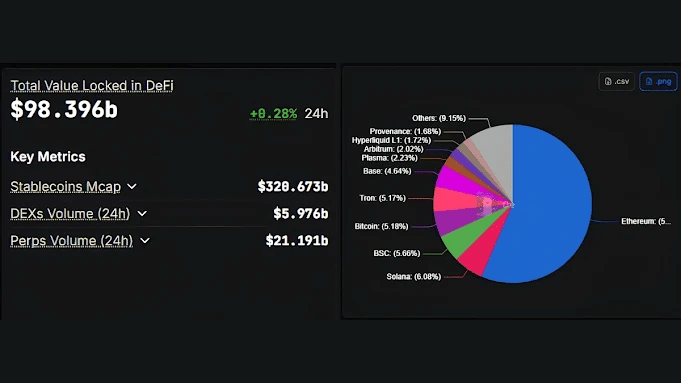
DeFi isn’t just surviving—it’s evolving into the backbone of on-chain finance, with total value locked hovering around $98.39 billion in early 2026 despite market swings. Yet every bull run brings the same question from regulators: how do we “protect” users without killing the very thing that makes decentralized finance decentralized?
Enter two heavyweight regulatory plays: the EU’s fully phased-in Markets in Crypto-Assets (MiCA) regulation and the US Digital Asset Market Clarity Act of 2025 (better known as the CLARITY Act, H.R. 3633). One has been law across Europe for over a year. The other passed the House last summer with strong bipartisan support and is now grinding through Senate negotiations as of April 2026.
On paper, both promise clarity, consumer safeguards, and a crackdown on the wild west era of hacks and rug pulls. But dig into the fine print—and the real-world impact on protocols, developers, and users—and a clearer picture emerges. One framework draws hard lines around what counts as “decentralized” and leaves genuine DeFi alone. The other creates a gray zone that’s already forcing projects to centralize, relocate, or go fully anonymous to survive.
Here’s the no-BS breakdown.
MiCA: Europe’s Clean-Up Crew for Centralized Crypto
MiCA rolled out in stages, with full application hitting by late 2024 and stablecoin rules tightening further into 2025–2026. It brings a single rulebook for crypto-assets that aren’t already securities or e-money under existing EU law. Think asset-referenced tokens (ARTs like stablecoins), e-money tokens, and a licensing regime for crypto-asset service providers (CASPs)—exchanges, custodians, brokers, you name it.
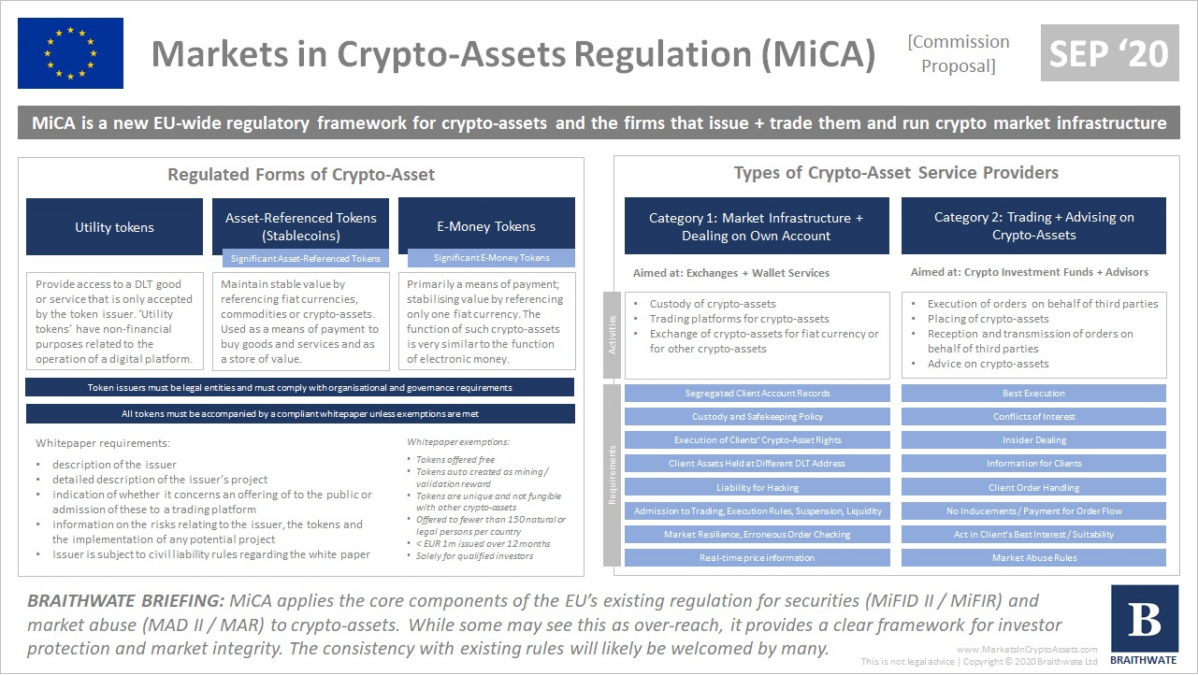
By December 2025, ESMA’s register showed roughly 102 authorized CASPs. Stablecoin issuers got their own strict reserve, transparency, and white-paper requirements. The goal? Stamp out scams, enforce AML/KYC, and give retail users confidence.
DeFi under MiCA? Officially, “fully decentralized” services without any identifiable intermediary or central operator are out of scope (Recital 22). Sounds great—until you realize there’s no precise definition of “fully decentralized.” National authorities and ESMA decides case-by-case. If your protocol has a frontend team, a governance token with voting power, or any centralized elements (even a multisig for upgrades), you could suddenly be treated as a CASP. That means full licensing, capital requirements (EUR 50k–150k+), custody rules, and ongoing compliance.
The result? Industry data shows over 47% of European DeFi projects have rushed to fully decentralized governance models or shifted operations to avoid enforcement. Some protocols report 20–25% TVL fragmentation between compliant and offshore versions. The data also shows that compliance costs are eating smaller builders alive—up to 15% of revenue for tiny teams.
Europe gets cleaner centralized trading and stablecoins. DeFi? It’s surviving in the shadows or moving elsewhere.
The CLARITY Act: America’s Explicit DeFi Shield
The CLARITY Act (full name: Digital Asset Market Clarity Act of 2025) finally tries to fix the SEC-vs-CFTC turf war that’s paralyzed US crypto for years.
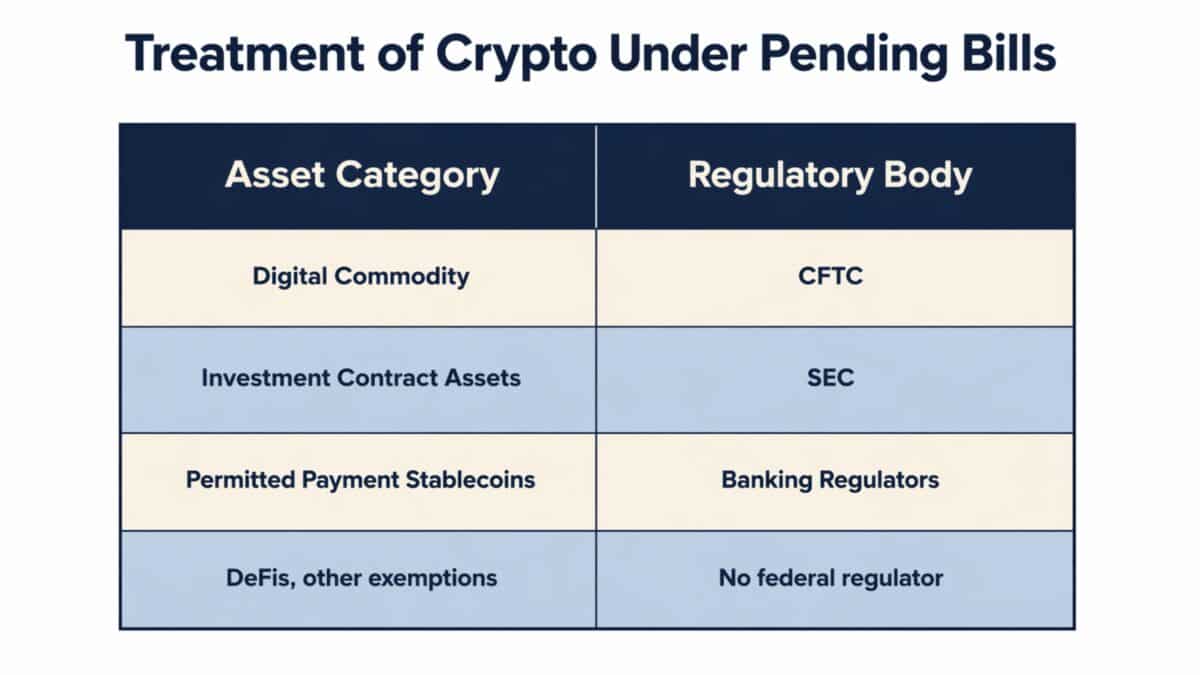
Crucially, it includes a “maturity certification” process: once a blockchain proves it’s sufficiently decentralized, tokens can graduate from SEC securities treatment to CFTC commodities.
The DeFi bombshell is in Sections 309 and 409. The bill explicitly excludes core decentralized activities from registration requirements if you’re not exercising control over customer funds or orders. That covers:
- Compiling or validating transactions
- Providing computational (node) work
- Building user interfaces or wallets
- Developing trading protocols or software
Centralized intermediaries that interact with DeFi still face tailored risk-management, cybersecurity, and compliance rules—but the code itself, the developers, and pure peer-to-peer activity get safe harbors. No more regulating software like it’s a bank.
1inch’s chief legal officer called it “very DeFi-friendly.” DeFi Education Fund praised the “meaningful wins” for protocols and developers. Even critics admit the language draws a clearer line than anything Europe has on the books.
As of mid-April 2026, the bill is still waiting on Senate markup amid delays and stablecoin yield debates, but momentum is building.
Also Read: The CLARITY Act Countdown: Will the Senate Deliver a Crypto Win or Run Out the Clock?
Head-to-Head: What Actually Protects DeFi?
Here’s the side-by-side that matters most to builders and users:
| Aspect | MiCA (EU) | CLARITY Act (US) | Winner for DeFi? |
|---|---|---|---|
| DeFi Scope | Exempt only if fully decentralised (vague; case-by-case) | Explicit safe harbors for devs, validators, protocols if no custody/control | CLARITY |
| Developer Protection | Risk of CASP licensing if any central element | Code and non-custodial activity protected by statute | CLARITY |
| Centralized Intermediaries | Heavy CASP rules (KYC, capital, custody) | Tailored rules only for those exercising control | Tie (both sensible) |
| Innovation Risk | Forces many projects to decentralize or relocate/centralize | Maturity path + exclusions preserve hybrid models | CLARITY |
| Compliance Burden | High for hybrids; 3,000+ firms affected | Lower for true DeFi; focuses enforcement on bad actors | CLARITY |
| Consumer Protection | Strong for CeFi & stablecoins; DeFi gray zone | Anti-fraud/anti-manipulation still applies everywhere | MiCA (CeFi) / CLARITY (DeFi) |
| Stablecoin Rules | Strict ART/EMT reserves & white papers | Separate GENIUS framework + yield debates ongoing | Too early |
Hacks tell part of the story too. Global crypto crime dropped in volume in 2025 (USD 2.87 billion across ~150 incidents), with better protocol security and rapid governance responses (see Venus Protocol’s quick freeze). But the biggest losses still hit centralized points. These frameworks magically won’t stop smart contract bugs—but CLARITY’s focus on control rather than code lets DeFi iterate faster on security without regulatory fear.
The Verdict: Who Actually Wins?
If you are a traditional fintech company looking to launch a regulated crypto brokerage, MiCA is the gold standard. It provides a clear rulebook, and companies that comply can freely passport their services across 27 countries.
MiCA has delivered exactly what it promised for centralized crypto: fewer shady exchanges, clearer stablecoin rules, and a more professional EU market. But its vagueness around decentralization has created the very uncertainty it was meant to fix—pushing some of the most innovative DeFi builders offshore or into full anonymity.
But if you are a DeFi builder coding permissionless smart contracts, the US CLARITY Act—despite its political baggage and the SEC’s historical hostility—presents a framework that actually allows decentralized finance to scale.
CLARITY says the quiet part out loud: DeFi isn’t the enemy. Software isn’t a financial intermediary. Peer-to-peer activity on mature blockchains doesn’t need a banking license. It regulates the parts that should be regulated (custody, order books, customer funds) and leaves the rest alone.
If the Senate finally passes CLARITY in the coming weeks, the US could leapfrog Europe as the genuine DeFi capital—not just by attracting capital, but by attracting builders. Europe’s MiCA-compliant TVL gains may prove temporary if the best protocols simply route around the ambiguity.
The crypto industry has waited years for actual frameworks instead of enforcement actions. Now we have two. One protects users by cleaning up CeFi. The other protects the soul of DeFi by refusing to regulate the unregulatable.
The one that actually preserves decentralized finance while still cracking down on the bad stuff? Right now, that’s CLARITY. Europe set the bar for centralized markets. The US has a chance to set it for everything else.
The Senate’s move in the next few weeks will decide whether America seizes that opportunity—or watches innovation flow elsewhere. DeFi users and builders are watching. The market is pricing it in.