Key Highlights
- The market reached a $4.3 trillion cap driven by structural integration, seeing a “K-shaped” recovery where Bitcoin thrived while speculative tokens lagged.
- The U.S. GENIUS Act and EU’s MiCA established a clear rulebook for banks, shifting the regulatory focus from enforcement to enablement.
- Tokenized Real-World Assets (RWAs) surpassed $30 billion, while stablecoins evolved from trading tools into essential payment infrastructure.
- Forecasts suggest 2026 will end the volatile “four-year cycle,” entering a sustained bull market driven by the convergence of AI and blockchain.
The year 2025 represents the definitive structural inflection point in the history of digital assets, marking the irrevocable transition from a speculative retail-driven asset class to a recognized, regulated, and integral component of the global financial infrastructure. Characterized by the convergence of legislative clarity, technological maturation, and unprecedented institutional participation, 2025 dissolved the lingering boundaries between “traditional finance” (TradFi) and the “crypto economy.”
While previous market cycles were defined by unchecked volatility and retail mania, 2025 was the “Year of the Institution.” The total cryptocurrency market capitalization peaked at approximately $4.3 trillion, a valuation underpinned not by transient hype but by deep structural integration into banking, payments, and capital markets.
The passage of the Guiding and Establishing National Innovation for U.S. Stablecoins Act (GENIUS Act) in the United States provided the long-awaited regulatory “rulebook,” catalyzing a rush of banking giants into the sector and legitimizing the digital dollar as a settlement rail.
Simultaneously, the tokenization of real-world assets (RWAs) graduated from experimental pilots to a $30 billion market, with U.S. Treasuries moving on-chain at scale via products from BlackRock, Fidelity, and Franklin Templeton.
Despite these structural victories, market sentiment remained complex—a state described by analysts as “conflicted feelings”. While adoption metrics soared, price action for many assets did not strictly follow the explosive parabolic trajectories of 2021, suggesting a maturation of market dynamics where utility begins to weigh as heavily as speculation. Divergence became the norm: a “K-shaped” recovery saw infrastructure assets and dominant protocols thrive, while speculative long-tail assets faced irrelevance.
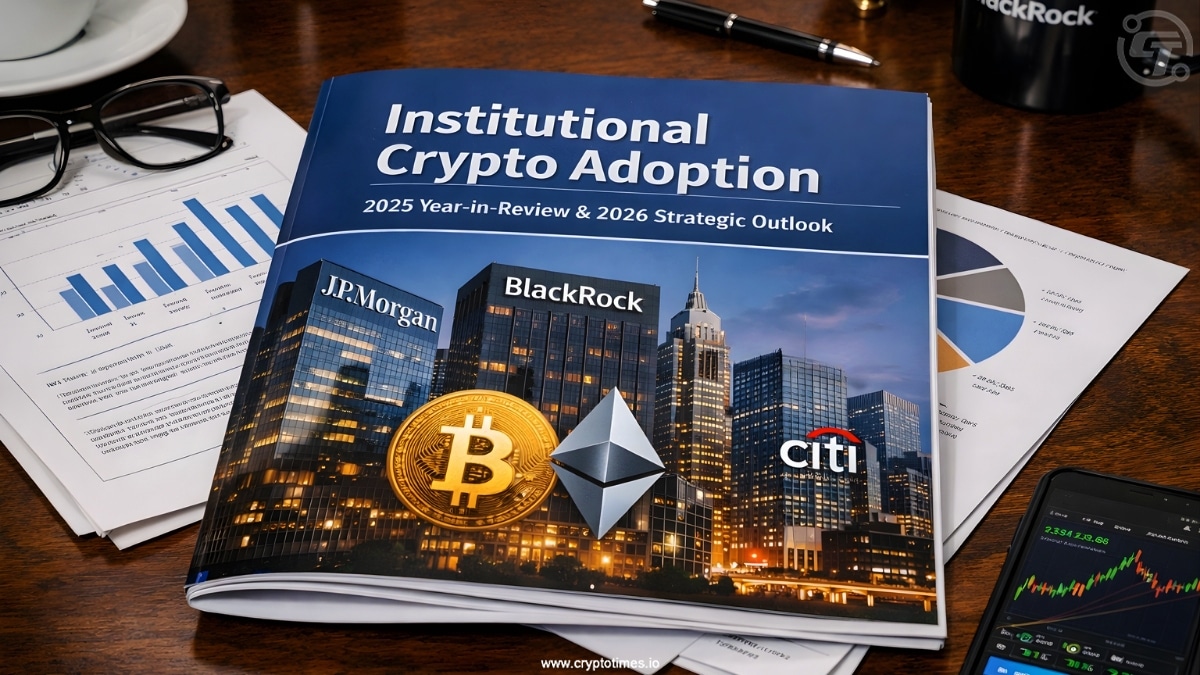
This report provides an exhaustive analysis of the institutional landscape in 2025. It dissects the regulatory shifts that opened the floodgates, the explosion of stablecoin utility in global payments, the tokenization of capital markets, and the strategic positioning of corporate treasuries. Furthermore, it synthesizes forecasts from leading research houses—including Grayscale, VanEck, and a16z—to offer a nuanced outlook for 2026, a year expected to challenge historical cyclical models and usher in the “Dawn of the Institutional Era”.
The macro landscape of 2025: From speculation to structure
The overarching theme of 2025 was “structural evolution.” In the U.S., crypto activity surged by approximately 50% between January and July 2025 compared to the same period in 2024, cementing the nation’s status as the largest crypto market globally in absolute terms measured by transaction volume. This surge was not merely a function of trading volume but of deeper integration into the fabric of financial operations.
Total crypto market capitalization reached a record high of $4.3 trillion during the year. However, unlike the 2021 peak, which was fueled by retail leverage and pandemic-era liquidity, the 2025 valuation was underpinned by “persistent institutional capital” and the asset class’s deeper integration into global macro dynamics. Bitcoin (BTC) jumped to new all-time highs above $126,000, behaving increasingly like a macro-sensitive asset rather than an isolated risk trade.
A critical development in 2025 was the shift in Bitcoin’s volatility profile. One of the key observations from institutional research was that Bitcoin’s volatility has gradually evolved to resemble that of high-growth technology stocks rather than a fringe speculative instrument. Coinbase Institutional noted that Bitcoin’s 90-day historical volatility declined to about 35% to 40% by the end of 2025, down from levels above 60% in mid-2024. This dampening of volatility, while perhaps frustrating for traders seeking asymmetric short-term gains, signaled Bitcoin’s graduation into a mature asset class capable of fitting within strict institutional risk mandates.
The “conflicted” sentiment and K-shaped recovery
Despite record adoption and all-time highs, 2025 was not a year of uniform euphoria. The Block Research characterized the year as one of “conflicted feelings”. While the industry finally received its wish of mass institutional adoption and regulatory clarity, cryptocurrency prices remained “lukewarm” for long stretches of the year.
This paradox highlights a critical maturation in market structure where positive fundamental news—such as a bank launching a tokenized fund—does not immediately translate into exponential token price appreciation for retail holders.
The market exhibited a distinct “K-shaped” landscape:
- The ascendants: Bitcoin, stablecoins, and select Real-World Asset (RWA) protocols thrived. Bitcoin solidified its role as a macro-asset, and stablecoins proved their utility as settlement infrastructure.
- The laggards: The long tail of altcoins, older NFT collections, and “governance tokens” with unclear value accrual mechanisms continued to fade into irrelevance.
This bifurcation was driven by institutional selectivity. The “slow-moving institutional capital” that entered the market in 2025 did so through highly specific, regulated vehicles like exchange-traded funds (ETFs) and tokenized treasuries, rather than broad-market baskets. Consequently, liquidity concentrated heavily in the “blue chip” assets that met regulatory and liquidity thresholds.
The end of the four-year cycle?
A profound theoretical shift emerged in 2025 regarding the cyclical nature of the crypto market. Historically, the market has adhered to a four-year cycle centered around the Bitcoin halving event. However, research from Grayscale and Gemini in late 2025 suggested that 2026 might mark the end of this recurring pattern.
The argument posits that the sheer scale of institutional participation, coupled with the introduction of spot ETFs and sophisticated derivatives markets, has dampened the supply-shock mechanics that previously drove boom-and-bust cycles.
Grayscale argues that the asset class is in a “sustained bull market” driven by secular adoption rather than cyclical speculation. This transition implies that 2026 may not see the deep “crypto winter” drawdowns typical of previous post-peak years, but rather a decoupling of assets based on fundamental performance, adoption, and macro-correlation.
Also Read: Why Gold and Silver Won 2025, And Why Bitcoin Isn’t Done Yet
Regulatory watershed: The GENIUS Act and global alignment
The single most consequential development of 2025 was the transformation of the regulatory environment from one of “enforcement” to one of “enablement.” This shift was most pronounced in the United States, which moved from a posture of skepticism to one of strategic embrace, viewing digital assets as a vector for national competitiveness.
The GENIUS Act: A Federal Rulebook for Stablecoins
On July 18, 2025, the Guiding and Establishing National Innovation for U.S. Stablecoins Act (GENIUS Act) was signed into law, establishing the first comprehensive federal regulatory framework for payment stablecoins in the United States. This legislation was a watershed moment, effectively ending the era of regulatory ambiguity that had kept major U.S. financial institutions on the sidelines.

Key provisions and mechanisms
The GENIUS Act fundamentally altered the landscape by prioritizing consumer protection and financial stability without stifling innovation. Its key provisions were designed to integrate stablecoins into the federal banking architecture:
- Permitted issuance and licensing: The Act strictly prohibits any entity from issuing a payment stablecoin in the United States unless they are classified as a “permitted payment stablecoin issuer.” This status is achievable through a “Two-Tier System”: issuers with a market capitalization exceeding $10 billion must obtain a federal license, while smaller issuers may opt for state-level licensing that adheres to federal standards.
- Reserve mandates: To prevent “bank runs” similar to historical failures, issuers are required to maintain 1:1 reserves in high-quality liquid assets (HQLA), specifically defined as U.S. coins and currency, short-term U.S. Treasuries, or central bank reserve deposits. These reserves must be disclosed monthly and attested by third-party auditors.
- Prohibition on interest: Crucially, the Act prohibits issuers from paying interest or yield to stablecoin holders solely for holding the token. This provision was designed to distinguish stablecoins from banking deposits and securities, cementing their role as a means of payment rather than an investment contract. This effectively protects the traditional banking sector’s deposit base from direct competition by stablecoin issuers.
- Insolvency protections: In the event of an issuer’s bankruptcy, stablecoin holders are granted priority claims over other creditors. This “segregation of assets” rule addresses a key risk highlighted by previous failures like TerraUSD, ensuring that user funds are not commingled with the issuer’s operational liabilities.
- Implementation timeline: While signed in 2025, the Act sets a deliberate timeline for full implementation. Federal and state regulators are required to promulgate final regulations by July 2026, with the Act coming into full force on January 18, 2027. This transition period allows the industry to adapt operational compliance frameworks.
Impact on banking and market structure
The GENIUS Act served as a definitive “green light” for the U.S. banking sector. Following its passage, federal banking regulators—including the OCC, FDIC, and Federal Reserve—rescinded previous guidance that effectively blocked banks from crypto engagement. This regulatory thaw led to immediate strategic shifts:
- Bank-issued stablecoins: Major institutions began preparing to issue their own compliant stablecoins or integrate existing ones into their payment rails, viewing them as essential tools for modernizing settlement layers.
- Custody services: The clarification of liability and asset segregation rules encouraged banks to offer digital asset custody, a critical missing piece for large-scale institutional adoption.
Global policy synchronization: MiCA and beyond
While the U.S. moved decisively in 2025, it was joining a global trend of regulatory formalization. The “regulatory arbitrage” that defined the early crypto era began to close as major jurisdictions aligned their frameworks.
- European Union (MiCA): The Markets in Crypto-Assets (MiCA) regulation became fully operational across all 27 EU member states in late 2024 and early 2025. 2025 saw the “rotation” of liquidity toward MiCA-compliant stablecoins (like Circle’s EURC) as exchanges delisted non-compliant assets. The “passporting” mechanism allowed authorized firms to operate EU-wide, fostering competition among member states like France and Germany to attract crypto hubs.
- Asia-Pacific: Hong Kong enacted its Stablecoin Ordinance in August 2025, establishing strict reserve and capital standards that mirrored the GENIUS Act’s rigor. Japan and Singapore also advanced their frameworks, focusing heavily on cross-border payment utility and tokenized deposits, signaling a desire to lead in the digitization of trade finance.
- Basel Committee on Banking Supervision: In a significant move for global banking capital standards, the Basel Committee announced a review of its prudential rules for banks’ crypto exposures in November 2025. Acknowledging that the original proposals were “unduly restrictive,” the Committee agreed to fast-track a reassessment. This is expected to lower the punitive capital risk weights assigned to stablecoins and tokenized assets held by banks, making it economically viable for G-SIBs (Global Systemically Important Banks) to hold digital assets on their balance sheets.
This global synchronization created a “regulatory moat” around compliant assets. By the end of 2025, over 70% of jurisdictions reviewed by TRM Labs had progressed stablecoin regulation, and financial institutions in 80% of jurisdictions had announced digital asset initiatives.
Stablecoins: The new rail of global finance
If 2024 was the year stablecoins proved their resilience, 2025 was the year they became systemic financial infrastructure. Transaction volumes for USD-backed stablecoins hit record highs, with some estimates suggesting annualized settlement volumes exceeded $30 trillion. TRM Labs reported that stablecoins comprised 30% of all on-chain transaction volume, reaching over $4 trillion in volume by August 2025 alone.

From trading liquidity to payment utility
The narrative shift for stablecoins in 2025 was absolute: they moved from being “chips at the crypto casino” to “internet-native money.”
- Cross-border settlement: Stablecoins decoupled from crypto trading volumes, finding product-market fit in remittances, B2B payments, and payroll. The speed and cost efficiency of blockchain rails—settling in minutes versus days for SWIFT—drove adoption among non-crypto-native corporations. Even manufacturing companies are using stablecoins to pay overseas suppliers to avoid the 3.5% FX spread charged by traditional banks.
- Sanctions evasion shift: Interestingly, while stablecoin volume surged, sanctions-related illicit activity involving stablecoins fell by 60%. This indicates that bad actors migrated to non-stablecoin assets as issuers like Tether and Circle enhanced their freezing capabilities and compliance controls, effectively “policing” the network.
Major corporate integrations
The integration of stablecoins into mainstream payment gateways was a defining trend of 2025:
- Visa: In December 2025, Visa launched USDC settlement in the United States, allowing banking partners to settle obligations over the Solana blockchain. This marked a technical breakthrough, as it integrated stablecoins directly into the treasury operations of traditional issuer and acquirer banks, bypassing legacy rails for settlement. It also announced that they are design partners for Arc- a new Layer 1 blockchain from Circle.
- PayPal: PayPal continued to expand its PYUSD ecosystem, integrating it into broader e-commerce platforms and enabling seamless conversion for merchants. The focus on “programmability” allowed PYUSD to be used in complex smart contract environments.
- Stripe: Stripe reintroduced crypto payments in 2025, focusing heavily on USDC for its global merchant base. This allowed businesses in 150+ countries to accept payments that settle instantly in fiat or stablecoins, bridging the “last mile” problem of crypto adoption.
The “de-risking” of reserves
Under the pressure of the GENIUS Act and MiCA, the composition of stablecoin reserves became a competitive differentiator. By October 2025, USD stablecoin issuers held approximately $155 billion in U.S. Treasury bills, representing about 2.5% of total outstanding marketable T-bills. This massive accumulation of government debt effectively integrated stablecoin issuers into the sovereign debt market.
This dynamic created a symbiotic relationship between the U.S. Treasury and the crypto ecosystem. Proponents of the GENIUS Act argued that stablecoins drive demand for U.S. Treasuries, thereby reinforcing dollar dominance in the digital age. The “digital dollar” is increasingly viewed not as a threat to the sovereign currency, but as its most potent export vehicle in a digitized global economy.
Tokenization and Real-World Assets
In 2025, the tokenization of real-world assets (RWAs) transformed from a niche experiment into a $30 billion+ market sector. Institutional investors began to view blockchains not just as trading venues for volatile tokens, but as superior record-keeping ledgers for traditional financial instruments.

Market sizing and sector breakdown
As of Q3 2025, the tokenized RWA market crossed the $30 billion threshold. The composition of this market highlights where institutional demand is most acute :
- Private credit: The largest segment, valued at ~$18.7 billion. Tokenization allowed for more efficient capital formation and fractionalization of credit opportunities, opening access to a wider range of investors.
- U.S. treasuries: The fastest-growing segment, reaching ~$8.8 billion by October 2025—a staggering 251% year-over-year increase. This sector became the “safe harbor” for on-chain capital, replacing volatile governance tokens as the preferred collateral in DeFi protocols.
- Commodities: Tokenized gold and carbon credits grew to ~$2.9 billion, driven by macro uncertainty and the desire for 24/7 liquidity in safe-haven assets.
The battle of the titans: BlackRock vs. Fidelity
The year 2025 witnessed a direct confrontation between the world’s largest asset managers on-chain, validating the technology at the highest level.
- BlackRock’s BUIDL Strategy: The BlackRock USD Institutional Digital Liquidity Fund (BUIDL) cemented its status as the market leader. With ~$2.8 billion in assets, it became the reference asset for on-chain yields. In late 2025, BlackRock aggressively expanded BUIDL beyond Ethereum to BNB Chain, Aptos, and other networks via Wormhole interoperability. This multi-chain strategy signaled BlackRock’s intent to be the universal liquidity provider for the entire crypto ecosystem, not just Ethereum.
- Fidelity’s FDIT Innovation: Not to be outdone, Fidelity launched the Fidelity Digital Interest Token (FDIT) on Ethereum. Unlike BUIDL, which acts as a standalone tokenized fund, FDIT functions as a tokenized share class of the existing Fidelity Treasury Digital Fund (FYOXX). This structure bridges Fidelity’s massive existing liquidity pool ($200M+ in the traditional fund) with the blockchain, offering a “compliance-first” approach that appeals to highly regulated counterparties who prefer a token linked directly to a traditional registered fund.
- Franklin Templeton: The Franklin OnChain U.S. Government Money Fund (BENJI) continued to grow, maintaining its position as a pioneer with ~$850 million in assets, leveraging the Polygon and Stellar networks to offer low-cost transactions.
The rise of the Canton Network
While public blockchains garnered headlines, the Canton Network quietly became the backbone of institutional tokenization. Designed specifically for privacy and regulatory compliance, Canton processes over $6 trillion in tokenized assets (including private assets not counted in public RWA stats) and facilitates over $280 billion in daily U.S. Treasury repo trades.
Canton’s success in 2025 stemmed from its ability to solve the “privacy vs. transparency” dilemma that has historically kept banks off public chains. Unlike Ethereum, where all transaction data is visible, Canton uses a “sync domain” architecture.
This ensures that transaction data is encrypted end-to-end and visible only to the direct participants in the trade. This feature made it the preferred venue for Goldman Sachs, BNP Paribas, and the DTCC to settle sensitive wholesale financial transactions. The SEC’s December 2025 “No-Action Letter” to the DTCC was the specific catalyst that allowed the Canton Network Treasury tokenization to move forward.
Institutional access: ETFs and corporate treasuries
The mechanisms by which institutions access crypto exposure matured significantly in 2025. The narrative shifted from “dipping a toe” to “building a fortress,” as corporations and asset managers utilized new vehicles to deepen their exposure.
The ETF landscape: Active management and new assets
Exchange-Traded Funds (ETFs) served as the primary on-ramp for passive institutional capital.
- Record inflows: Global ETF inflows hit unprecedented levels ($2.04 trillion across all asset classes), with crypto products capturing a significant share. Bitcoin ETFs continued to see sustained inflows, while Ethereum ETFs saw growing traction among advisors and hedge funds.
- Expansion of products: The approval of Solana staking ETFs added a third major asset to the regulated menu, accumulating $1 billion in AUM within their first month. This signaled regulatory comfort with Proof-of-Stake mechanisms.
- Active management: A notable trend in 2025 was the rise of active crypto ETFs. Rather than purely passive tracking, these funds employed strategies to manage volatility or generate yield (e.g., covered calls), catering to investors seeking risk-managed exposure. Active ETFs captured a record share of inflows, reflecting a demand for professional oversight in a volatile market.
The Digital Asset Treasury (DAT) phenomenon
Following the playbook rewritten by Strategy (Formerly known as MicroStrategy), 2025 saw the emergence of the “Digital Asset Treasury” (DAT) as a distinct corporate strategy.
- Strategy’s dominance: As of December 2025, MicroStrategy holds 671,268 BTC, valued at roughly $60–70 billion depending on market fluctuations. The company has continued to raise billions through convertible debt and equity to aggressively acquire Bitcoin, targeting a “BTC Yield” of 30%. Their strategy effectively turned the company into a leveraged Bitcoin index fund, trading at a premium to its NAV due to its ability to access cheap capital.
- Corporate adoption: Over 100 publicly traded companies adopted DAT strategies in 2025, collectively raising $29 billion to deploy into crypto holdings.
- The SMB wave: It wasn’t just public giants. A report by River Financial revealed that small and medium-sized businesses (SMBs) were leading adoption by count, with 75% of business Bitcoin users having fewer than 50 employees. These firms allocated a median of 10% of net income to Bitcoin, using it as an inflation hedge and a diversification tool against currency debasement.
While MicroStrategy leads the US, Metaplanet in Japan and Semler Scientific in the US have shown that the DAT model has gone viral across multiple sectors.
Tesla and Block Inc.: Strategic holders
- Tesla: In Q3 2025, Tesla reported an $80 million gain on its Bitcoin holdings due to new fair-value accounting rules, despite not selling any assets. The company continued to hold ~11,509 BTC. The accounting change (FASB) allowed companies to report unrealized gains, removing a significant “headline risk” barrier that had previously discouraged corporate adoption.
- Block Inc.: While Block Inc. held “immaterial” amounts of BTC for its own treasury, it focused heavily on its ecosystem (Square, Cash App) to facilitate Bitcoin adoption for merchants and consumers. Their strategy emphasized utility over holding, building the “rails” for the circular Bitcoin economy.
Reddit’s “immaterial” holdings
Reddit’s IPO filing revealed it held small amounts of Bitcoin and Ether, primarily acquired as payment for virtual goods. While financially “immaterial,” this signaled a normalization of crypto assets on the balance sheets of social media platforms, hinting at future integrations of crypto into the creator economy.
Banking and payment integration
The wall between banking and crypto crumbled in 2025. Driven by client demand and the regulatory cover of the GENIUS Act, banks moved from “exploration” to “execution.”
J.P. Morgan and the “deposit token”
J.P. Morgan expanded its Project Kinexys (formerly Onyx) initiative, launching the JPMD deposit token. Unlike a stablecoin (which is a liability of a private issuer), a deposit token is a tokenized claim on a commercial bank deposit.
This distinction is crucial for institutional clients, as it carries the same legal protections and insurance as a standard bank deposit. JPMD was integrated into cross-border payment workflows, allowing corporate clients to move liquidity 24/7 without leaving the regulated banking perimeter.
The “programmable treasury”
Banks began offering “programmable treasury” services to corporate clients. Using smart contracts, companies like Siemens could automate internal transfers based on real-time triggers (e.g., “release payment when delivery is verified”). This utility transformed corporate cash management from a passive, manual process into an active, automated one, unlocking billions in trapped liquidity.
Technological convergence: AI, privacy, and DePIN
While finance dominated the headlines, 2025 also saw the convergence of crypto with other frontier technologies, setting the stage for 2026 narratives.
AI x Crypto (The “Agentic Economy”)
The intersection of Artificial Intelligence and blockchain—often termed the “Agentic Economy”—gained significant traction.
- Agents as users: As AI agents became more autonomous, they required payment rails. Traditional banking systems (requiring KYC/AML for humans) are ill-suited for software bots. Crypto wallets became the de facto bank accounts for AI agents.
- Content provenance: With the proliferation of deepfakes, blockchains were increasingly used to verify the provenance of digital content and data used to train AI models.
Privacy enhancements (ZKP & FHE)
Institutional adoption created a paradox: institutions need public blockchains for liquidity but private ledgers for confidentiality. This drove massive investment in privacy technologies:
- Zero-knowledge proofs (ZKPs): Used to prove compliance (e.g., “I have the funds”) without revealing underlying data.
- Fully homomorphic encryption (FHE): Allowed computations to be performed on encrypted data, enabling “blind” smart contracts that can process sensitive financial data on public networks. This technology is viewed as the “Holy Grail” for institutional DeFi.
DePIN (Decentralized Physical Infrastructure Networks)
DePIN projects, which use tokens to incentivize the build-out of physical infrastructure (GPUs, wireless networks, sensors), generated over $100 million in on-chain verifiable revenue in 2025.
As of late 2025, DePIN networks collectively support over 41 million devices globally (per DePINscan). This sector proved that crypto incentives could drive real-world capital formation beyond finance, creating decentralized alternatives to cloud providers like AWS.
2026 strategic outlook: The dawn of the institutional era
As we look toward 2026, the consensus among researchers is that the crypto industry has fundamentally changed. The volatility of the past is yielding to the utility of the future, but risks remain.
Forecasts and thesis
Grayscale: The end of the cycle
Grayscale posits that 2026 will challenge the traditional “four-year cycle” theory. They forecast a “sustained bull market” driven by macro demand for alternative stores of value (amid rising sovereign debt) and the solidification of regulatory clarity. They predict Bitcoin will reach new all-time highs in the first half of 2026, irrespective of the halving timeline.
VanEck: Consolidation and maturation
VanEck offers a slightly more tempered view, predicting 2026 as a year of “consolidation” rather than explosive vertical growth. They argue that the market will digest the massive institutional inflows of 2025. However, they remain bullish on the fundamentals, citing “monetary debasement” as a long-term tailwind for Bitcoin, which they view as a non-sovereign reserve asset comparable to gold.
a16z and Pantera: The utility supercycle
Venture capital firms a16z and Pantera focus less on price and more on application.
- a16z predicts 2026 will be the year stablecoins become “mainstream financial infrastructure,” facilitating trillions in volume that is invisible to the end user (backend settlement). They also highlight the rise of “Super Apps” that integrate DeFi rails into consumer-friendly interfaces.
- Pantera forecasts the growth of “capital-efficient consumer credit” on-chain and the expansion of tokenized gold.
Top 10 predictions for 2026
| Prediction | Description | Probability |
|---|---|---|
| 1. Stablecoins > Visa | Stablecoin settlement volume will surpass Visa’s global transaction volume as B2B adoption scales. | High |
| 2. The Tokenization Tipping Point | Tokenized RWA market will exceed $150 billion, driven by U.S. Treasuries and the entry of a G7 sovereign bond issuance on-chain. | High |
| 3. Bank-Issued Stablecoins | At least two G-SIB (Global Systemically Important Banks) will launch their own public-facing stablecoins or deposit tokens. | High |
| 4. The Privacy Pivot | Regulatory frameworks will amend “total transparency” demands to accommodate privacy-preserving tech (ZKP) for institutional trade settlement. | Medium |
| 5. AI Agents on Payroll | “Agentic commerce” will become a measurable economic sector, with AI agents holding millions in crypto treasury for operational costs. | Medium |
| 6. The Great Decoupling | Bitcoin correlation with tech stocks will drop to historic lows as it behaves more like a sovereign store of value/gold. | Low/Med |
| 7. DeFi “Backends” | DeFi protocols will be integrated into fintech apps (Neobanks) such that users earn yield without knowing they are using DeFi. | High |
| 8. Sovereign Adoption | A second G20 nation will announce a strategic Bitcoin reserve or sovereign wealth fund allocation, following the U.S. lead. | Low/Med |
| 9. Ethereum’s Identity Crisis | ETH will face pressure to define itself as either “money” (like BTC) or “tech platform” (like Solana) amidst intense L1 competition. | Medium |
| 10. DePIN Revenue Flip | Top DePIN protocols will generate more revenue than top SaaS (Software as a Service) companies of comparable market cap. | Low |
Major risks to adoption in 2026
- Regulatory fragmentation: While the U.S. and EU have clarity, divergent rules in Asia or strict capital controls in emerging markets could fracture global liquidity.
- Cybersecurity/Quantum threat: As value scales, the incentive for hacks increases. Advancements in quantum computing (though likely post-2026) remain a tail risk for current encryption standards.
- Macro reversal: If global central banks pivot back to aggressive tightening to fight resurgence inflation, the liquidity required for on-chain expansion could dry up.
- Bearish scenarios: Analysts like Peter Brandt warn that if the cycle theory holds, Bitcoin could retrace to $60,000 levels in a post-peak correction, dragging the broader market down.
Conclusion
The year 2025 was the bridge between the “Crypto Wild West” and the “Internet of Value.” The passage of the GENIUS Act, the entry of BlackRock and Fidelity into tokenization, and the integration of stablecoins into global payment rails have irreversibly altered the financial landscape.
The U.S. government is now technically the world’s largest crypto “HODLer” after President Donald Trump signed an executive order establishing the “Strategic Bitcoin Reserve and United States Digital Asset Stockpile,” a major policy shift to hold seized crypto, particularly Bitcoin, as a national reserve asset.
For institutions, the question is no longer “should we engage?” but “how do we engage strategically?” The “wait and see” approach has become a “risk of irrelevance.” As we move into 2026, the focus will shift from access (getting money on-chain) to utility (using on-chain money to do things faster, cheaper, and more transparently). The infrastructure is built; the rulebook is written. The next phase is execution.