Key Highlights
- Borrower interest on Aave is routed primarily to suppliers (liquidity providers), while only a smaller slice is retained via the reserve factor into protocol reserves/DAO treasury.
- AAVE holders do not have an automatic claim on lending interest, and treasury spend is governed/discretionary rather than distributed as dividends.
- Governance activity has mostly focused on risk controls (caps, LTV changes, oracle/risk parameter tightening) to protect solvency and supplier liquidity during stress.
- The Safety Module positions staked AAVE as the loss-absorbing backstop in shortfall events, making token holders structurally junior in downside scenarios.
Recent “revenue sharing” discussion targets off-protocol revenue, reinforcing that Aave has avoided redirecting core lending cash flows away from suppliers.
Aave has existed long enough, survived enough market cycles, and processed enough capital that questions about its economics can no longer be answered with narratives or sentiment. The protocol has crossed from experimental decentralized finance (DeFi) into something closer to financial infrastructure. At that point, the relevant question is no longer whether the protocol “works”, but who it works for, and how that is enforced.
For years, observers have noticed a tension. Aave routinely sits at the top of DeFi rankings by total value locked (TVL). It processes billions of dollars in borrow and supply activity. Borrowers pay substantial interest.
Yet, the AAVE token continues to trade like slow-moving infrastructure rather than a high-growth asset.
This disconnect is not a mystery. It is the logical outcome of how Aave distributes value, and trading data confirms it.
What Is Aave?
The Aave dApp is a decentralized application that functions like a global, automated money market. It connects people who have crypto to lend with people who want to borrow it.
As a leader you deposit your crypto (like ETH or USDC) into the dApp. You immediately start earning interest, which is paid out by borrowers. In return, you get aTokens, which are yield-bearing tokens that represent your share of the pool.
On the other side, if needed, you can take out a loan instantly on Aave by providing collateral. Because there are no credit checks, Aave uses over-collateralization (e.g., you deposit $1,000 in ETH to borrow $700 in USDC) to ensure the loan is safe.
Aave V4 the latest version of the dApp uses a “Hub-and-Spoke” architecture. This unifies liquidity across dozens of different blockchains (like Ethereum, Polygon, and Base), making it faster and cheaper to move money between networks. While V4 is aimed at improving capital efficiency and liquid mobility, it does not change cash flow priority. Borrower interest still routes to suppliers first.
What Aave was built to be
Aave did not begin as a token-first experiment. From its earliest iterations, it framed itself as a liquidity protocol. Back in 2021 plans for the liquidity mining program for its v2 protocol brought it a lot of attention. Even now the whitepapers and technical documentation are explicit about the problems being solved: fragmented liquidity, inefficient collateral utilization, and the inability of early DeFi money markets to remain solvent during stress.
The documents focus relentlessly on liquidation mechanics, collateral factors, utilization curves, oracle design, and risk isolation. These are not cosmetic details. In a credit market, they determine whether the system survives a volatility event or collapses into bad debt.
What is conspicuously absent from these documents is any promise that token holders will receive a share of borrower interest. There is no dividend language. There is no entitlement framing. The AAVE token is described in terms of governance and safety, not income. This is not a drafting oversight. It reflects a design choice: the protocol optimizes for liquidity continuity, not token yield extraction.
This matters because DeFi lending protocols do not fail slowly. They fail abruptly when liquidity disappears during drawdowns. Every architectural decision in Aave is shaped by that constraint.
How Cash Actually Moves Through Aave
Once the design intent is clear, the mechanics become easier to follow. The question is no longer whether Aave could distribute value differently, but how value has actually moved through the system since launch. That movement is governed less by governance votes than by accounting logic embedded directly in the protocol.
At its core, Aave produces one economically meaningful output: borrowed liquidity. Everything else—TVL, utilization ratios, liquidation events, even governance debates—is downstream of that single activity. Borrowers deposit collateral and pay interest to access assets they do not currently hold. That interest is the only recurring, non-speculative source of value the protocol generates.
What happens to that interest is not ambiguous.
When a borrower pays interest on Aave, the overwhelming majority of that payment is routed directly to liquidity providers—the users who supplied the borrowed asset into the protocol. This routing happens automatically at the smart-contract level. Interest accrues continuously to aToken balances, increasing suppliers’ claim on the underlying assets block by block. No vote is required. No discretionary decision is involved. The protocol pays suppliers because the protocol cannot exist without them.
A smaller portion of borrower interest is skimmed off through what Aave calls the reserve factor. This portion accumulates in protocol reserves and, over time, becomes part of the DAO treasury. The reserve factor can be adjusted by governance within limits, but its role is deliberately secondary. It is not designed to maximize protocol profit; it is designed to fund operations, cover unforeseen losses, and support development and risk management.
Crucially, there is no automatic step after this where value flows from the treasury to AAVE token holders. Treasury funds are controlled by governance and are typically deployed for audits, contributor payments, risk service providers, incentive programs, or ecosystem development. They are not distributed as dividends, nor are they claimable by token holders simply by virtue of holding AAVE.
This distinction is where many analyses go wrong. They treat borrower interest as if it were corporate revenue, and the protocol as if it were a firm with shareholders. Aave is neither. Borrower interest is primarily user-to-user transfer i.e. from borrowers to suppliers, with the protocol acting as coordinator and risk enforcer. Only a thin slice of that flow is retained by the protocol itself, and even that slice is not earmarked for token-holder income.
The effect of this structure is cumulative. Over time, liquidity providers capture the bulk of the economic value generated by the protocol simply by supplying assets. Their earnings scale naturally with utilization: when borrowing demand rises, interest rates rise, and suppliers earn more. When borrowing demand falls, yields compress, and suppliers earn less. At no point does this require token-holder participation.
Token holders, by contrast, sit outside this primary cash-flow loop. They do not receive borrower interest. They do not earn more simply because utilization increases. Their exposure to protocol success is indirect and contingent, mediated through governance decisions that may or may not ever translate into token-level value capture.
This is not an oversight that governance failed to correct. It is a structural outcome of how Aave defines “revenue” versus “fees.” Fees, in the colloquial sense, are what borrowers pay. Revenue, in Aave’s accounting, is only the portion retained after liquidity providers are paid. That semantic distinction reflects a deeper economic one: the protocol does not consider supplier interest to be protocol income at all.
Once this is understood, the hierarchy becomes explicit. Liquidity providers are senior claimants on borrower cash flows. The protocol treasury is a junior claimant. AAVE token holders have no direct claim at all. Any value they receive must come through secondary mechanisms like emissions, incentives, buybacks each of which depends on governance approval and can be changed or removed.
In January 2026, Aave Labs said it was exploring revenue sharing with AAVE holders. It was coming out in response to the long-running complaints that the token captures little of the protocol’s economic output.
Crucially, the proposal targets off-protocol revenue, not borrower interest. That distinction confirms the article’s central point: Aave cannot redirect lending fees without weakening liquidity incentives. Even now, value capture for token holders is being pursued only in ways that do not interfere with supplier payouts. The hierarchy remains unchanged—liquidity providers are paid first, token holders last.
This is why discussions about “turning on the fee switch” in Aave have always been misleading. There is no switch that redirects borrower interest from suppliers to token holders without undermining the system’s liquidity guarantees. To do so would be to reverse the protocol’s core economic logic.
The next question, then, is empirical rather than theoretical: what has this structure produced in practice since launch? How much have liquidity providers actually earned, how much has been retained by the protocol, and how does that compare to what token holders have received over the same period?
What and How Liquidity Providers Earn on Aave?
At this point, it is useful to stop talking about design intent and look at outcomes. The easiest place to do that is on the supply side, because liquidity provider earnings are the cleanest, most mechanically enforced part of the system.
Since launch, Aave has routed borrower interest almost entirely to liquidity providers. This is not an assumption; it follows directly from how interest accrues to aToken balances and how reserve factors are applied. Borrowers pay interest. Suppliers receive it. The protocol retains only a small fraction.
Aggregated data providers that separate fees (what users pay) from revenue (what the protocol keeps) show a consistent pattern across Aave’s lifetime. Roughly ninety percent of borrower-paid value has gone to suppliers, with the remaining ten percent or less has been retained by the protocol as reserves. That retained portion funds operations and risk management, not token-holder payouts.
What matters here is not the exact dollar figure at any single point in time, but the structure of accumulation. Liquidity provider earnings are continuous. Every block that a position is open, interest accrues. When utilization rises, yields rise. When borrowing demand increases during volatile periods, suppliers are compensated more, not less. There is no governance gate, no proposal, and no discretionary allocation involved.
This makes LP earnings predictable in a way token-holder earnings are not. A supplier does not need to believe in long-term governance outcomes or future policy changes. They are paid because someone else is borrowing. If borrowing happens, suppliers earn. If borrowing does not happen, suppliers do not earn. The relationship is direct.
Over time, this compounds. Even when markets are flat, borrow demand for stablecoins persists. Even when risk appetite drops, certain assets continue to be borrowed for hedging, arbitrage, or liquidity management. As long as Aave remains solvent and relevant, suppliers extract value simply by participating.
This is why, when people ask who has made money from Aave since launch, liquidity providers are the only group for which the answer is unambiguous. They have received the bulk of borrower-paid cash flows, automatically, and without relying on governance discretion.
Are there risks of being a liquidity provider?
The straight answer is yes. The continued cash flow rewards does not mean supplying liquidity is risk-free. Suppliers take smart contract risk, liquidation risk on certain assets, and opportunity cost. But from an accounting perspective, they sit at the top of the cash-flow hierarchy. They are paid first, and they are paid by design.
The contrast with token holders becomes clearer once their side of the ledger is examined, because token-holder earnings follow a very different pattern. It’s one that is intermittent, indirect, and dependent on governance choices rather than protocol mechanics. And most of all it’s more exposed to the overall market sentiments and trading activities in real time.
Governance Decisions and What They Actually Changed
At this stage, the distinction between liquidity providers and token holders is already visible in the cash-flow structure. Governance is where that structure could, in theory, have been altered. What matters, therefore, is not what governance could have done, but what it did do, repeatedly, and over time.
Since launch, Aave governance has been active and an interventionist. Parameters have been adjusted frequently. New assets have been listed and removed. And entire versions of the protocol have been redesigned. This makes Aave a good case study because the absence of major token-holder value capture is not due to governance inactivity, rather it is the result of governance choices.
The overwhelming majority of approved proposals fall into one category: risk management. Loan-to-value ratios have been reduced during volatile periods. Supply and borrow caps have been imposed to limit exposure to specific assets. Correlated collateral has been isolated. Oracle dependencies have been changed or hardened. Liquidation thresholds and bonuses have been adjusted to ensure liquidations remain attractive to third parties during stress.
Each of these changes has a direct economic effect. They reduce the probability that liquidity providers are trapped in a failing system. They improve the likelihood that suppliers can withdraw capital when they choose. They reduce the chance that bad debt accumulates silently. In short, they protect the position of liquidity providers as senior participants in the system.
At the same time, these decisions often limit growth. Lower LTVs reduce borrowing capacity. Caps restrict market size. Conservative oracle choices slow expansion into riskier assets. Governance has consistently accepted these trade-offs, and growth has been sacrificed to preserve solvency.
By contrast, proposals that would materially redirect value toward token holders have either failed or been diluted or deferred. There has never been a governance decision that introduced automatic fee sharing from borrower interest to AAVE holders. Discussions around such mechanisms surface periodically, but they run into the same structural problem: reducing supplier yield weakens liquidity at precisely the moments the protocol most needs it.
Even proposals that appear to be about decentralization rather than economics have been evaluated through this lens. The rejected proposal to move brand and intellectual property fully under DAO control is a case in point. Whatever its ideological appeal, it introduced legal and operational uncertainty without strengthening liquidity, liquidation efficiency, or solvency. Governance rejected it accordingly.
This pattern is not accidental. Aave governance behaves less like a shareholder assembly and more like a risk committee at a financial institution. Decisions are evaluated primarily on whether they improve the protocol’s ability to survive adverse conditions. Token-holder income is not ignored, but it is subordinate to system stability.
This also explains why changes that do benefit token holders tend to be indirect and cautious. Buyback programs, staking incentives, and similar measures draw from protocol reserves rather than from supplier interest. They are sized conservatively and framed as experiments rather than permanent entitlements. Governance has treated them as optional enhancements, not as core obligations.
The cumulative effect of these decisions is clear. Governance has had many opportunities to alter Aave’s economic hierarchy. But it has consistently chosen not to. Liquidity providers remain protected and paid first, and token holders remain exposed to governance outcomes and tail risk, without a guaranteed claim on protocol cash flows.
The Safety Module and Where Losses Actually Go
Up to this point, the analysis has focused on who receives cash flows in normal operation. The Safety Module matters because it answers the opposite question: who pays when normal operation breaks down. In Aave’s design, this is not left ambiguous, and it is not spread evenly across participants.
In Aave, liquidity providers and token holders do not share downside risk symmetrically. Liquidity providers face market risk and smart-contract risk, but they are structurally protected against protocol-level insolvency by design choices made elsewhere in the system. Token holders, specifically those who stake AAVE, are explicitly positioned as the loss-absorbing layer.
The Safety Module exists to cover a shortfall event. A shortfall occurs when liquidations fail to fully cover borrower debt because of extreme price moves, oracle issues, or liquidity constraints. In that scenario, the protocol does not attempt to claw back funds from suppliers retroactively. Instead, it turns to the Safety Module, where staked AAVE can be slashed to recapitalize the system.
This placement is deliberate. The Safety Module is not a yield feature; it is a capital buffer. Stakers are compensated during normal conditions because they agree to be available during abnormal ones. Their rewards are not tied to how much borrowing happens or how much interest is paid. They are tied to how much risk they are willing to underwrite.
This has two important implications that are often glossed over.
First, token holders are not merely excluded from the primary cash-flow loop; they are also explicitly junior in the loss hierarchy. Liquidity providers earn interest and can withdraw based on market conditions. If the system encounters an extreme failure, suppliers are not the first line of defense. Staked AAVE is.
Second, the existence of the Safety Module reinforces why governance is conservative about redirecting value toward token holders. If token holders are expected to absorb losses, governance has to ensure that the system minimizes the probability of those losses occurring in the first place. That leads back to conservative risk parameters, lower leverage, tighter caps, and cautious expansion. Token holders, in effect, underwrite the protocol’s stability while having limited influence over its revenue distribution.
This structure also explains why staking rewards have always been framed as incentives rather than entitlements. They are adjustable, reducible, and subject to change because they are compensation for risk, not participation in profit. If protocol risk declines, governance can reduce rewards. If risk rises, rewards may increase to attract more backstop capital. None of this is mechanically linked to protocol usage.
From a financial perspective, this makes AAVE closer to insurance or guarantee capital than to equity. Insurance capital is paid to be available, not to participate in upside. It trades at a discount to assets it protects. It is expected to be stable, not reflexive. When losses occur, it is consumed.
Once this is recognized, several things become clearer. The muted response of the AAVE token to increases in TVL or borrowing activity is not anomalous. The reluctance of governance to promise token-holder income is not indecision. The emphasis on protecting liquidity providers, even at the cost of token upside, is not bias. It is consistency with the role the token has been assigned.
The Safety Module does not sit on the periphery of Aave’s design. It is the clearest expression of the protocol’s economic ordering. Liquidity providers are paid first. Token holders govern and insure. When something breaks, token holders are the ones expected to absorb the damage, while suppliers mostly sit back and enjoy.
Understanding this ordering is essential before looking at how the market prices AAVE, because markets tend to price downside risk more efficiently than upside optionality.
How the Market Trades AAVE
By the time cash flows and loss absorption are accounted for, the way the AAVE token trades stops looking mysterious. The market is not failing to connect usage with value. It is responding to the specific role the token plays inside the system.
AAVE trades with deep liquidity across major venues. It is easy to enter and exit large positions. Volume is steady rather than explosive, and price moves tend to be contained relative to other DeFi tokens. This is not because Aave lacks activity. It is because activity on the protocol does not mechanically translate into demand for the token.
Borrowers don’t need AAVE to borrow, liquidity providers don’t need AAVE to supply, and liquidators don’t need AAVE to operate. The protocol can grow, process more loans, and generate more borrower interest without creating a single unit of forced token demand. That breaks the feedback loop that exists in many other crypto systems, where usage and token buying are tightly coupled.
As a result, AAVE trading volume reflects positioning, hedging, and long-term allocation more than speculation on protocol growth. Large holders tend to be governance participants, DAOs, or long-duration investors rather than short-term users reacting to changes in borrowing demand. This dampens reflexive price behavior. When TVL rises, the token does not automatically follow. When borrowing spikes, the price does not spike with it.
This also explains why AAVE often holds its structure during downturns. Because there is no forced unwind tied to protocol usage, activity declines do not trigger cascading sell pressure. The token behaves less like a growth asset and more like a governance instrument with embedded downside risk. That profile produces stability, not momentum.
Markets are generally good at pricing this kind of structure. Assets that represent control and insurance tend to trade with lower volatility and lower sensitivity to short-term revenue changes. They are valued on durability and trust rather than on growth rates. That is exactly how AAVE trades.
When observers argue that AAVE should trade higher because Aave processes more value, they are implicitly assuming an equity-like relationship between activity and ownership. The market is making the opposite assumption: that ownership does not imply cash-flow participation, and therefore protocol growth alone is not a sufficient reason to reprice the token.
This is not a failure of imagination by traders. It is a recognition of how the system is built. The market is pricing AAVE as a governance and backstop asset, not as a claim on borrower interest. Once that is accepted, the trading behavior looks internally consistent rather than puzzling.
The final step is to connect this market behavior back to the original question: if using Aave and owning AAVE lead to such different economic outcomes, which strategy has actually made more sense over the protocol’s lifetime?
What the Numbers Look Like in Practice
As of now, Aave holds approximately $32–34 billion in TVL across its deployments. Of this, roughly $20–22 billion is actively borrowed at any given time. This shows that a large share of supplied capital is not idle. It is being used continuously, and borrowers are paying for that usage.
That borrowing activity generates real interest payments. On an annualized basis, borrowers pay well over $500 million per year in gross interest across Aave markets. This is the raw economic output of the protocol before any splits occur.
Once that interest is routed, the split becomes clear. After liquidity providers are paid, the portion is retained by the protocol. Apart from this what Aave records as revenue and accumulates in reserves amounts to roughly $60–90 million per year, depending on utilization and market conditions. In percentage terms, this means more than 80–85% of borrower-paid value flows directly to liquidity providers, while less than 15–20% is retained by the protocol.
That retained portion is what governance can actually allocate. It funds the DAO treasury, audits, development, incentives, and buyback programs. It is also the only pool from which token-holder–aligned value capture can occur.
Now compare this to the token market, as per data from CoinMarketCap, the AAVE token trades at a market capitalization of approximately $2.5–3.0 billion. Daily trading volume typically ranges between $200 million and $500 million, depending on market conditions. These numbers indicate that AAVE is liquid and actively traded, but they also show that the token’s valuation is small relative to the scale of capital moving through the protocol.
Put differently: Aave intermediates $30+ billion in user capital, generates $500+ million per year in borrower interest, but retains under $100 million per year as protocol revenue. The token represents control over that retained surplus and responsibility for covering losses, not a claim on the full $500+ million.
This is why the frequently cited TVL-to-market-cap ratio, often below 0.10 is misleading. TVL reflects user assets temporarily deposited. Market capitalization reflects how the market values governance authority and loss-absorbing capacity over a system of that size. Those figures are not meant to track each other.
Nothing in the live data suggests that this relationship is unstable or about to reverse. Liquidity providers continue to earn the majority of clearly measurable cash flows in real time. The protocol continues to retain a comparatively small surplus. Token holders continue to rely on governance decisions, buybacks, and market repricing rather than on usage-driven income.
The numbers do not undermine the earlier analysis. They confirm it quantitatively. Aave is large, heavily used, and economically productive, but the productivity accrues primarily to those who use the protocol, not to those who hold its token.
The comparison of earnings
Let’s assume there are two users and each have committed $1,000 at the start of every year from 2021 onward. One bought the AAVE token and held it, benefiting only from protocol-level value capture rather than market price movements. While the other used Aave as intended, supplying stablecoin liquidity. A point to note here is that yearly APR is calculated based on the average observed over time and is not definitively picked out from a data set.
In 2021, AAVE entered the year trading around $85 and ended near $265. A $1,000 position became roughly $2,919, a 180% gain producing $1,919 for user 1. As the DeFi borrowing activity was elevated, at a 9.5% interest rate, a liquidity provider earned roughly $95 on that $1,000 from borrower interest alone.
In 2022, the same position produced the opposite outcome. AAVE fell from about $254 to $52 by the year’s end. User 1’s $1,000 investment made at the start of the year collapsed, ending with a value of just $204. Despite the bear market, User 2 still earned about $45.
AAVE began a slow climb, moving from $52 to roughly $108. User 1’s $1,000 commitment for the year doubled to $2,076. However, for User 2, this was “DeFi Winter”; interest rates hit their floor, returning approximately $35 on the year’s $1,000 deposit.
In 2024, the cycle turned sharply. AAVE rose from $108 to approximately $321. The same $1,000 became almost $3,000, again a double on investment. While a liquidity provider earned close to $68 over the same period.
In 2025, Aave dropped from $320 to $149. Thus, User 1 lost over half of their investment as it went from $1000 to $465. User 2, on the other hand, received 5% APR netting out $50. Over five years, the result is not subtle.
The following table shows a comparative analysis for each user:
| Year | USDC LP Earnings ($) | AAVE Holder PnL ($) |
|---|---|---|
| 2021 | 95 | 1919 |
| 2022 | 45 | -796 |
| 2023 | 35 | -1076 |
| 2024 | 68 | 2000 |
| 2025 | 50 | 535 |
| Total | 293 | 1512 |
To summarize, User 1, who owned the token, earned approximately 1512 and User 2 who used Aave earned approximately $293 from protocol activity. Both were exposed to market risk, but only one sat inside the cash-flow loop.
Now seeing what the AAVE token holders earned, here’s the big question. How did the protocol benefit liquidity providers, and why not just start investing more on AAVE tokens?
How the Picture Changes When the Liquidity Is ETH or BTC
So far, the comparison has relied on USDC for a reason. Stablecoins strip out price movement and make it easier to isolate what Aave itself pays. But Aave has never been only a stablecoin protocol.
A significant share of its liquidity, especially during bull cycles, has been supplied in ETH and wrapped in BTC.
Once ETH enters the picture, the protocol’s role becomes secondary to price movement. ETH suppliers on Aave have historically earned between 1.8% and 2.5% annually in ETH terms, depending on utilization. On its own, that yield is modest. But it stacks on top of ETH’s price cycles.
Instead of doing the whole math again, here is a simple chart to explain the upside
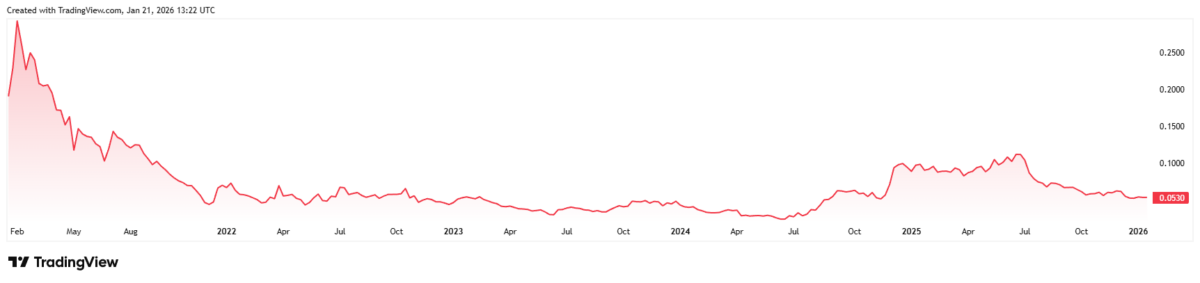
It’s clearly visible that over the five years since the launch of AAVE, ETH has outperformed aave except in the year 2023, which frankly was also not so good for AAVE.
Now an Important question that everyone is curious about. Should you buy AAVE or use Aave?
The answer to this question is simple to state but hard to understand, as Aave plays very different roles depending on how it is used.
Supplying stablecoins turns Aave into an income instrument. Supplying ETH or BTC turns it into a yield-enhanced exposure to volatile assets. Buying AAVE turns it into a bet on how markets will value governance and risk absorption over time.
In every case, however, the protocol itself behaves consistently. It pays for liquidity. It does not pay for ownership. ETH and BTC suppliers earn more than stablecoin suppliers because of the assets moved, not because Aave changed its economics. Token holders earn only when markets decide to reprice control.
Fed back into the broader argument, this reinforces the central conclusion rather than complicating it. Aave determines who gets paid for providing liquidity, not which assets appreciate. The difference between using Aave and buying AAVE is not subtle, and it does not disappear once price exposure is introduced. It becomes clearer.
Also Read: Aave Faces $500M Market Hit Amid DAO and Company Clash