Key Highlights
- Novig sued Missouri’s attorney general and gaming commission leaders on October 16, one day before the state’s deadline to stop offering sports event contracts or obtain state authorization.
- The company argues its contracts qualify as swaps under the Commodity Exchange Act and fall under the CFTC’s exclusive jurisdiction.
- Novig says Missouri’s licensing requirements could undermine its peer-to-peer trading model by restricting the pool of buyers and sellers.
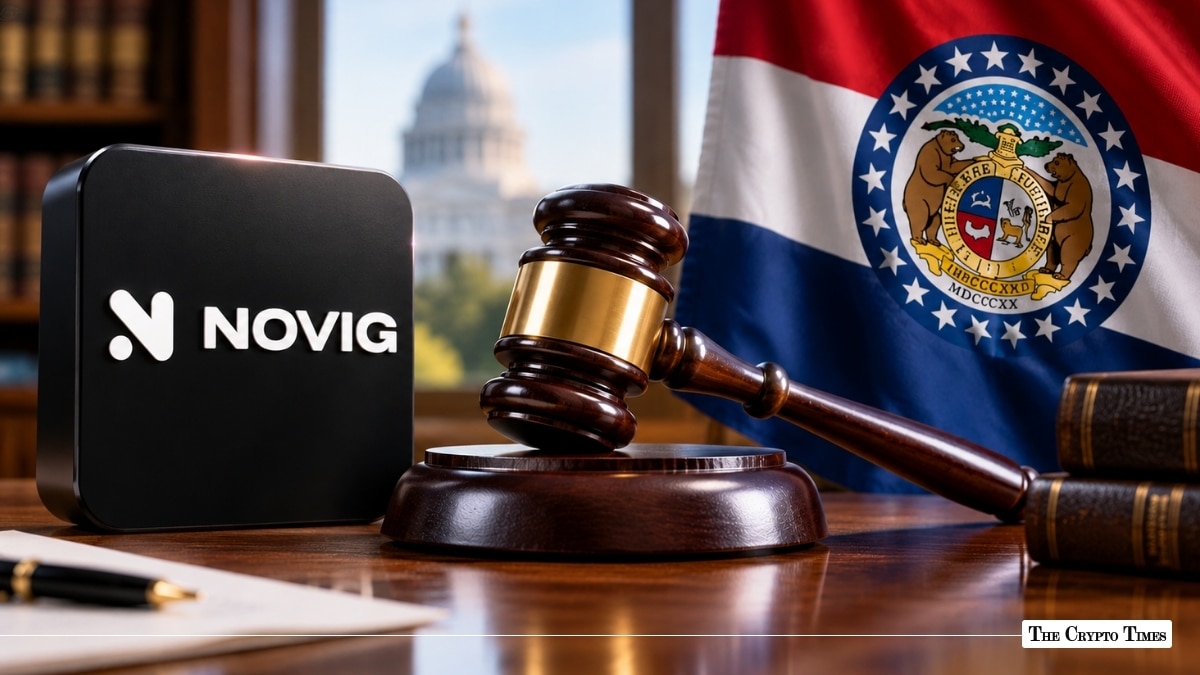
Prediction market operator Novig has sued Missouri officials over the state’s efforts to restrict its sports event contracts, arguing that federal law prevents Missouri from applying its gambling laws to the exchange.
Ludlow Exchange LLC, which operates as Novig, filed the complaint on October 16 in the US District Court for the Eastern District of Missouri. The defendants include Missouri Attorney General Catherine Hanaway, Missouri Gaming Commission Executive Director Michael Lear, and Commission Chair Jan Zimmerman, each named in an official capacity.
Novig filed suit one day before the October 17 deadline to stop offering sports event contracts to Missouri residents or obtain a state gaming license and pay the required taxes and fees.
Missouri orders prediction markets to stop or seek licenses
The lawsuit follows a cease-and-desist letter Hanaway sent to Novig on September 17. The letter gave the company 30 days to stop offering sports event contracts to Missouri residents or obtain authorization from the Missouri Gaming Commission.
Novig was among six companies targeted by the state. The others were Polymarket, Kalshi, Crypto.com, Underdog and Robinhood. Hanaway argued that companies cannot avoid state gambling laws by describing sports bets as event contracts.
The attorney general’s office also raised concerns about age restrictions at five of the six platforms, excluding Novig. Its announcement said those companies either permitted underage access or lacked adequate safeguards to prevent participation by Missouri residents under 21. Novig’s complaint says its rulebook restricts trading to users aged 21 and older.
The available information does not establish whether the other five companies have filed similar lawsuits against Missouri.
Novig argues its sports contracts are federally regulated swaps
Novig argues that its sports event contracts qualify as swaps under the Commodity Exchange Act (CEA), giving the Commodity Futures Trading Commission (CFTC) exclusive jurisdiction over swaps traded on designated contract markets.
Sports betting lawyer Daniel Wallach highlighted the argument in an October 17 post on X, noting that Novig’s complaint describes the contracts as “quintessential swaps” under the CEA. Whether the contracts qualify as swaps for this purpose remains a legal question; the court has not ruled on Novig’s claim.
Novig’s complaint also relies on its CFTC-regulated status to support its argument that federal law preempts Missouri’s enforcement action. The company’s claim that its contracts fall within the CFTC’s exclusive jurisdiction remains subject to judicial review.
Novig argues that state licensing requirements could undermine its peer-to-peer model by restricting trading to Missouri residents and reducing the pool of buyers and sellers available to match orders. The company says users trade against one another rather than against Novig itself, and that it does not take the opposite side of trades or charge a built-in betting margin.
The complaint says Novig is challenging the application of Missouri’s gambling laws to its exchange, not the state’s general authority to regulate gambling.
CFTC Lawsuit against Kentucky adds to the dispute
The Missouri case comes amid a wider dispute over whether federal derivatives law preempts state regulation of prediction markets.
In June, CFTC had sued Kentucky over a 14.25% state tax on prediction market contracts. CFTC Chairman Michael Selig argued that federal law preempts state requirements for contracts within the agency’s jurisdiction. The lawsuit challenged the application of Kentucky’s tax to prediction market operators, including Kalshi and Polymarket.
The two cases address different state measures: the Kentucky lawsuit concerns taxation, while Novig’s case challenges Missouri’s enforcement of gambling laws.
Novig’s complaint cites decisions from the Third and Ninth Circuits supporting federal preemption for certain sports event contracts traded on CFTC-regulated exchanges. In September, the Sixth Circuit reached a different conclusion in a case involving Kalshi, finding that the contracts at issue were not swaps and that federal law did not preempt the relevant state gambling laws.
The Sixth Circuit ruling adds to the legal disagreement over whether federal derivatives law prevents states from regulating sports event contracts. How courts resolve these questions could affect prediction market operators facing similar state enforcement actions.
Novig seeks injunction against Missouri enforcement
Novig is asking the federal court for preliminary and permanent injunctions preventing Missouri officials from enforcing state gambling laws against its exchange. It also seeks a declaration that those laws are preempted when applied to its contracts.
The complaint says enforcement could expose the company to criminal liability, as well as potential penalties under Missouri’s consumer protection and public nuisance provisions.
The lawsuit follows Novig’s efforts to expand its federally regulated peer-to-peer trading model. In February, The Crypto Times reported that the company had raised a reported $75 million at a $500 million valuation as it pursued CFTC approval.
The court has not yet ruled on Novig’s request for an injunction or its argument that federal law preempts Missouri’s enforcement action.
Also Read: ECB’s Lagarde Pushes Digital Euro and Tokenized Settlement at IMF