
Bitcoin (BTC) and Ethereum (ETH) recovered on October 15 after a sharp intraday decline, as hotter-than-expected U.S. producer inflation coincided with nearly $937 million in crypto liquidations over 24 hours.
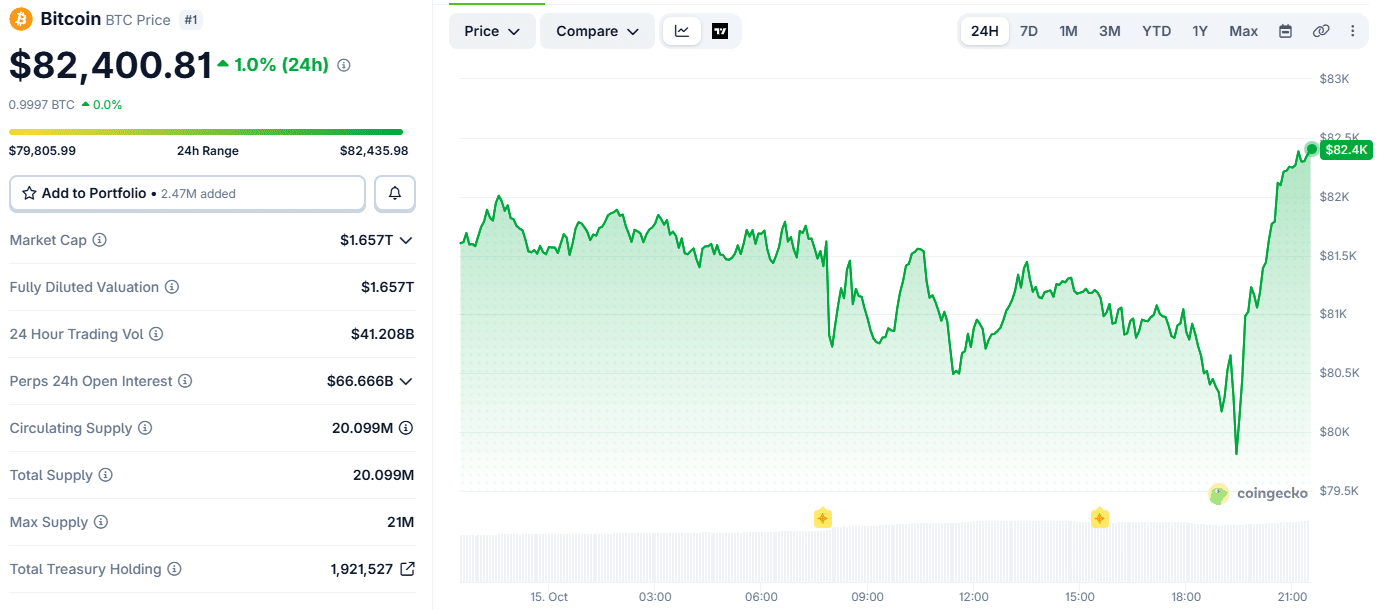
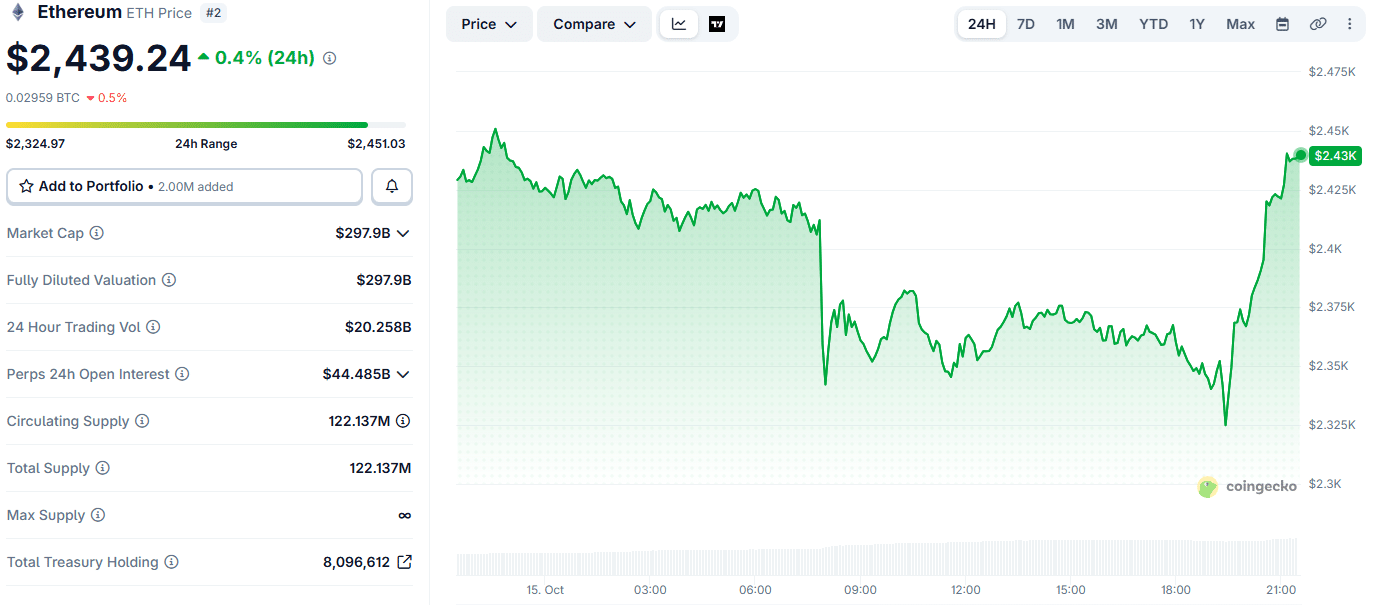
Bitcoin traded at $82,400.81, up 1% over the period, after falling to $79,805.99. Ethereum rose 0.4% to $2,439.24 after reaching an intraday low of $2,324.97, according to data from CoinGecko (on October 15 at 16:00 UTC).
The recovery followed a sharp reduction in leveraged positions. Data from CoinGlass (on October 15 at 16:00 UTC) showed that 176,058 traders were liquidated over 24 hours, with total forced closures reaching $937.06 million. Long positions accounted for $787.18 million, or 84% of the total, indicating that bullish traders absorbed most of the losses during the market decline.
The volatility coincided with the release of September’s U.S. Producer Price Index (PPI), which showed a 1.3% monthly increase. The inflation reading added to concerns about persistent price pressures as traders assessed the outlook for Federal Reserve monetary policy.
US producer inflation accelerates to 1.3%
The U.S. Bureau of Labor Statistics reported that final-demand producer prices increased 1.3% in September, accelerating from a 0.5% rise in August and a 0.2% increase in July.
On an annual basis, producer prices climbed 6.3%, marking the largest 12-month increase since December 2022. Energy costs accounted for much of the monthly advance. Final-demand goods prices increased 2.6%, their largest monthly gain since December 2009, with energy prices rising 10.8%. Gasoline prices jumped 20.3%.
Final-demand services prices also increased 0.8%, supported by a 1.4% rise in trade margins. The producer price index excluding food, energy and trade services advanced 0.5% during the month and 5% from a year earlier.
The data showed that inflationary pressures extended beyond goods, with services and intermediate production costs also recording increases. Higher producer prices can influence expectations for consumer inflation and monetary policy. However, the report alone does not establish how the Federal Reserve will adjust interest rates.
Long positions account for most crypto liquidations
The inflation release coincided with heavy selling across crypto derivatives markets, where leveraged long positions accounted for most forced liquidations.
On October 15 at 16:00 UTC, CoinGlass recorded $937.06 million in liquidations over 24 hours. Long positions represented $787.18 million, compared with $149.88 million in short positions. Ethereum had the largest reported liquidation total among individual assets at $286.20 million, with 83.8% coming from long positions. Bitcoin followed with $214.66 million, of which 80.5% involved bullish bets. Solana recorded $29.30 million in liquidations, while XRP and Dogecoin saw $12.79 million and $12.17 million, respectively.
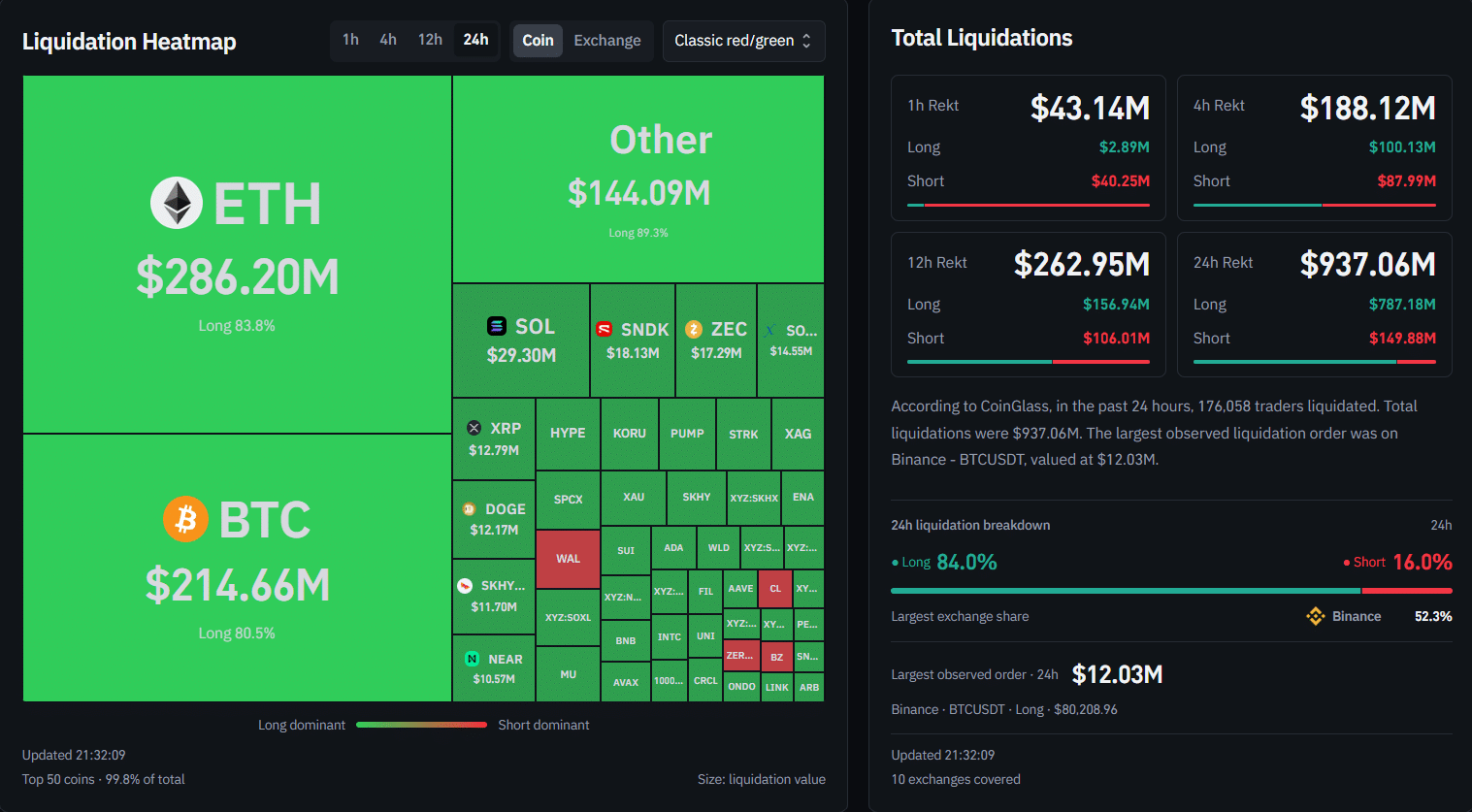
Binance accounted for 52.3% of the reported liquidation volume across the 10 exchanges covered by the dashboard. The largest individual liquidation order was valued at $12.03 million and involved a Bitcoin long position on Binance’s BTCUSDT market, according to data from CoinGlass (on October 15 at 16:00 UTC).
The figures indicate that the sell-off disproportionately affected traders positioned for higher prices rather than those betting on further declines.
Bitcoin and Ethereum rebound from intraday lows
Bitcoin and Ethereum recovered from their respective 24-hour lows, although both remained within ranges marked by sharp intraday volatility.
Bitcoin traded at $82,400.81, gaining 1% over 24 hours after falling to $79,805.99. The asset reached a high of $82,435.98 during the same period, leaving it close to its session peak. Its market capitalization stood at approximately $1.657 trillion, while 24-hour trading volume reached $41.20 billion, according to data from CoinGecko (on October 15 at 16:00 UTC).
Ethereum also moved higher after touching an intraday low of $2,324.97. It traded at $2,439.24, up 0.4% over 24 hours, after reaching $2,451.03. Its market capitalization was approximately $297.9 billion, with daily trading volume of $20.26 billion, according to data from CoinGecko (on October 15 at 16:00 UTC).
The rebound followed the sharp intraday declines, but the available market data does not establish whether short covering, spot purchases, or other trading activity drove the recovery. Both cryptocurrencies remained exposed to changes in interest-rate expectations as investors assessed the latest inflation figures. Moreover, the available market data does not establish that the PPI release directly caused the moves in digital assets.
Also Read: Pump.fun’s PUMP Token Drops 13.7% as Crypto Market Sell-Off Deepens