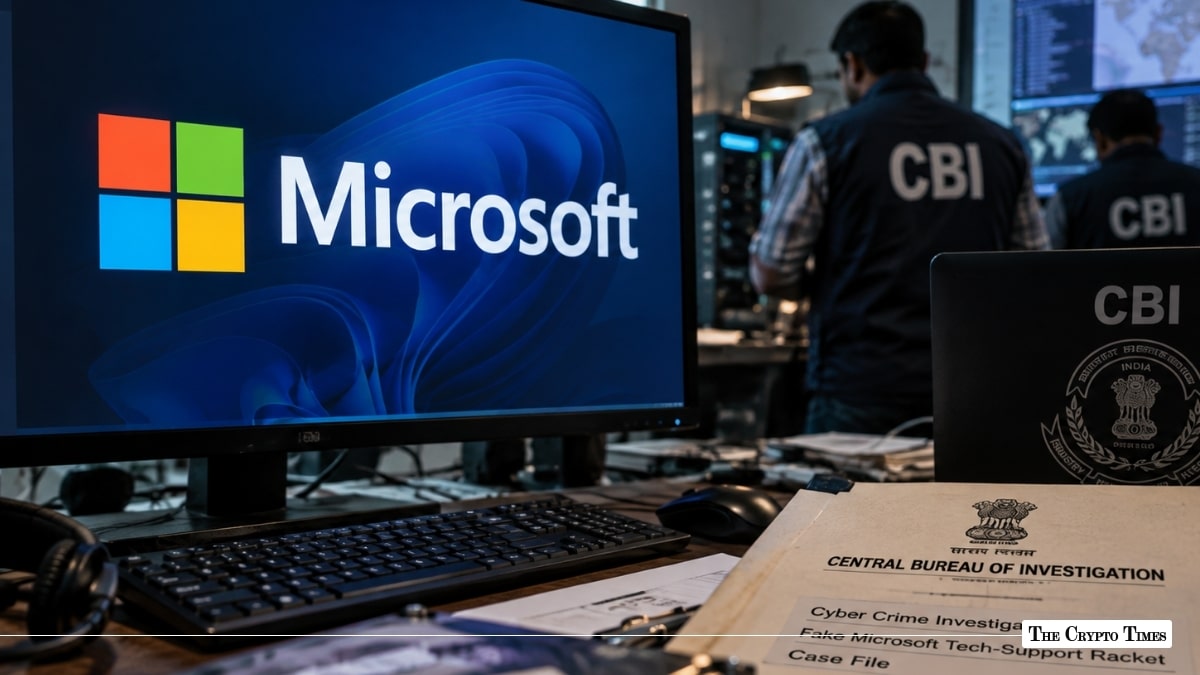
The Central Bureau of Investigation (CBI) has arrested four people in an alleged international tech-support fraud and extortion racket targeting US nationals, according to the agency. Investigators say the group operated through fake call centres and offices in Punjab and Delhi and posed as representatives of Microsoft, financial institutions and law-enforcement agencies.
The CBI said it conducted searches at 10 locations across Punjab and Delhi during the intervening night of August 5 and 6, 2026, including an alleged fake call centre operating from the Mohali premises of Sourabh Rana, whom the agency identified as the alleged kingpin. The other arrested accused were identified as Indermohan Singh, Harneet Singh, and Jappandeep Singh. The agency said the investigation remains ongoing.
The case highlights how traditional tech-support fraud is increasingly intersecting with cryptocurrency payments. The CBI alleges that victims were manipulated into sending cryptocurrency, including through Bitcoin ATMs, before the funds were routed through multiple wallets and transferred out of the US. All four people are accused and have not been convicted. The allegations described by the CBI remain subject to the ongoing investigation and court proceedings.
How the Alleged Scam Worked
According to the CBI, the alleged syndicate used fake computer pop-ups displaying counterfeit Microsoft toll-free numbers. Victims who called the numbers were allegedly connected to operators posing as technical-support personnel.
The agency said the operators also impersonated representatives of financial institutions and law-enforcement agencies. In some cases, victims were allegedly told that their computers or financial information had been compromised. The CBI also said the accused falsely claimed that victims were connected to serious crimes, including child pornography, as part of the alleged extortion scheme.
The alleged objective was to pressure victims into making payments. In cryptocurrency-related cases, the CBI said victims were coerced into making ransom payments through cryptocurrency ATMs. The agency said the cryptocurrency was subsequently routed through multiple wallets and transferred out of the United States before the proceeds were allegedly laundered through operators in Delhi.
The mechanics described by the CBI are consistent with warnings from US authorities. The FBI’s guidance on tech-support scams says scammers can use fake pop-ups and impersonate legitimate companies before demanding money, gift cards or cryptocurrency. The FBI also warns that such scams can involve fraudulent call centres operating across countries.
The Human Cost
The CBI cited two specific US victims in describing the alleged operation.
A Florida resident was allegedly defrauded of about $440,000 in 2022, after being falsely told that her personal and financial information had been compromised and that illegal material had been planted on her computer. The agency said she made multiple deposits through a Bitcoin ATM, with the funds subsequently routed to a wallet address and then to accounts allegedly controlled by the accused.
A New Jersey resident was allegedly defrauded of approximately $130,000 in 2023, according to the CBI. Investigators said she was falsely told that her computer had been compromised and that unknown parties were accessing her banking information before being coerced into depositing funds through Bitcoin ATMs.
During the searches, the CBI said investigators seized more than 20 mobile phones, 15 laptops and tablets, multiple hard drives, pen drives and memory cards, cash, documents and cryptocurrency wallets.
Microsoft was not identified by the CBI as a participant in the scheme. Its name was allegedly used by the fraudsters to impersonate a legitimate technology provider.
Microsoft’s own guidance on technical-support scams says the company does not proactively contact users with unsolicited technical support and that genuine Microsoft error messages do not include a phone number to call.
Why Bitcoin ATMs Were Used
Bitcoin ATMs can allow users to convert cash into cryptocurrency and send the resulting assets to a wallet. That functionality has also made the machines a recurring feature in fraud cases in which scammers persuade victims to withdraw cash and convert it into crypto.
The US Federal Trade Commission has warned that scammers increasingly direct victims to Bitcoin ATMs after falsely claiming that their money is at risk. The FTC says victims may be instructed to withdraw money from bank, investment or retirement accounts and deposit it into a Bitcoin ATM, after which the cryptocurrency is sent to a wallet controlled by the scammer.
The FBI has similarly described cryptocurrency ATMs as a tool used in elder-fraud schemes. In its guidance, the agency says scammers can persuade victims to withdraw large amounts of cash and deposit it into cryptocurrency ATMs before transferring the resulting crypto to other accounts.
That does not mean Bitcoin ATMs themselves are fraudulent. The risk arises when a caller or online contact instructs someone to use a cryptocurrency ATM to “protect” money, resolve an alleged investigation or pay an unexpected fee. The FTC says legitimate businesses and government agencies will not instruct consumers to use Bitcoin ATMs for those purposes.
Part of a Broader Tech-Support Fraud Problem
The CBI’s latest case fits a broader pattern of tech-support and impersonation fraud targeting older Americans. The FBI says tech-support scams typically involve criminals posing as technical or customer-support representatives and claiming that a victim’s computer or account has a problem. Scammers can use pop-ups, unsolicited calls or messages and pressure victims to act quickly.
The FTC has separately reported that losses from business and government impersonation scams among people aged 60 and older have risen sharply. Its 2025 data spotlight said reported losses of more than $100,000 among older adults increased nearly sevenfold between 2020 and 2024.
The Crypto Times has also tracked the intersection of cryptocurrency and cross-border fraud. Its previous coverage includes the CBI’s investigation into a crypto scam targeting senior citizens in the US and Canada, Operation Chakra-V and the seizure of crypto linked to a cybercrime ring, and the arrest of an alleged kingpin linked to crypto scam camps in Myanmar.
More recently, The Crypto Times reported on India’s arrest of 13 people over an alleged fake Apple-support crypto scam and the Enforcement Directorate’s arrest of an alleged crypto-hawala operator linked to a US call-centre scam.
These cases illustrate a recurring law-enforcement concern: cryptocurrency can be used as a payment or transfer mechanism within fraud schemes, while the underlying crime remains an impersonation, extortion or financial-fraud operation.
How to Protect Against Tech-Support and Bitcoin ATM Scams
The warning signs are relatively consistent. Do not call a phone number displayed in an unexpected computer pop-up. Microsoft says genuine error messages do not include phone numbers and that the company does not proactively contact users to provide unsolicited technical support.
Do not withdraw cash or move money because an unexpected caller tells you to “protect” your funds. The FTC specifically warns that legitimate businesses and government agencies will not tell consumers to deposit money into a Bitcoin ATM to resolve a problem.
Do not give remote access to a stranger claiming to be technical support. The FBI recommends refusing unsolicited requests for remote access and independently contacting the company through a trusted website or phone number if there is a genuine concern.
US victims can report internet-enabled fraud through the FBI’s Internet Crime Complaint Center and consumer fraud through the FTC’s ReportFraud.gov. Microsoft also provides a dedicated reporting channel for technical-support scams.
In India, cybercrime can be reported through the government’s National Cyber Crime Reporting Portal or by calling the 1930 cyber-fraud helpline.
Cryptocurrency transactions can be difficult to reverse once funds have been sent, but that does not mean victims should delay reporting. The FBI and FTC both advise victims to report suspected fraud and contact the relevant financial or cryptocurrency service as quickly as possible.