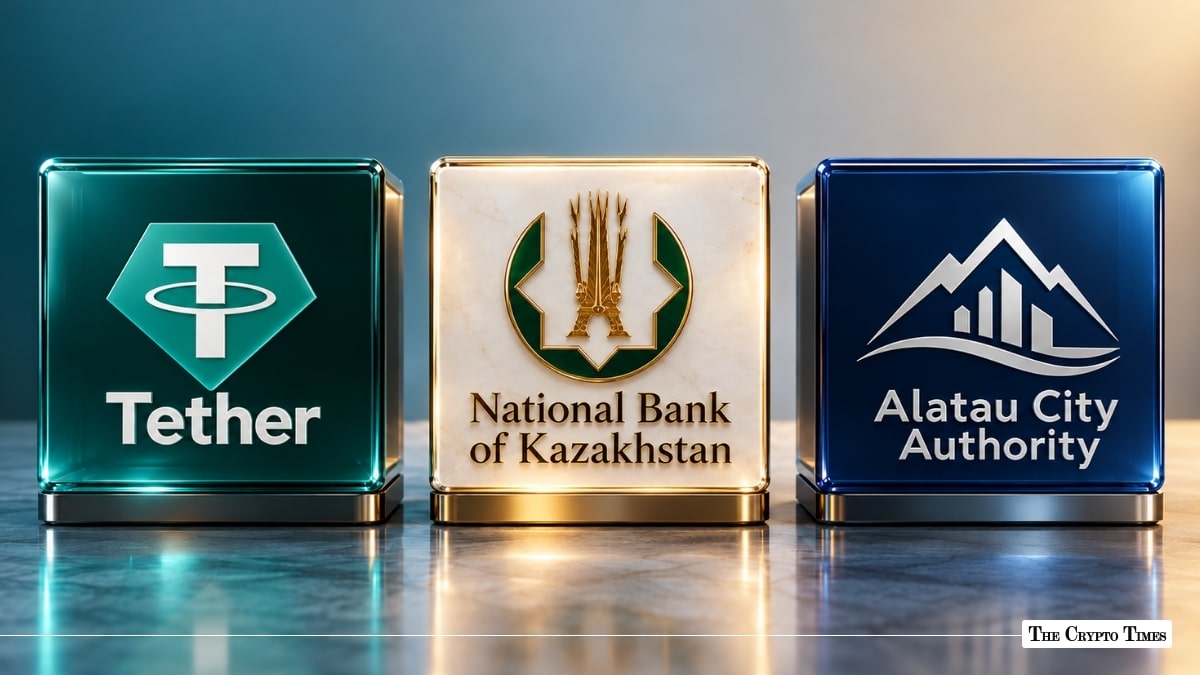
Tether, the issuer of the USDT stablecoin, has signed a Memorandum of Understanding (MoU) with the National Bank of Kazakhstan (NBK) and the Alatau City Authority (ACA). The three parties will study a stablecoin pegged to the Kazakhstani tenge and design an asset tokenization pilot in Alatau, a new city with its own special legal regime.
The agreement was announced on October 7, 2026. It is an exploratory deal. The parties will work on concepts, pilot proposals, and training, and they have not committed to launch a product. Tether issues USDT, a stablecoin designed to hold a 1:1 value against the US dollar. A stablecoin is a cryptocurrency whose price is tied to a reference asset, usually a national currency.
What the Tether, NBK and Alatau MoU Covers
The MoU has three main parts.
1. A tenge stablecoin concept.
The parties will study how other countries issue stablecoins, define possible use cases, and prepare a concept and pilot proposal for a stablecoin pegged to the tenge, Kazakhstan’s national currency.
2. An asset tokenization framework.
Tokenization means representing ownership of an asset, such as a bond, property or commodity, as a digital token on a blockchain. When the asset exists outside crypto markets, it is called a real-world asset (RWA). The parties will pick priority asset categories, design a conceptual tokenization model, and launch a pilot within the jurisdiction of Alatau. They may use Hadron by Tether, the company’s tokenization platform, which Tether launched on November 14, 2024.
3. Training and capacity building.
Tether, the NBK, and the ACA will hold workshops, seminars, and training programs. Topics include the global stablecoin and digital asset market, stablecoin issuance and reserve management, and RWA tokenization using distributed ledger technology (DLT), the shared database system that blockchains run on. The programs are meant for NBK specialists and staff from relevant government agencies.
The parties also said they will explore opportunities in decentralized finance (DeFi), which refers to financial services that run on blockchain-based smart contracts instead of traditional intermediaries.
Who Are the NBK and the Alatau City Authority?
The National Bank of Kazakhstan is the country’s central bank. It sets monetary policy, oversees payment systems, manages currency regulation, and is responsible for financial stability.
The Alatau City Authority runs public administration and regulatory development in Alatau, a planned city in the Almaty Region. The ACA was created as a state fund by presidential decree and, under a constitutional law on Alatau’s special legal regime, became a government body effective July 1, 2026.
The Alatau City Council, chaired by Prime Minister Olzhas Bektenov, has since approved the regulation governing the ACA. The same council listed “Alatau Crypto City” as one of the city’s development tracks, focused on tokenization projects and a Web3 ecosystem. President Kassym-Jomart Tokayev first announced a CryptoCity pilot zone in Alatau in May 2025.
What Tether and the National Bank Said
Tether CEO Paolo Ardoino said digital assets are moving from use cases toward sovereign-level financial infrastructure. He described Kazakhstan’s approach to tokenization and a strategic reserve framework as deliberate and forward-looking, and said the aim is efficient and transparent infrastructure that also protects data and privacy.
Binur Zhalenov, Deputy Governor of the National Bank of the Republic of Kazakhstan, said the central bank will study international practice in stablecoin issuance and RWA tokenization as part of its pilots. He added that financial stability, transaction transparency and investor protection remain the “paramount priority for the National Bank.”
How the Deal Fits Kazakhstan’s Wider Crypto Strategy
The MoU is the latest step in a state-led digital asset program. Kazakhstan already has a tenge stablecoin in testing. Evo (KZTE), issued by local exchange Intebix with Eurasian Bank, Solana and Mastercard, launched in 2025 inside the NBK’s regulatory sandbox for digital assets. The announcement does not say how the new tenge stablecoin concept would relate to Evo.
The NBK also runs the digital tenge, its central bank digital currency (CBDC). A CBDC is issued directly by a central bank, while a stablecoin is usually issued by a private entity and backed by reserves.
On reserves, President Tokayev used his September 8, 2025, state-of-the-nation address to order the creation of a State Digital Asset Fund to build a strategic crypto reserve. The NBK later confirmed that the reserve would sit with the National Investment Corporation (NIC), its investment subsidiary. In March 2026, the central bank said it had set aside $350 million for crypto-linked investments. On September 15, 2026, the government said the National Crypto Reserve had reached $700 million, with about $200 million already invested, mainly through hedge funds.
Kazakhstan has also widened its licensed market. In July 2026, regulators issued the country’s first crypto exchange license under new rules.
For Tether, the deal continues a series of agreements with public and institutional partners. Two weeks earlier, on September 24, 2026, it signed an MoU with Pave Bank and the Global Finance & Technology Network (GFTN) for a fintech education program.
What Remains Unclear
The announcement leaves several key points open:
- No timeline for the tenge stablecoin concept or the Alatau tokenization pilot
- No financial terms or budget
- No detail on who would issue a tenge stablecoin, which blockchain it would use, or how its reserves would be held
- No list of the asset categories chosen for tokenization
- No confirmation that Hadron will be used. The MoU only refers to its potential use
Ardoino’s reference to a “strategic reserve framework” also does not appear among the MoU’s listed work streams, so any role for Tether in Kazakhstan’s crypto reserve is not established by this agreement.
The next indicators to watch are a published concept or pilot proposal from the NBK, rules issued by the ACA under Alatau’s special legal regime, and any decision on the asset classes selected for the first tokenization pilot.
Also Read: Genius Group Restarts Bitcoin Treasury After US Court Lifts Injunction