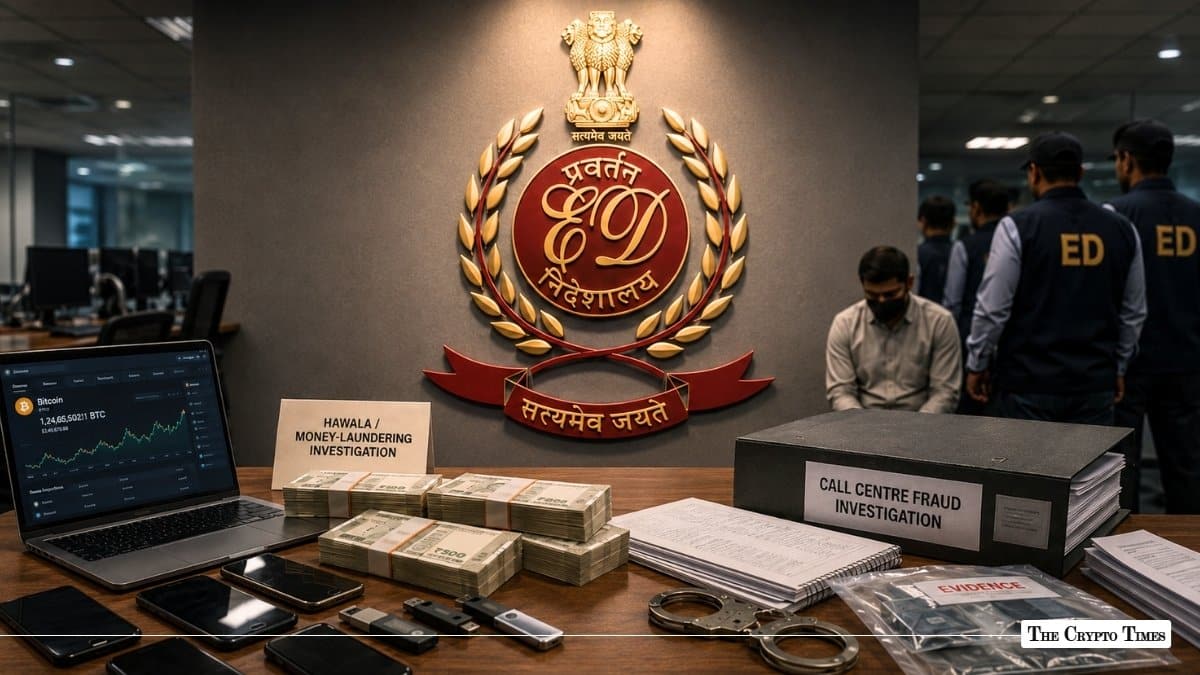
India’s Enforcement Directorate (ED) has arrested Vikas Kumar Nimar, the alleged mastermind behind a transnational fake call centre syndicate that targeted American citizens and funneled the proceeds through cryptocurrency conversions and informal hawala channels to move money back into India.
The arrest, made on July 27 in Hyderabad, adds to a growing list of cases where digital assets have served as the bridge between international cybercrime and domestic money laundering operations.
How the Scam Worked
According to a report by the Times of India, Nimar, who went by the alias “Misty,” ran call centres across Hyderabad, Visakhapatnam, Lucknow, Bihar, Delhi, and Andhra Pradesh. The operation was not a small side hustle. It was a structured cybercrime network with dedicated roles at every stage, from data procurement to fund extraction.
The syndicate bought personal data of US citizens from specialized call vendors and sent out fraudulent emails designed to look like malware alerts, virus warnings, and tech support messages. When panicked victims called the toll-free numbers embedded in these emails, the calls landed at Nimar’s fake call centres, where operators impersonated officials from US government agencies and well-known private companies.
Victims were coerced into purchasing Amazon gift cards or making digital payments under the threat of fabricated legal consequences, pending loans, or tax evasion cases. The pressure tactics were deliberate, leaving victims little time to verify the legitimacy of the callers before parting with their money.
The Crypto-Hawala Pipeline
What makes this case particularly relevant to the crypto space is how the stolen funds were layered to avoid detection.
The gift cards collected from victims were first redeemed and converted into cryptocurrencies, including Bitcoin. Once in crypto form, the funds were moved to India through a combination of crypto exchanges, informal cash settlement mechanisms that investigators describe as resembling hawala operations, and traditional banking channels.
This hybrid model of crypto-to-hawala laundering is not new to Indian enforcement agencies. The ED has flagged it repeatedly in recent months, from narcotics pipelines running through Dubai to fake investment platforms using shell companies and peer-to-peer transfers. But the call centre syndicate model is distinct because crypto was not the product being sold. It was purely the laundering tool, used to obscure the trail between gift card fraud in the United States and cash distribution in India.
Once converted into Indian currency, the proceeds were distributed among the operators, controllers, and beneficiaries of the syndicate. Nimar allegedly funneled a portion of the money through a company called VC Solutions, where large cash deposits and suspicious credits were recorded in bank accounts.
To make the income appear legitimate, he reportedly filed income tax returns declaring the earnings as profits from grocery trading and other purported business activities. Investigators found no evidence of any corresponding legitimate business.
Earlier Searches in Ahmedabad
The arrest of Nimar builds on groundwork laid earlier this year. In February 2026, the ED’s Hyderabad Zonal Office conducted searches at six locations in Ahmedabad linked to the same case. During those raids, officials traced cryptocurrency worth $12,000 from another accused, Aqib Ghulam Rasool Ghanchi, and transferred it to the ED’s official crypto wallet. The agency also seized Rs 13.5 lakh in cash, recovered digital evidence, and froze 31 bank accounts along with one bank locker.
Other accused identified in the case include Mohammed Ansari, Divyang Raval, and Pradeep V Rathod. The investigation was initiated under the Prevention of Money Laundering Act (PMLA) based on an FIR filed at Hyderabad’s Madhapur police station. The Central Bureau of Investigation (CBI) had also registered a separate case based on inputs received from the US Embassy through Interpol.
Following his arrest, Nimar was produced before the court and sent to judicial custody. The ED has said it is continuing to examine the roles of other accused, the broader movement of funds, and the full extent of cryptocurrency transactions involved.
Part of a Broader Pattern
The case fits squarely into a pattern that India’s financial crime watchdog has been tracking with increasing urgency. ED Director Rahul Navin, speaking at the agency’s 70th anniversary event earlier this year, specifically named crypto fraud as a top enforcement priority alongside terror financing and cyber-enabled crimes.
The numbers back that up. In just the past few weeks, the ED has busted a Rs 303 crore cyber fraud ring with a crypto trail leading to Dubai, seized Rs 3.35 crore in digital assets during 19 coordinated raids across Tamil Nadu and Kerala, arrested three suspects in a Rs 500 crore Korvio Coin Ponzi scheme, and launched a $35 million probe into OTC crypto scams involving self-styled key opinion leaders.
Separately, a Cyberabad police operation recently busted a similar fake call centre in Hyderabad that was targeting Australian citizens, with the illegally acquired funds also being routed through hawala networks and cryptocurrency transactions. That syndicate allegedly moved Rs 8 to 10 crore over two years.
India’s Directorate of Revenue Intelligence has also noted in its latest annual report that cryptocurrency and stablecoins are increasingly replacing traditional hawala networks in drug and gold smuggling operations, calling digital assets a “potent tool” for smuggling syndicates.
For an industry trying to move past its association with illicit finance, cases like these present a double challenge. They show that crypto’s speed and pseudonymity continue to attract bad actors, even as India’s enforcement machinery develops more sophisticated tools to trace and freeze digital assets. The ED’s ability to identify and transfer $12,000 in crypto from an accused’s wallet directly into its own official wallet during the Ahmedabad searches is one example of that growing capability.
The investigation remains ongoing.
Disclaimer: This article reports on publicly available information. All allegations described herein are those made by investigative authorities and have not been adjudicated by a court of law. Entities and individuals named are presumed innocent unless and until proven guilty.
Also Read: Indian CFO Loses ₹79L to Matrimonial App Pig Butchering Crypto Scam