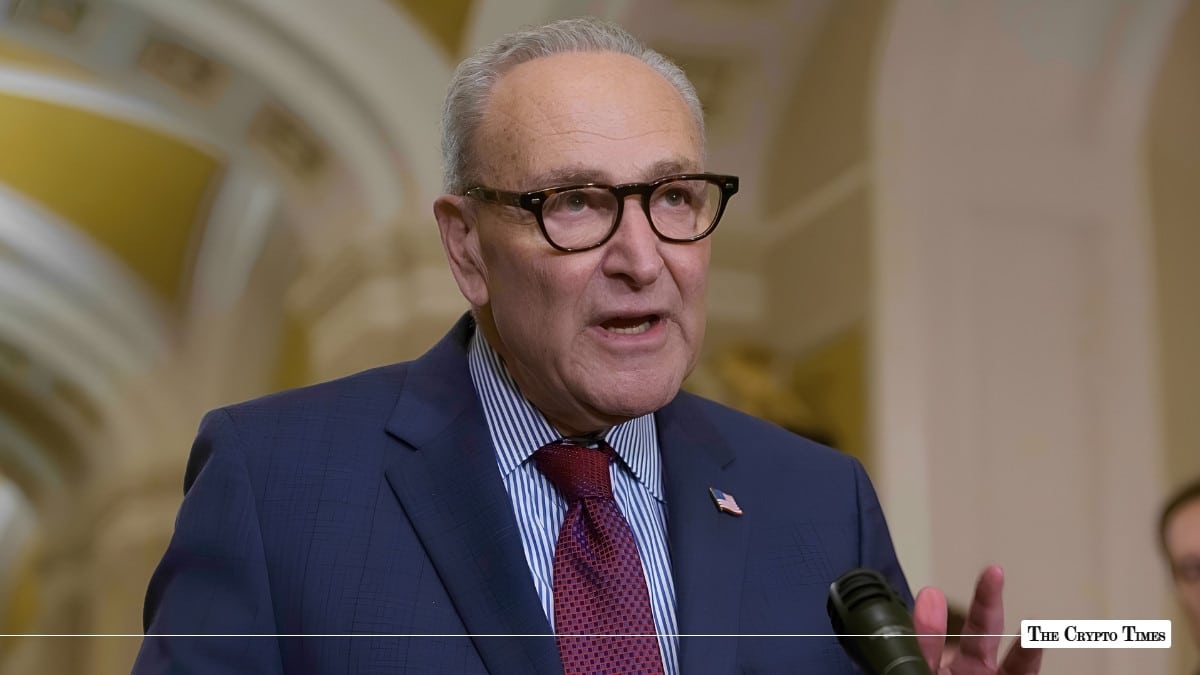
Senate Democratic Leader Chuck Schumer (D-NY) on July 30 introduced the Anti-Corruption Bureau Creation Act, a bill that would establish an independent federal agency to investigate executive-branch corruption and recover money that officials obtain through it. Democrats framed the measure as a direct response to what they describe as President Donald Trump’s use of public office for private gain, a case in which the Trump family’s cryptocurrency ventures are named explicitly.
While Schumer’s press release leads with imagery of “gilded ballrooms” and “luxury jets,” the bill’s own text is specific about crypto. Its congressional findings state that the alleged gains come “from various, and extremely lucrative, cryptocurrency ventures,” and single out World Liberty Financial by name. The measure is unlikely to become law, Republicans control both chambers of Congress, which sharply limits its path forward, but it sharpens the Democratic case in which digital assets are the leading example.
What the bill would do
According to Schumer’s office, the Anti-Corruption Bureau Creation Act would create a new agency led by a seven-member, Senate-confirmed board with fixed terms and partisan-balance requirements, designed to be insulated from presidential interference. The bureau would hold investigative, subpoena, oversight and enforcement powers, and would be able to issue public reports.
Its most novel feature is a claw-back mechanism (detailed below) that would let private plaintiffs and state attorneys general sue to recover money obtained through corruption. The legislation would also consolidate three existing bodies, i.e. the Federal Election Commission, the Office of Government Ethics and the Office of Special Counsel, under the new bureau, create a three-judge panel of the D.C. Circuit empowered to appoint temporary members if a president tried to disable it, and fund it through a dedicated “Freedom From Influence Fund” intended to shield its budget from retaliation.
The bill is co-sponsored by Senators Jeff Merkley (D-OR), Alex Padilla (D-CA), and Andy Kim (D-NJ), and endorsed by watchdog groups including Public Citizen, Common Cause, the Campaign Legal Center, CREW and Protect Democracy.
The Democratic framing, and the figures behind it
The bill’s findings are pointed. They state that Trump has “earned not less than $2,000,000,000 since returning to the White House in 2025 according to a recent financial disclosure,” and that, per an estimate the bill attributes to The New Yorker, Trump and his immediate family “have made more than $4,000,000,000 exploiting the presidency.” Schumer separately said no president should be able to treat the White House “like a personal ATM.” These are the bill’s and Schumer’s characterizations, presented as congressional findings rather than adjudicated fact.
Independent tallies vary and measure different things. In a recent letter, Warren put Trump’s 2025 crypto income at roughly $1.4 billion based on his federal financial disclosure, as The Crypto Times reported. CNBC reported Trump disclosed at least $2.24 billion in 2025 revenue, including hundreds of millions tied to crypto. Reuters has reported the family’s crypto businesses generated billions in proceeds, and Forbes estimated Trump’s net worth reached about $6.5 billion in 2026, up from roughly $2.3 billion before he took office. These are different measures — income, revenue, proceeds and net worth are not interchangeable — and they come from a mix of news outlets and partisan sources, so the numbers do not line up into a single agreed total.
The bill’s headline enforcement tool is a claw-back mechanism modeled on whistleblower-style “qui tam” suits: it would let private plaintiffs and state attorneys general sue in the name of the United States over corrupt personal enrichment above $50,000, reaching conduct back to January 20, 2025, with penalties including disgorgement and up to treble damages. Successful plaintiffs would keep between 15% and 30% of what is recovered.
Why this is a crypto story
The crypto dimension is written into the bill itself. In its Title I findings, the legislation asserts that the Trump family holds “more than $1,000,000,000 in this crypto fund that is tied to foreign governments,” identifies that fund as World Liberty Financial, and states that a United Arab Emirates-backed purchase of a 49% stake “funneled $187,000,000 to the Trump family.” The bill also reaches into existing crypto law: among its technical amendments, it rewrites references in the GENIUS Act, the stablecoin framework enacted in 2025, so that ethics oversight tied to that law would fall under the new Anti-Corruption Bureau.
That places the bill inside a year-long Democratic focus on the Trump family’s crypto interests — the decentralized-finance venture World Liberty Financial, the $TRUMP memecoin, and the USD1 stablecoin. Senator Elizabeth Warren (D-MA) has called for a Securities and Exchange Commission (SEC) probe of World Liberty Financial and co-sponsored the End Crypto Corruption Act, which would bar the president, vice president, lawmakers and their families from issuing or profiting from digital assets.
That fight also has a live legislative venue: the CLARITY Act, the market-structure bill that would set rules for most U.S. crypto activity. As The Crypto Times has covered, the bill has stalled in the Senate largely over an ethics provision meant to address the president’s crypto holdings; a provision Democrats say is too weak, and Republicans and the White House say is historic. Schumer’s anti-corruption bureau is best understood as a broader companion to that narrower, crypto-specific dispute.
The Trump and Republican response
Trump and the White House reject the corruption framing. Trump has defended his ventures publicly, stating there was “nothing illegal” or “wrong” with them, and the White House has repeatedly said his assets are held in a trust managed by his children and that his business interests “do not create conflicts of interest.”
On the crypto-specific ethics question, Republicans and the administration argue they have already acted. A White House official later told media that Trump agreed to what it called “the most comprehensive and wide-ranging ethics provision in history” in the CLARITY Act, language that would bar public officials and their spouses from issuing or sponsoring digital assets while in office. Critics counter that the provision excludes the president’s adult children who run the family’s crypto firms, sunsets in 2029, and assigns enforcement solely to the Department of Justice rather than to state attorneys general. Both characterizations are contested, and neither has been tested in law.
What happens next
As a practical matter, the Anti-Corruption Bureau Creation Act faces steep odds. With Republicans holding majorities in the House and Senate, Democratic-sponsored legislation of this kind is unlikely to reach the floor, and the bill is, for now, more a statement of the party’s position than a measure with a clear route to passage. Its introduction does, however, signal that Democrats intend to keep the Trump family’s crypto profits at the center of their 2026 messaging.
For crypto markets, the more consequential near-term question remains the CLARITY Act’s ethics clause, which continues to hold up the most significant U.S. crypto-regulation effort to date. How that provision is ultimately written, and who is empowered to enforce it, will matter more to the industry than a bureau bill that is unlikely to advance.
Also Read: The Donald Trump Crypto Presidency: Power, Policy, and $2.3 Billion