The BLAST token, the native asset of the Ethereum scaling network Blast, fell more than 44% in 24 hours after the project said it will wind down its network. The team cited ongoing costs that exceed the revenue the chain generates.
What Blast Announced
Blast announced the wind-down on X at 14:45 UTC (Coordinated Universal Time) on October 2, 2026. The team said it built the chain to be self-sustaining, but that the economics of operating it “no longer make sense”. It added that it does not see a credible path to making the network economically sustainable.
Blast is an Ethereum Layer 2 (L2) network. An L2 processes transactions away from the Ethereum mainnet, the base blockchain, and posts the resulting data back to it, which is meant to lower fees and speed up transactions.
The network was created by Tieshun “Pacman” Roquerre, co-founder of the NFT (non-fungible token) marketplace Blur. The project raised $20 million in funding led by Paradigm and Standard Crypto, as announced in November 2023.
BLAST Price Analysis
BLAST traded at $0.0002242 at the time of writing, down 44.5% over 24 hours, according to CoinGecko. The token also fell 43.2% against Bitcoin (BTC) over the same period. Its 24-hour range ran from a low of $0.0002128 to a high of $0.0004124.
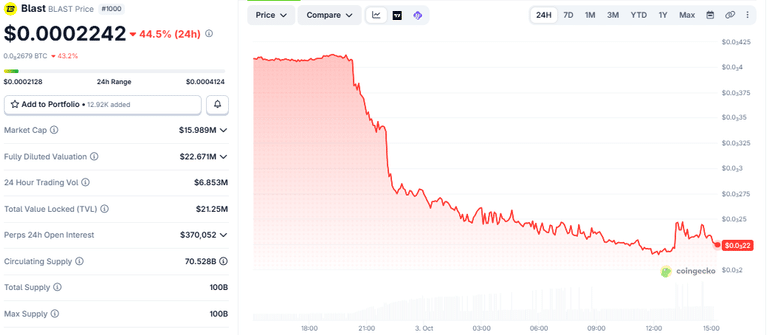
The token’s market capitalization stood at $15.989 million, and CoinGecko ranked it at #1000. Its fully diluted valuation (FDV), which values all tokens at the current price including those not yet in circulation, was $22.671 million. The 24-hour trading volume was $6.853 million.
Circulating supply was 70.528 billion BLAST, against a total and maximum supply of 100 billion. Open interest in BLAST perpetual futures, derivatives contracts with no expiry date, was $370,052.
Figures differ between data providers because of different sources and update times. CoinMarketCap showed BLAST near $0.0002448, down 39.67% over 24 hours, in a separate reading on October 3.
CoinMarketCap lists an all-time high of $0.5223 for BLAST, recorded on June 26, 2024. At $0.0002242, the token trades more than 99.9% below that level.
Blast TVL and Network Activity
Total value locked (TVL), the value of assets deposited in a network’s decentralized finance (DeFi) applications, was $21.25 million, according to CoinGecko. DeFi refers to financial services such as lending and trading that run on blockchains without traditional intermediaries.
That compares with a peak above $2 billion in June 2024, when Blast’s activity was at its height.
Withdrawal Timeline for Blast Users
Blast asked users to move their assets to Ethereum mainnet, including balances held in the Blast PWA (progressive web app). The team said it will cut the withdrawal delay to 24 hours, but it will first unwind positions held in Lido, a liquid staking protocol where users stake ETH (Ether) and receive a tradable token in return. The unwind is expected to take about one week, and withdrawals are paused during that period.
Users can keep using the normal Blast interface until October 26, 2026. After that date, assets remain withdrawable, but holders must interact directly with the Blast bridge contracts on Ethereum. The team said it will publish instructions before the deadline.
Blast’s canonical bridge held about $63.03 million as of 16:39 UTC on October 2, according to data from DeFiLlama. The canonical bridge is the official contract that locks assets on Ethereum while they are used on Blast. That figure covers bridged assets and is separate from DeFi deposits on the chain.
South Korean exchanges Upbit and Bithumb designated BLAST a trading-caution asset after the announcement, citing sustainability concerns and the end of mainnet operations.
The announcement does not set a redemption value for BLAST. The token was the native asset of the network that is now being shut down as operating costs exceed revenue. Market participants will be watching trading volume and the pace of withdrawals ahead of the October 26 interface cutoff.
Also Read: SAND Price Surges 62% as Upbit, Bithumb and Coinone Lift Sandbox Trading Warning