Key Highlights
- Aave (AAVE) rose 9.32% in 24 hours to $183.24, with trading volume reaching $708 million, up 64.78% from the previous period.
- The token’s market capitalization stood at $2.82 billion, while Aave’s total value locked reached $17.75 billion.
- AAVE traded between $165.37 and $186.67 during the 24-hour period, with a fully diluted valuation of $2.93 billion.
AAVE, the native cryptocurrency of the decentralized Aave protocol, rose 9.32% over the past 24 hours to trade at $183.24, according to CoinMarketCap data (on October 2 at 15:00 UTC). The token’s market capitalization stood at $2.82 billion, reflecting the same 9.32% increase. Trading volume reached $708 million, up 64.78% from the prior period, while the volume-to-market-cap ratio stood at 25.16%.
According to the CoinMarketCap data (on October 2 at 15:00 UTC), the 24-hour price range extended from a low of $165.37 to a high of $186.67. Fully diluted valuation measured $2.93 billion. Total value locked in the protocol totaled $17.75 billion, with a market-cap-to-TVL ratio of 0.159. Circulating supply was listed at 15.43 million AAVE out of a total supply of 16 million tokens.
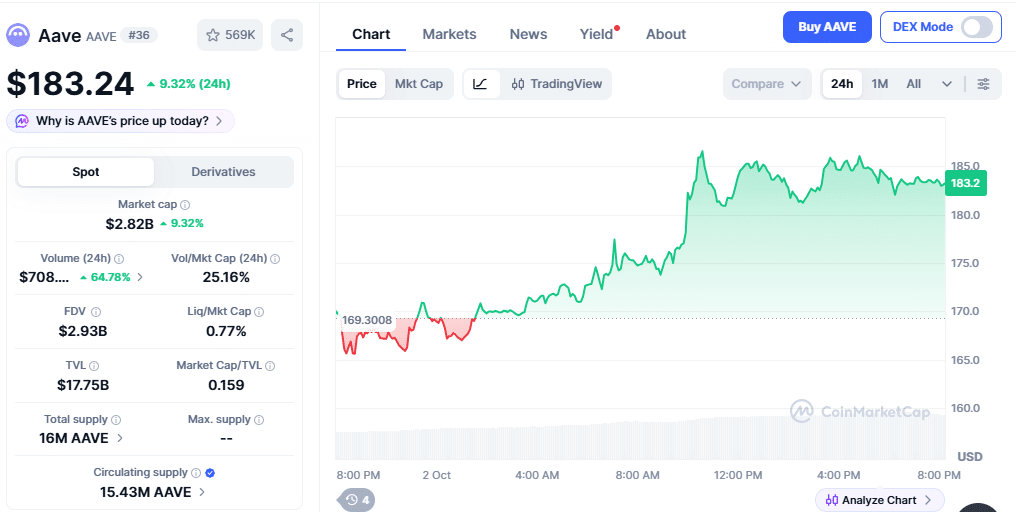
AAVE Price Momentum on October 2 at 15:00 UTC | Source: CoinMarketCap
Chart data showed the price advancing from levels near $169 earlier in the session before reaching $183.24. The token remains 72.56% below its all-time high of $666.86, recorded on May 19, 2021. Its all-time low dates to October 3, 2020, according to data from CoinMarketCap.
Founder’s comments on European regulation
The price movement came as Aave founder Stani Kulechov addressed recent European regulatory positions on stablecoin yield and decentralized finance.
In an X post on Friday, Kulechov said he was disappointed by the European Central Bank’s and European Banking Authority’s responses to the Markets in Crypto-Assets (MiCA) consultation.
Kulechov said the authorities advocated a prohibition on paying yield on stablecoins and restrictions on crypto-asset service providers offering access to DeFi protocols, including those providing yield on non-MiCA-authorized stablecoins. He noted the absence of a clear framework for how access to DeFi should operate in practice.
The founder added that the responses suggested crypto-asset service providers should limit DeFi access to certain user groups through suitability tests, along with a potential certification regime for DeFi lending protocols. Kulechov stated it remained unclear how these requirements would function and warned that determining suitable protocols for European users could produce outcomes different from open DeFi.
He said such measures risked creating walled gardens that undermine the liquidity and network effects of open financial networks, limiting Europeans’ ability to access methods to grow and preserve wealth. Kulechov described the proposals as consumer-protection measures but said excessive restrictions could create friction for innovation and slow development of open, transparent, and auditable financial infrastructure.
Aave Labs submission to MiCA review
Aave Labs submitted a 57-page response, dated September 30, to the European Commission’s review of MiCA. In a separate X post, Kulechov said the company argued that on-chain finance brings access and transparency that legacy financial rails lack. He said Europe’s financial system should be built around DeFi, stablecoins, and tokenization to provide new financial infrastructure for European users.
The submission said MiCA was largely designed around the first generation of crypto markets, including issuers, exchanges, and custodians. Aave Labs argued that the next phase of financial infrastructure will increasingly involve onchain lending, collateral, settlement, and savings. A central point in the document is that regulators should not automatically treat open-source protocols like centralized financial intermediaries.
Kulechov noted that U.S. regulators, including the Securities and Exchange Commission (SEC) and the Commodity Futures Trading Commission (CFTC), have taken a more pragmatic approach toward enabling onchain financial innovation. He said European regulators should place users and their interests at the center of the framework and allow banks and other incumbents to adapt to an increasingly onchain economy rather than relying on restrictions that could increase costs and reduce access.
The founder said onchain finance, including stablecoins, DeFi, and tokenized securities, has the potential to reshape financial infrastructure by reducing friction, increasing transparency, and expanding access to financial opportunities. European consumers and businesses could benefit if companies building this infrastructure can continue to operate and compete from within Europe.
Also Read: Zondacrypto Probe Deepens as Poland Forms Seven-Prosecutor Team