Key Highlights
- According to Grayscale, its AI-focused crypto sector gained 54% in September, compared with a 24% rise for the broader crypto market.
- Grayscale’s research note said NEAR gained 183%, followed by Venice (VVV) at 70%, World (WLD) at 47%, and Bittensor (TAO) at 37%.
- The AI category remains Grayscale’s smallest crypto sector, with a market value of about $15 billion.
Grayscale’s AI-focused crypto sector gained 54% in September, outperforming the broader digital asset market during the month as the firm examined potential links between artificial intelligence (AI) and blockchain infrastructure.
According to a research note published by Grayscale Head of Research Zach Pandl on October 2, the firm’s Artificial Intelligence crypto sector gained 54% during September, compared with a 24% increase for the broader crypto market.
AI crypto sector outperforms broader market
Grayscale highlighted four tokens in its latest research based on their September performance:
- NEAR: +183%
- Venice (VVV): +70%
- World (WLD): +47%
- Bittensor (TAO): +37%
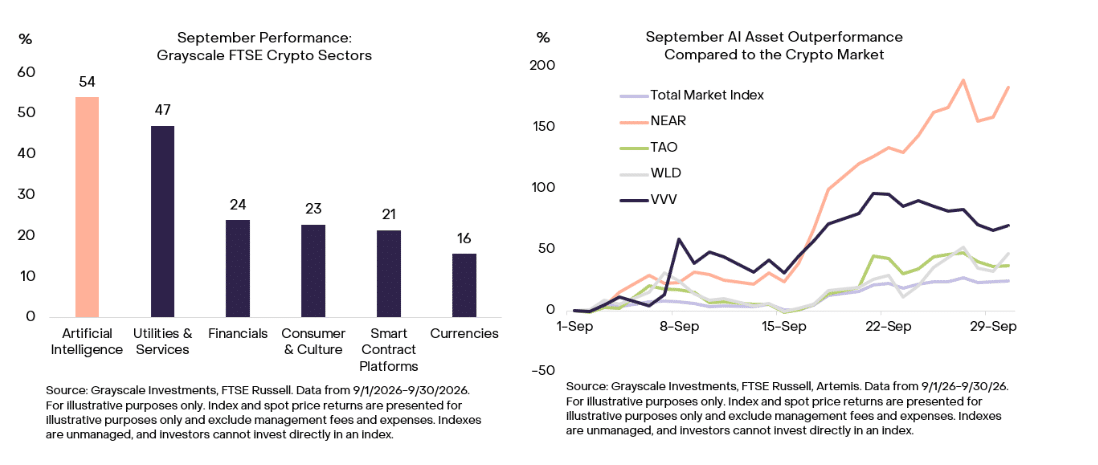
The figures reflect September market performance and do not establish whether those gains will continue. The AI category remains relatively small compared with Grayscale’s other crypto sectors, despite its stronger performance during the month.
Blockchain could support AI agents
Pandl’s latest research focuses on infrastructure requirements that could emerge as AI systems become more autonomous. He argued that artificial intelligence could become one of the most consequential technologies of the 21st century, while development remains concentrated among a relatively small number of companies.
According to Pandl, public blockchains could complement centralized AI systems through agent payments, identity, private computing and verifiable records. The idea is that AI agents may eventually need to make payments, interact with digital services and establish records that can be independently verified.
These remain potential use cases rather than established sources of blockchain demand.
Grayscale builds on earlier AI research
The latest report builds on Grayscale’s August research, which examined how AI adoption could create demand for public blockchain infrastructure.
That report identified agentic finance, verifiable digital records, and decentralized AI as areas where the technologies could overlap. Grayscale said AI agents may eventually require programmable wallets, automated payments, micropayments, and on-chain reputation systems.
The earlier research also examined blockchain-based records for AI computation, digital identity, and reputation, while discussing decentralized AI networks as an alternative to infrastructure concentrated among a small number of companies.
The October report extends that research by examining the performance of AI-focused crypto assets during September.
AI sector remains small
At approximately $15 billion, Grayscale’s AI category remains the smallest of its six crypto sectors. The firm said it believes the sector could produce one or more significant projects over the next five years. That is a forward-looking assessment from Grayscale rather than an indication that any particular project will succeed.
The category covers several different types of applications rather than a single blockchain use case.
AI tokens target different use cases
The projects highlighted by Grayscale represent different approaches to AI and blockchain.
Grayscale described NEAR as a platform focused on agentic commerce.
Bittensor operates an open network of specialized AI-related subnets spanning areas such as inference, agents, data, and computing resources.
World focuses on proof-of-human infrastructure, while Venice is a privacy-focused AI application designed to provide access to AI models without storing users’ prompts or responses.
The projects represent different applications within Grayscale’s AI category rather than a single technology or use case.
Fed policy provides separate macro context
Grayscale’s AI analysis follows the firm’s September assessment of monetary policy and crypto markets.
After the Federal Reserve raised its benchmark rate to 3.75%-4% in September, Pandl described the move as a “mid-cycle adjustment” and said one or two additional rate hikes would not necessarily produce the same change in crypto capital allocation seen during the 2022-23 tightening cycle.
That analysis focused on monetary policy and near-term crypto markets, while the October report examines the longer-term relationship between AI adoption and blockchain infrastructure.
AI adoption remains the longer-term question
The September rally does not by itself show that blockchain-based AI applications are already generating widespread real-world demand.
AI-related tokens can move on expectations about future applications before those applications reach significant adoption.
Grayscale’s longer-term argument is that increasingly autonomous AI systems could create demand for programmable payments, digital identity, verifiable records, and decentralized computing.
Whether those potential use cases translate into sustained blockchain activity will depend on factors including transaction costs, scalability, privacy, regulation and adoption.
For now, Grayscale’s latest research links September gains in AI-focused crypto assets with a longer-term thesis about potential blockchain applications as AI systems become more autonomous.
Also Read: Kalshi Reports 84% Chance Fed Holds Rates in October