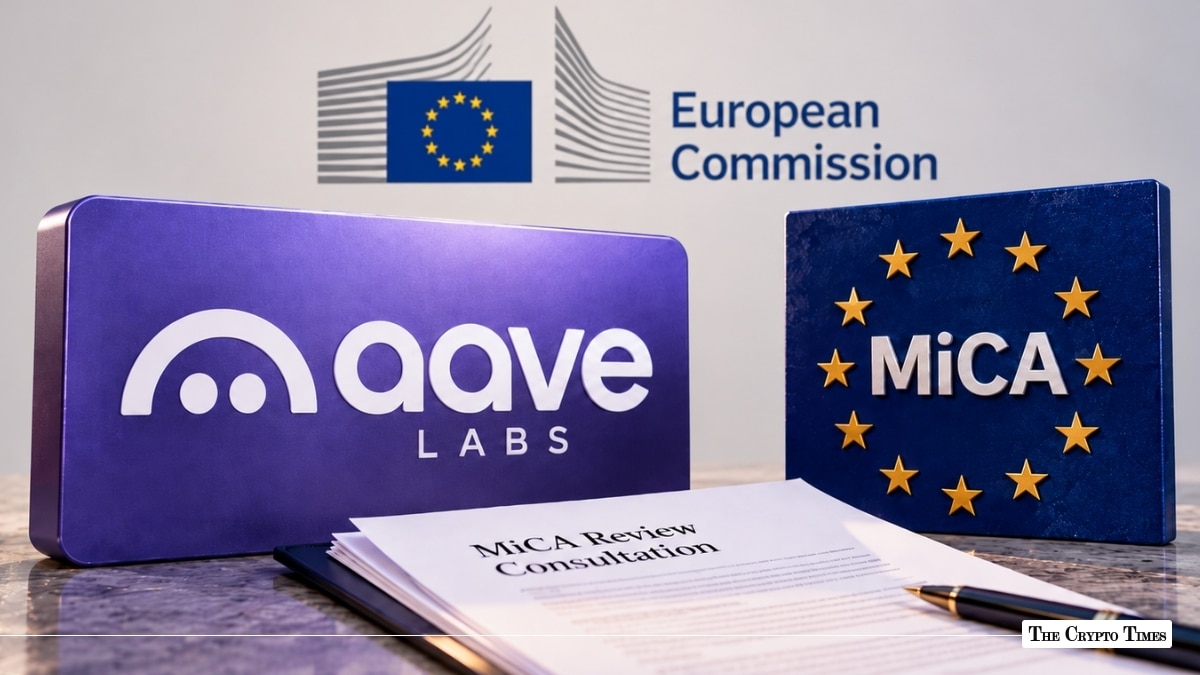
Aave Labs has submitted its response to the European Commission’s review of the Markets in Crypto-Assets Regulation (MiCA), calling for a regulatory framework that accommodates decentralized finance (DeFi), stablecoins, and tokenization.
In a post on X, Aave founder and CEO Stani Kulechov said the company had submitted its response to the consultation and argued that “onchain finance brings access and transparency that legacy financial rails lack today.”
Kulechov added that Europe’s financial system should be built around DeFi, stablecoins, and tokenization, which he said could provide new financial infrastructure for European users.
The 57-page Aave Labs submission, dated September 30, says MiCA was largely designed around the first generation of crypto markets, including issuers, exchanges, and custodians. The company argues that the next phase of financial infrastructure will increasingly involve onchain lending, collateral, settlement, and savings.
Aave wants intermediaries regulated, not software
A central argument in Aave Labs’ submission is that regulators should not automatically treat open-source protocols like centralized financial intermediaries.
The company says an identifiable legal person that controls an activity and exercises ongoing discretion over users, terms or assets should be regulated. But open-source software that executes rules disclosed in advance should not automatically be treated as a regulated financial intermediary.
“Technology is an instrumentality,” Aave Labs wrote in its response. The company said developers who neither control user assets nor exercise discretion over a service should not be treated as intermediaries. It also distinguished this model from custodial crypto lenders that take customer assets and re-lend them on opaque terms.
Aave Labs pointed to its subsidiary Push Virtual Assets Ireland, which is authorised as a crypto-asset service provider by the Central Bank of Ireland under MiCA, as an example of an intermediary that can fall within the regulatory framework.
Stablecoin lending returns
Aave Labs also opposed extending MiCA’s restrictions on stablecoin interest payments to lending and staking.
The company argues that returns generated when borrowers pay to use stablecoins are different from interest paid simply for holding a stablecoin. In its view, the borrower is paying a market price for access to the asset while the lender retains a claim recorded through the protocol.
Aave asked the European Commission to clarify that lending returns paid by borrowers and staking rewards are not covered by MiCA’s prohibition on interest for stablecoin holders.
The company said extending the restriction could reduce the usefulness of MiCA-authorized stablecoins, limit treasury and liquidity-management tools for institutions and make euro stablecoins less competitive against dollar-based alternatives.
The position differs from that of the European Banking Authority (EBA), which has recommended that the MiCA review consider regulating crypto-asset lending, including activities linked to DeFi. The EBA has also raised concerns about potential regulatory-arbitrage and consumer-protection risks associated with crypto-asset lending.
Circle has also called for changes to MiCA’s stablecoin framework in its response to the same European Commission consultation. The company recommended preserving multi-issuance, which would allow stablecoins to be issued through both EU-authorized and foreign-regulated entities and continue serving users across different markets.
The European stablecoin market is also seeing new bank-led initiatives. Qivalis, a consortium of 37 banks across 15 European countries, plans to issue a euro-backed stablecoin on Ethereum under the MiCA framework. The project is still awaiting regulatory approval in the Netherlands.
Self-Custody and tokenized assets
Aave Labs also called for self-custody to remain available to European users, arguing that people should be able to hold, use and lend their own digital assets without an intermediary.
“Self-custody is not a regulatory blind spot,” the company said. The submission cited Article 17 of the EU Charter of Fundamental Rights and noted that existing anti-money-laundering requirements can apply when self-custodial wallets interact with regulated firms. Aave proposed using reporting requirements, controls at regulated service providers and onchain analytics to address supervisory concerns.
The company also called for a clearer legal framework for tokenized assets, particularly around ownership, transfers and insolvency. Aave Labs said differences between national property systems can create uncertainty around onchain collateral.
The company proposed an optional EU-level framework that would give ledger entries clearer legal effect. It also aims to protect good-faith buyers and provide greater certainty in insolvency cases.
Aave Labs also wants Europe to maintain access to global stablecoin liquidity and allow different forms of digital money, including tokenized deposits and stablecoins, to operate alongside central bank money.
Aave calls for open European markets
Aave Labs said public blockchains can give regulators real-time visibility into positions, collateral and liquidations. It proposed tools such as blockchain analytics, observer nodes, machine-readable risk disclosures and embedded-supervision pilots to help authorities monitor onchain markets directly.
The company said these approaches could provide a regulatory framework suited to decentralized finance rather than applying rules designed for traditional intermediated financial systems.
Aave Labs’ submission is part of the stakeholder input being considered in the European Commission’s broader review of MiCA. The Commission said the consultation is intended to assess whether MiCA remains fit for purpose following its initial implementation and developments in crypto-asset markets.
The company said it is prepared to work with the European Commission, European Supervisory Authorities, and European Central Bank as the review progresses.
Also Read: SEC Proposes Tailored Crypto Custody Rules for Advisers and Funds