The Sandbox (SAND) price climbed 62.5% in 24 hours to October 3, 2026, after three major South Korean crypto exchanges, Upbit, Bithumb, and Coinone, lifted the trading caution designations they had placed on the token in August.
The labels followed the August 22 exploit of SAND’s cross-chain bridge, and their removal restored deposits and withdrawals for Korean holders after roughly six weeks.
SAND traded at $0.07678 at press time on October 3, according to data from CoinGecko, up 62.5% over 24 hours and 65.7% against Bitcoin (BTC).
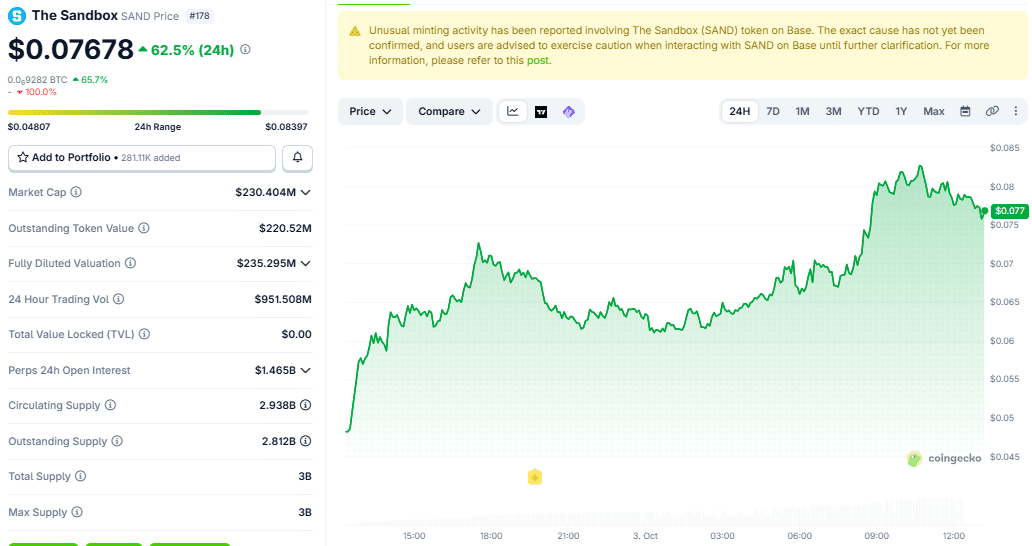
The token moved between a 24-hour low of $0.04807 and a high of $0.08397, a 74.7% swing from bottom to top, and sat 8.6% below that peak at the time of writing.
SAND is the native utility and governance token of The Sandbox, a blockchain-based virtual world where users own land, build games, and trade digital assets. CoinGecko data showed a market capitalization of $230.40 million, ranking SAND No. 178, with 24-hour trading volume of $951.51 million. That volume equals about 4.1 times the token’s market value. Circulating supply stood at 2.938 billion SAND against a maximum supply of 3 billion.
Why Upbit, Bithumb, and Coinone lifted the SAND warning
All three exchanges removed their designations on October 2. Bithumb said in its official notice that it judged the grounds for the trading caution label to have been resolved, and scheduled SAND deposits and withdrawals to resume at 16:00 Korea Standard Time (KST), or 07:00 Coordinated Universal Time (UTC), the same day.
Upbit, South Korea’s largest exchange by trading volume, posted on its official X account that the investment warning period for SAND had been lifted. Upbit had applied the warning to its SAND/KRW (Korean won) and SAND/BTC pairs on August 24, a step that put the token under formal review and raised the risk of delisting by early October. Coinone also removed its label and set transfers to restart at 16:00 KST.
A trading caution designation is a review status Korean exchanges apply when a listed token faces unresolved risks, such as a security incident. At the end of the review, an exchange can lift the label, extend it, or end trading support for the token. The exchanges said explanations and public materials provided by The Sandbox had resolved the concerns behind the August labels.
Spot trading of SAND on the Korean venues had largely continued during the review. What returned on October 2 was the ability to move SAND on and off the exchanges, along with the removal of a label that had kept delisting on the table.
What triggered the August trading caution
The Sandbox said in an August 22 statement that an attacker exploited a flaw in its bridge configuration on Base, the Ethereum layer-2 network incubated by Coinbase, and BNB Smart Chain (BSC). The attacker minted unbacked SAND on those networks without a matching deposit on Ethereum. The project disabled bridging to both networks, told users not to buy, sell, or trade SAND on Base or BSC, and said Ethereum and Polygon balances were not affected.
The project’s August 27 post-mortem put the withdrawal from its Ethereum vault at 14,742,341.84 SAND, worth about $697,000 at the time. The bridge was closed at the contract level at 05:26 UTC on August 22, and no SAND left the vault after 02:21 UTC that day. The Ethereum supply of SAND remained at 3 billion tokens.
On-chain security firm Blockaid had flagged roughly $49 billion in face-value SAND minted across more than 400 transactions while the attack was active. That figure reflects paper value, not cash stolen, since most of the minted tokens were stranded once the bridge was shut.
The Sandbox then set out a 1:1 compensation plan for wallets that held legitimately bridged SAND on Base or BSC before the incident. According to its post-mortem summary, eligible holders are paid in Ethereum SAND from the treasury with no new tokens minted, based on snapshots at Base block 50,283,176 and BSC block 117,321,965. Upbit and Bithumb users were to be handled through the exchanges.
SAND liquidations hit $13.47 million as shorts get squeezed
The rally forced out traders on both sides of the derivatives market. A liquidation occurs when an exchange forcibly closes a leveraged position because the trader’s margin can no longer cover losses.
CoinGlass data showed $13.47 million in SAND liquidations over 24 hours, of which $8.71 million, or 64.7%, came from short positions betting on a decline. Long positions accounted for $4.76 million. SAND posted the sixth-largest single-asset total on the CoinGlass 24-hour heatmap, behind Ethereum (ETH), Bitcoin, Zcash (ZEC), XRP, and Solana (SOL).
The balance flipped as SAND eased from its high. In the hour to 07:42 UTC on October 3, SAND led all assets with $323,210 in liquidations, of which $250,590, or 77.5%, were longs. That single token made up about 18% of the $1.80 million liquidated across the entire crypto market in that hour. Market-wide 24-hour liquidations stood at $428.84 million across 96,996 traders.
Leverage remains heavy. CoinGecko listed SAND perpetual futures open interest, the total value of outstanding contracts not yet closed, at $1.465 billion. That is about 6.4 times the token’s market capitalization, a ratio that leaves the price exposed to further forced selling or buying in either direction.
What the SAND rally does not change
The October move reflects restored access on Korean exchanges, not new activity inside The Sandbox metaverse. It does not reopen the Base or BSC bridge, and The Sandbox’s instruction not to trade SAND on those networks still stands.
CoinGecko continued to display a caution on its SAND page on October 3, stating that unusual minting activity involving SAND on Base had been reported and advising users to take care with SAND on Base until the cause is clarified.
The reopening of deposits also means Korean holders can now move SAND onto exchanges to sell. Whether buyers absorb that potential supply, with open interest several times larger than the token’s market value, is likely to shape SAND’s price in the sessions ahead.
Also Read: Canary Amends PEPE ETF Filing as Token Price Drops Nearly 7%