
Bitcoin (BTC), the largest cryptocurrency by market value, slipped back to about $84,600 on October 3, 2026, after a rally on October 2 carried it close to $87,100 and then faded. The reversal triggered about $433.6 million in forced closures across the crypto derivatives market over 24 hours, and traders who had bet on higher prices absorbed roughly three-quarters of those losses.
A liquidation happens when an exchange forcibly closes a leveraged trading position because the trader’s margin, or collateral, can no longer cover losses. A long position profits when price rises, and a short position profits when price falls. When a rally fails, leveraged longs are the positions most exposed.
Bitcoin Price Trades Closer to Its 24-Hour Low
Data from CoinGecko, reviewed at 06:00 Coordinated Universal Time (UTC) on October 3, showed Bitcoin at $84,635.62, a decline of 1.6% over 24 hours. The 24-hour range ran from a low of $83,898.29 to a high of $87,085.81.
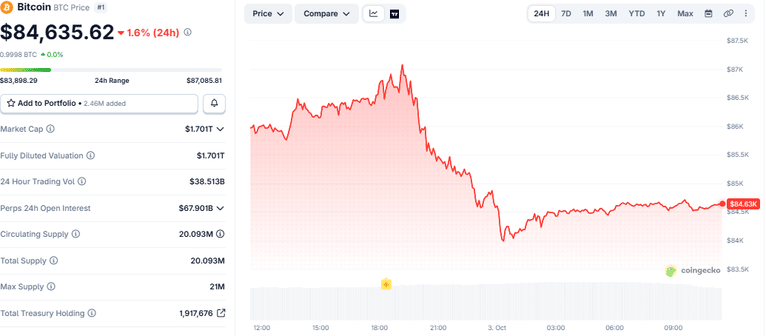
At that price, Bitcoin sat at $2,450.19, or about 2.8% below its 24-hour high and $737.33 above its 24-hour low. The CoinGecko intraday chart shows the price climbing through October 2, peaking at around 13:30 UTC, and then falling sharply until shortly before 19:00 UTC. Since then, Bitcoin has moved in a narrow band just under $85,000.
CoinGecko listed Bitcoin’s market capitalization, the total value of all coins in circulation, at $1.701 trillion. Spot trading volume over 24 hours stood at $38.513 billion. Circulating supply was 20.093 million BTC, against a fixed maximum supply of 21 million BTC.
U.S. Jobs Data Arrived Before the Peak
The rally developed around a key U.S. data release. The U.S. Bureau of Labor Statistics (BLS) reported on October 2 at 12:30 UTC that nonfarm payrolls rose by 29,000 in September, while the unemployment rate stood at 4.2%.
The figure came in well below the 84,000 forecast, according to CNBC, and traders priced in a high probability that the Federal Reserve (Fed), the U.S. central bank, would keep interest rates unchanged at its meeting later in October.
Bitcoin opened October 2 at $84,849.93 and rose to $86,459.67 that morning. CoinGecko’s chart places the top of the move roughly an hour after the BLS release. The timing is notable, although price data alone does not establish that the jobs report caused the peak or the reversal that followed.
The October 2 move extended an advance that The Crypto Times tracked as Bitcoin’s fourth quarter opened with price holding in the mid-$80,000s but still short of a confirmed breakout.
Crypto Liquidations Reach $433.57 Million, Longs Take 74%
CoinGlass liquidation data, reviewed at 11:32 IST (06:02 UTC) on October 3, showed total crypto liquidations of $433.57 million over 24 hours. Long positions accounted for $321.77 million, or about 74.2%, and short positions accounted for $111.80 million.
According to CoinGlass, 100,263 traders were liquidated during the period. The largest single liquidation order was an ETHUSDT position on Binance, valued at $4.51 million. ETHUSDT is a trading pair that prices Ethereum (ETH) against Tether’s USDT stablecoin.
The shorter windows show when the damage occurred. CoinGlass recorded:
| Window | Total | Longs | Shorts |
|---|---|---|---|
| 1 hour | $1.62M | $738.15K | $878.11K |
| 4 hours | $10.66M | $5.66M | $5.00M |
| 12 hours | $222.39M | $201.52M | $20.87M |
| 24 hours | $433.57M | $321.77M | $111.80M |
The 12-hour window, which covers the final leg of the decline into the low, carried $201.52 million in long liquidations against $20.87 million in shorts. That puts longs at about 90.6% of the total for the period. The 1-hour and 4-hour windows were small and close to balanced, which points to a market that has stopped forcing positions out for now.
Bitcoin and Ethereum Lead Liquidations by Asset
Ethereum and Bitcoin carried the largest liquidation totals on the CoinGlass heatmap. Ethereum liquidations stood at just over $105 million, while Bitcoin liquidations totaled $103.68 million, or nearly a quarter of the market-wide figure.
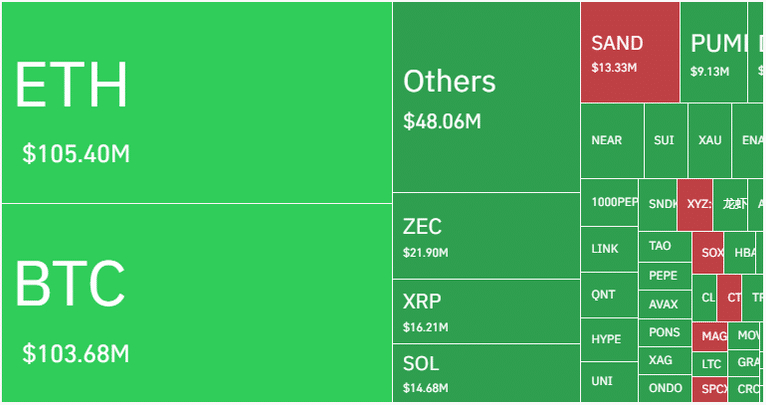
In Bitcoin, long liquidations reached $74.50 million and short liquidations reached $29.18 million. Longs were about 2.6 times larger than shorts.
After the two largest assets, CoinGlass listed the combined “Others” category at $48.06 million, Zcash (ZEC) at $21.90 million, XRP at $16.21 million, and Solana (SOL) at $14.68 million. The Sandbox (SAND) recorded $13.33 million and was shaded red on the heatmap, the color CoinGlass uses for shorts, indicating that short liquidations made up the larger share of that token’s total.
Leverage Remains High Relative to the Price Move
Open interest (OI) measures the total value of outstanding derivatives contracts that have not been closed or settled. Data shows Bitcoin’s perpetual futures open interest at $67.901 billion. Perpetual futures are derivatives contracts with no expiry date and are the main instrument traders use to take leveraged positions in crypto.
That level equals about 4% of Bitcoin’s $1.701 trillion market capitalization. Against a 1.6% daily price decline, it suggests that a large amount of leveraged positioning remains open even after the overnight liquidations. When leverage stays elevated, a sharp move in either direction can trigger another round of forced closures.
Spot Bitcoin ETF Flows Turned Positive on October 1
Demand from spot Bitcoin exchange-traded funds (ETFs), which hold actual BTC on behalf of investors, has been mixed this week. Data from SoSoValue, cited by The Crypto Times, showed U.S. spot Bitcoin ETFs recorded a net outflow of $148.7 million on September 30, followed by a net inflow of $102.67 million on October 1.
BlackRock’s iShares Bitcoin Trust (IBIT) led that day with $195.57 million in new inflows. Flow data for October 2, the day of the rally and the reversal, was not included in that report.
Bitcoin Price Analysis: Key Levels to Watch
The 24-hour low at $83,898.29 is the first level the market is watching. As long as Bitcoin holds above it, the decline remains a pullback within the recovery that began in the third quarter. A sustained move below that level would confirm the $87,085.81 peak as a lower high, a pattern in which each rally fails below the previous one. In that case, the next cluster of liquidations would likely sit below the market rather than above it.
On the upside, Bitcoin would need to reclaim the $87,000 level before the October 2 breakout attempt can be treated as more than a brief test of resistance. The Crypto Times noted earlier this week that Bitcoin had already faded from a run toward $87,000 in late September, which makes this the second rejection near that zone in about two weeks.
For now, Bitcoin is consolidating between $84,000 and $85,000 rather than trending. The next major macro event on the calendar is the Fed’s Federal Open Market Committee (FOMC) meeting on October 27 and 28, where policymakers will set the direction of U.S. interest rates.
Also Read: Bitcoin Price Prediction for October 2026: $40K Bottom Risk Vs Low-$80K Hold