Key Highlights
- Polygon burned 100 million POL, worth about $10.12 million, permanently removing it from circulation.
- The burn came from accumulated transaction fees, with the 100 million POL representing about 1% of the token’s total supply.
- POL remains under market pressure, down 6.46% on the day but still nearly 10% higher over the past week.
Polygon has permanently burned 100 million POL, worth about $10.12 million, in its first major burn under the network’s new burn system.
Polygon Foundation CEO Sandeep Nailwal confirmed this in a post on X on September 23, 2026, saying the tokens had been permanently removed from supply through a transaction on Polygon.
“BURN COMPLETE: 100 MILLION POL (~1% of POL total supply) IS OFFICIALLY BURNED PERMANENTLY,” he said.
He also shared an image showing the 100 million POL transfer. The transaction was marked successful and took place on September 23, with the tokens sent from an address beginning with “0xDEAD” to the Polygon POL token contract.
The 100 million POL represents about 1% of the token’s total supply. Once tokens are burned, they cannot be used again. In simple terms, the coins are sent to a place designed to make them unusable, taking them out of circulation permanently.
The tokens came from fees
The burn did not come from Polygon simply deciding to take 100 million POL from a general treasury. Instead, the tokens had built up through Polygon’s transaction-fee system. This is an important part of how the new burn system works.
According to a recent blog post by KuCoin exchange, When people make transactions on Polygon, they pay fees in POL. Those fees are split into different parts. One part is called the base fee, while another part is the priority fee. The base fee is collected for burning, while priority fees are used to pay block producers or validators.
Over time, the base fees have added up in Polygon’s fee collector. Before this first major burn, the collector held around 121 million POL. Burning 100 million POL therefore removes most of the POL that had already built up there.
Polygon has used an EIP-1559-style fee system since January 2022, so burning part of its transaction fees is not a completely new idea. What has changed is the way Polygon now handles the larger amount of POL that has accumulated and how future burns can be carried out.
The new system is also designed to reduce the need for Polygon’s team to handle every burn themselves. After the required contracts and approvals are completed, any community member can call the burn function when a burn is available. Future burns are expected to happen on a quarterly basis as more base fees build up.
That means the process is linked directly to activity on the network. More transactions can lead to more base fees being collected, and those accumulated fees can later be removed from the POL supply through the burn system.
POL token faces market pressure
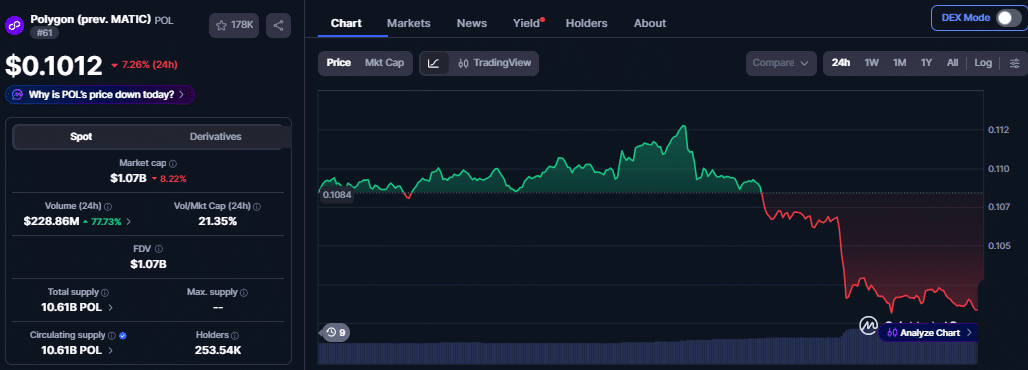
However, this comes as POL itself is facing pressure despite the overall crypto market recovery. According to data from CoinMarketCap as at 7:34 a.m. UTC, POL, formally MATIC is down 6.46% today. The token is still up nearly 10% in a week.
The token is currently trading for $0.1014 with its market cap sitting at $1.07 billion in value. Its 24-hour trading volume was around $228.83 million, after increasing by more than 77%.
The burn therefore puts a large amount of POL permanently out of circulation while also showing how Polygon plans to handle future burns. Rather than treating the process as a one-time event, the new system connects token burns to transaction fees collected from activity on the network.
Also Read: XRP Ledger Moves Closer to Native Lending With New Upgrade