Citigroup will begin offering tokenized deposit remittance services to Japanese corporate clients as early as the end of 2026, marking the first cross-border blockchain-based payment product from a foreign lender aimed at companies in Japan.
The service will enable round-the-clock transfers of foreign currency funds between Japan and five overseas Citi markets, including during nights, weekends, and public holidays.
The plan was outlined by Shahmir Khaliq, global head of services at Citi, in remarks reported by Nikkei on September 9, 2026. According to the Nikkei Asia English edition, corporate clients will be able to move funds between Japan and Citi hubs in the United States, the United Kingdom, Singapore, Hong Kong, and Ireland by selecting the token option on the bank’s existing payment instruction screen. Citi will retain administrative and risk management responsibilities for the transactions.
Product Scope and Corridor Design
Tokenized deposits are digital representations of ordinary commercial bank deposits recorded on a permissioned distributed ledger. The instrument keeps the holder’s claim on the issuing bank intact, which distinguishes it from stablecoins that are typically issued by non-bank entities and backed by reserves held separately from the banking system.
Citi moves roughly $6 trillion in funds daily across its network, of which tokenized deposit volume currently accounts for around $1 billion per day, according to the report. Japan is treated by the bank as one of its five most important markets globally. The stated next phase is broader Asia Pacific coverage followed by cross-bank tokenized deposit transfers extending outside Citi’s own network.
Underlying Platform Already Live in Other Markets
The Japan rollout will run on Citi Token Services for Cash, a permissioned blockchain platform that has been operational for institutional clients outside Japan since 2024. The system moves tokenized balances between participating Citi branches without waiting for traditional settlement cutoffs.
The platform’s footprint has expanded in stages. In September 2025, Citi connected Token Services to its 24/7 USD Clearing rail, enabling dollar payments to reach respondent banks outside the operating hours of the Federal Reserve Wire Network (Fedwire) and the Clearing House Interbank Payments System (CHIPS).
Euro capability and a Dublin, Ireland booking centre were added in November 2025, extending earlier live markets in the United States, the United Kingdom, Singapore, and Hong Kong. In July 2026, Siam Commercial Bank became the first respondent bank live on the integrated 24/7 USD Clearing and Token Services setup.
Interoperability work has advanced in parallel. Citi joined a 17-bank blockchain ledger pilot operated by the Society for Worldwide Interbank Financial Telecommunication (SWIFT) in July 2026. The pilot is built on the Hyperledger Besu framework and records payment commitments among issuing banks. On 5 September 2026, DBS Bank and Citi completed a weekend dollar transaction between Singapore and New York on that shared ledger.
Japan’s Existing Tokenized Money Framework
Japan already regulates yen-denominated stablecoins under the Payment Services Act (PSA), with issuance restricted to licensed banks, trust companies and registered fund transfer providers. Custody of these tokens requires registration with the Financial Services Agency (FSA), and amendments tightening reserve asset requirements were scheduled to take effect in June 2026.
Domestic tokenized deposit initiatives have advanced alongside stablecoin activity. DeCurret DCP operates the DCJPY network, a permissioned tokenized deposit platform whose earliest issuing partner was GMO Aozora Net Bank.
Japan Post Bank has said it plans to issue DCJPY in fiscal 2026 for uses that include security token settlement. Mitsubishi UFJ Trust and Banking’s Progmat platform allows multiple Japanese lenders to issue deposit tokens on shared infrastructure under the amended PSA.
Policy momentum has strengthened in 2026. In May, Japan’s Liberal Democratic Party (LDP) released a strategy paper that treated stablecoins and tokenized deposits as core financial infrastructure, cautioning that dollar-based stablecoins could dominate cross-border settlement without domestic alternatives.
Three months later, the FSA, Ministry of Finance, Bank of Japan and market operators began studying blockchain-based settlement for equities and Japanese government bonds, with tokenized central bank reserves under review for the wholesale settlement leg.
Citi’s product does not compete with these domestic yen systems. It is a foreign bank cash service for corporates that already maintain Citi accounts, aimed at foreign exchange and cross-border liquidity rather than domestic yen payments.
Cross-Bank Interoperability Track
Whether Citi’s Japan service remains confined to Citi accounts or extends to other institutions depends on two parallel infrastructure efforts. The Swift ledger functions as an orchestration layer, with participating banks continuing to issue tokenized deposits on their own ledgers while the shared infrastructure records payment commitments. Final interbank settlement continues to occur through existing systems.
A separate track is being developed through The Clearing House. Wall Street Journal reporting in June 2026 identified JPMorgan Chase, Bank of America, Citigroup, and Wells Fargo as participants in a shared tokenized deposit network targeting the first half of 2027, with internal working names reported as “the bridge” and “the chain.”
Wider Digital Asset Roadmap
Citi has framed tokenized bank money as part of a larger settlement thesis. Its June 2026 research note Tokenization 2030: Wall Street On-Chain placed a base case estimate of $5.5 trillion on tokenized real-world assets by 2030 and characterized bank-issued digital cash and stablecoins as underlying settlement infrastructure. The bank has also confirmed plans to add institutional Bitcoin custody later in 2026 under a Custody+ suite, a product line separate from Token Services.
Market Position
Citigroup shares closed at $137.72 on September 4, 2026 on the New York Stock Exchange, giving the bank a market capitalization of approximately $231.02 billion.
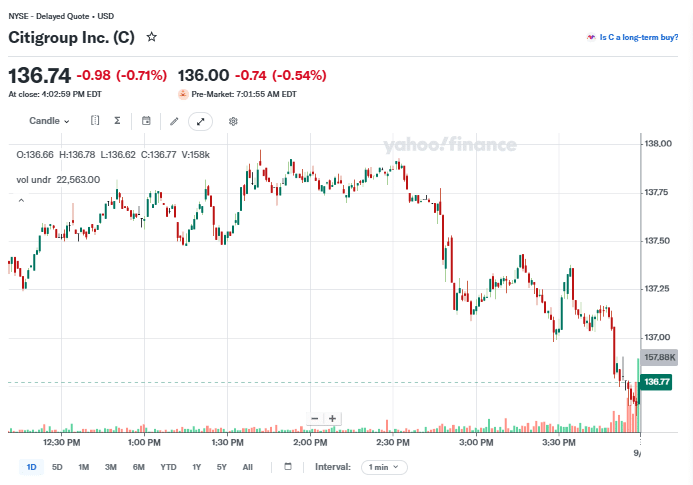
The stock has gained 19.80% year to date and 44.86% over the past year, outperforming the S&P 500 over both periods. The average analyst price target stands at $154.50, with a low of $129 and a high of $176.
Open Details
Several elements of the Japan rollout have not yet been disclosed. No official product name, fee structure, currency list, or client eligibility criteria were released alongside the Nikkei report. Launch clients were not identified, and the end of 2026 timing remains dependent on internal build stages, Japanese regulatory processes, and client onboarding.
The five-country corridor is limited to Citi-to-Citi movements. Transfers involving non-Citi Japanese banks would require the SWIFT and Clearing House interoperability layers that remain in development. Tokenized deposits and yen stablecoins also remain legally distinct instruments under Japanese law, and the planned service concerns bank-issued deposit tokens on Citi’s permissioned ledger rather than any public chain yen-denominated stablecoin.
Also Read: Gemini Secures Singapore MPI License for Crypto Services