Key Highlights
- Senator Cynthia Lummis urged colleagues to support the CLARITY Act, framing the upcoming vote as a choice between U.S. innovation and losing ground to China.
- Lummis said the bill would designate digital commodities as customer property in bankruptcy, addressing issues highlighted by FTX customers.
- The legislation would require qualified custodians and segregated customer funds, according to Lummis’s September 5 comments.
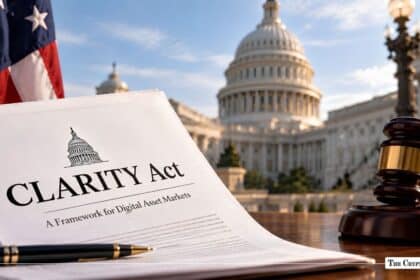
U.S. Senator Cynthia Lummis (R-Wyo.) urged Senate colleagues on September 8 to advance the CLARITY Act, framing the upcoming vote as a choice between supporting American innovation and strong consumer protections or ceding the future of finance to China.
In a post on X, Lummis wrote, “Next week, my colleagues have a choice: they can choose American innovation and strong consumer protections, or cede the future of finance to China.”
Additional comments and connection to earlier statements
In a separate post the same day, Lummis referenced the experience of FTX customers. She noted that those customers waited years for bankruptcy courts to recover funds because existing law lacked a framework for digital assets.
She said the CLARITY Act would designate digital commodities as customer property in bankruptcy, a step intended to protect consumers and facilitate recovery of assets.
The September 8 comments follow a September 5 post in which Lummis said the bill would require qualified custodians and segregated customer funds.
She linked those requirements to failures at crypto exchanges. The comments come at a time when lawmakers are preparing for a planned September 15 cloture vote on a motion to proceed.
Op-Ed on Wyoming experience and legislative background
In a recent op-ed published on September 7, Lummis described her background as a rancher, lawyer, state legislator, state treasurer, U.S. House member, and senator. She wrote that government rules carry consequences for businesses, jobs, and individuals who manage limited resources, and that capital, talent, and innovation move to jurisdictions that welcome them.
Lummis stated that Wyoming established the nation’s first comprehensive legal framework for digital assets nearly a decade earlier. She cited the decision by Kraken to locate in the state, the subsequent creation of jobs, and the consumer protections that accompanied the framework.
She described the state’s approach as writing clear rules that allowed innovators to operate within defined boundaries. According to the op-ed, Wyoming became a destination for digital asset companies and provided additional employment opportunities for younger residents.
Lummis wrote that while Wyoming developed its framework, the Biden administration pursued regulation by enforcement rather than by statute. She referenced policies that limited banking access for digital asset firms, an initiative she identified as Operation Chokepoint 2.0, and stated that the approach directed domestic investment overseas and left consumers without protections. She also pointed to regulatory frameworks developed in Europe and Asia during the same period.
The op-ed stated that President Donald Trump altered the prior trajectory by seeking to position the United States as a center for cryptocurrency activity. Lummis wrote that Congress now holds responsibility for making that approach permanent through legislation.
Provisions of the CLARITY Act
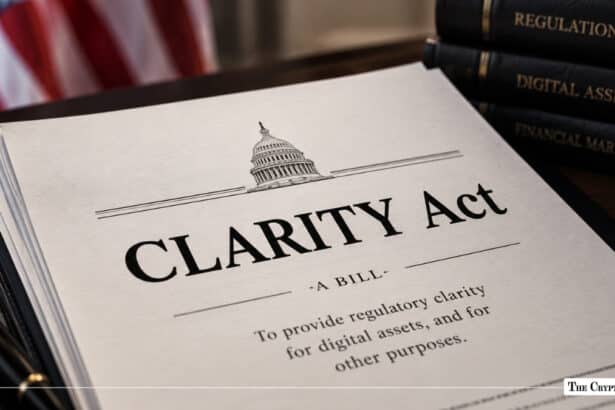
According to the op-ed, the CLARITY Act would establish statutory boundaries between the Commodity Futures Trading Commission and the Securities and Exchange Commission. It would provide businesses with clearer standards and add consumer protections, according to Lummis.
Lummis wrote that the Senate will not have another realistic opportunity to advance the measure before the end of the decade if the September 15 vote fails. She stated that blockchain technology can reduce transaction costs, expand access to capital, and create new channels for energy producers, manufacturers, and technology companies.
She added that the United States has historically led major periods of global finance and that the current choice concerns whether that pattern continues.
The op-ed noted that more than 100 provisions were added during negotiations at the request of Democratic colleagues. Lummis concluded that the Senate should complete action on the bill and transmit it to the president.
The statements and op-ed present the September 15 procedural vote as the immediate decision point for the legislation.
Also Read: CLARITY Act Faces New Uncertainty as Senate Ethics Talks Stagnate