Flare’s protocol revenue system showed a sharp pickup in activity during the second half of August, while the amount of FLR committed to staking has climbed 82% in about five months.
Cumulative collections flowing into the Flare Income Reinvestment Entity, or FIRE, nearly doubled during the final two weeks of August, according to Flare’s FIP.16 tokenomics tracker.
The dashboard showed cumulative collections of roughly $29,400 as of September 1. Close to half of the revenue accumulated since collections began in May arrived during the final two weeks of August, including the two largest daily collection totals recorded so far.
The absolute amount remains relatively small, but the acceleration provides an early indication that more network activity is beginning to feed into Flare’s revised token economics.
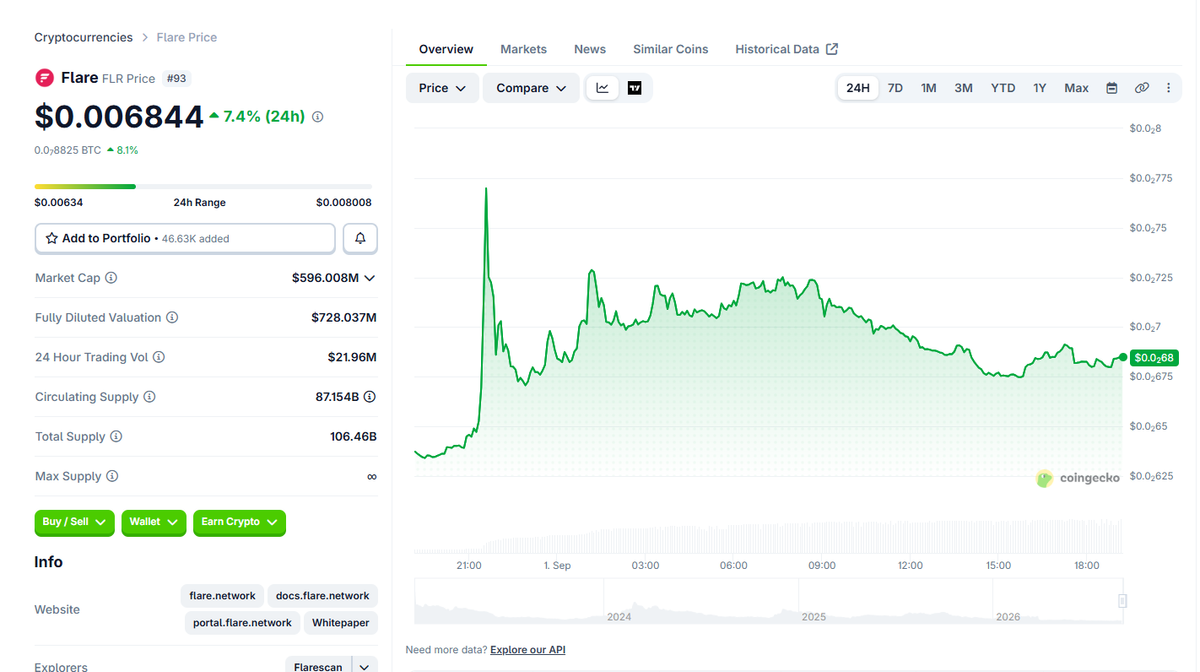
FLR was trading around $0.0068 on September 1, up roughly 7.4% over the previous 24 hours at the time of writing, according to CoinGecko. The token remains about 16% above its all-time low of approximately $0.00586, recorded on August 19.
FIRE begins capturing Flare network revenue
FIRE was introduced through Flare Improvement Proposal 16, a broader tokenomics overhaul approved by governance in April.
The entity is designed to collect revenue generated across the Flare ecosystem and redirect it toward FLR through mechanisms including market purchases and token burns.
Potential revenue sources include FAssets minting, Flare Data Connector attestations, Smart Account fees and protocol-level maximal extractable value, or MEV.
Current collections are still being generated primarily by the smaller revenue streams, particularly activity linked to FAssets. Full protocol-owned block building, which is expected to allow Flare to capture more MEV, has not yet been fully deployed.
That means one of the potentially largest revenue sources envisioned under FIP.16 is still largely absent from FIRE’s current numbers.
FLR staking reaches 20 billion tokens
Alongside the rise in revenue collections, FLR staking has also increased substantially. About 20 billion FLR was staked as of August 19, up from roughly 11 billion when FIP.16 was proposed in March. That represents an increase of about 82% in five months.
With approximately 87.1 billion FLR currently circulating, close to 23% of the circulating supply is now committed to staking.
The network had reported 16 billion FLR staked across 177 validators and more than 7,000 delegators in July. Staking incentives increased after a reward adjustment introduced under FIP.16 gave P-Chain staking greater weight relative to C-Chain delegation.
FIP.16 tightens FLR supply
The growth in staking comes as Flare is also reducing new token issuance. FIP.16 lowered the network’s annual inflation target from 5% to 3%, representing a 40% reduction, while cutting the annual issuance cap from 5 billion FLR to 3 billion FLR.
The proposal also increased Flare’s minimum base transaction fee from 25 gwei to 500 gwei, a twentyfold increase. Flare estimated that the revised fee structure could eventually burn around 300 million FLR annually if network activity remains sufficiently strong.
Another source of new token distribution has already disappeared. The FlareDrop program completed its 36-month distribution schedule on January 30, ending a recurring monthly source of FLR supply.
Meanwhile, Flare continues to build activity around XRP-based decentralized finance. More than 150 million FXRP has been minted through the FAssets system, with Flare previously reporting that more than 85% was being deployed across lending, vaults, staking and yield strategies.
DeFiLlama currently shows about $131.7 million in standard DeFi TVL on Flare, alongside roughly $350 million in bridged value.
The next test for FIRE will be whether the recent acceleration continues as Flare expands protocol-owned block building. If MEV begins flowing into FIRE at scale, the network could gain a considerably larger source of revenue for FLR buybacks and burns.
Also Read: Flare Begins Voting on FIP.16 as Inflation Cut and MEV Model Go Live