
U.S. spot Bitcoin exchange-traded funds (ETFs) absorbed about $2.8 billion of net inflows in the two weeks through August 28, the strongest concentrated institutional bid of 2026.
The first of those weeks brought in $1.92 billion, the largest weekly total since early October 2025, according to data from SoSoValue. The following five sessions added another $924.5 million, even after a $202 million outflow on Friday August 28, ending a nine-day buying streak.
The inflow arrived as Bitcoin broke out of a mid-year range near $63,000. Aggregated market data from CoinGecko show Bitcoin at $80,209.61 on August 27, then $77,838.65 on August 28—trading near $78,100 as of 6:30 AM UTC.
Market data reported an Asian-session high of $81,257 and a New York print near $78,000, still far below the October peak of $126,080, as recorded by CoinGecko. The tape and the ETF tape moved together. When price ripped, creations accelerated and when the price slipped on Friday, redemptions returned.
A two-week bid led by one fund
BlackRock’s iShares Bitcoin Trust (IBIT) did most of the work. SoSoValue data show IBIT taking about $503 million on August 20 alone and the bulk of the first week’s $1.92 billion. Across the nine-day streak that ran from Aug. 17 through August 27, IBIT supplied roughly three-quarters of net creations. On August 27 it printed $277.6 million while Fidelity’s FBTC and Grayscale’s GBTC were net sellers, leaving IBIT larger than the entire category’s net result that day.
This concentration is the institutional signature of this market. Large allocators have standardized on one ticker. Robbie Mitchnick, BlackRock’s head of digital assets, has said another slice of demand is not new cash at all but existing Bitcoin being swapped into the ETF.
The firm has processed about $5 billion of tax-deferred coin-to-ETF transfers and cut the minimum from $25 million to $1 million. “As we continue to expand access, this scale will continue to grow,” Mitchnick noted—as mentioned by Bloomberg’s Senior ETF Analyst Eric Balchunas.
The complex is now large enough that those flows matter for price. SoSoValue data shows that combined net assets in U.S. spot Bitcoin ETFs briefly touched about $101 billion on Aug. 27 before settling near $97.6 billion after Friday’s outflow and the drop in Bitcoin. Cumulative net inflows since the January 2024 launch remain about $54.6 billion. August month-to-date inflows of roughly $3.3 billion make it the strongest month of 2026. The calendar year is still net negative by about $2.8 billion. The two-week burst repaired a hole. It did not close the year.
Read: Inside Crypto’s Fastest Week of 2026: Bitcoin’s August Price Rally Was Not a Retail Story
Price caught a macro bid, then lost $80,000
Bitcoin’s year-to-date (YTD) chart explains why the first week was violent. Bitcoin closed August 17 near $64,300, August 19 near $68,400, August 20 near $72,600, and August 21 near $77,000, per TradingView data.
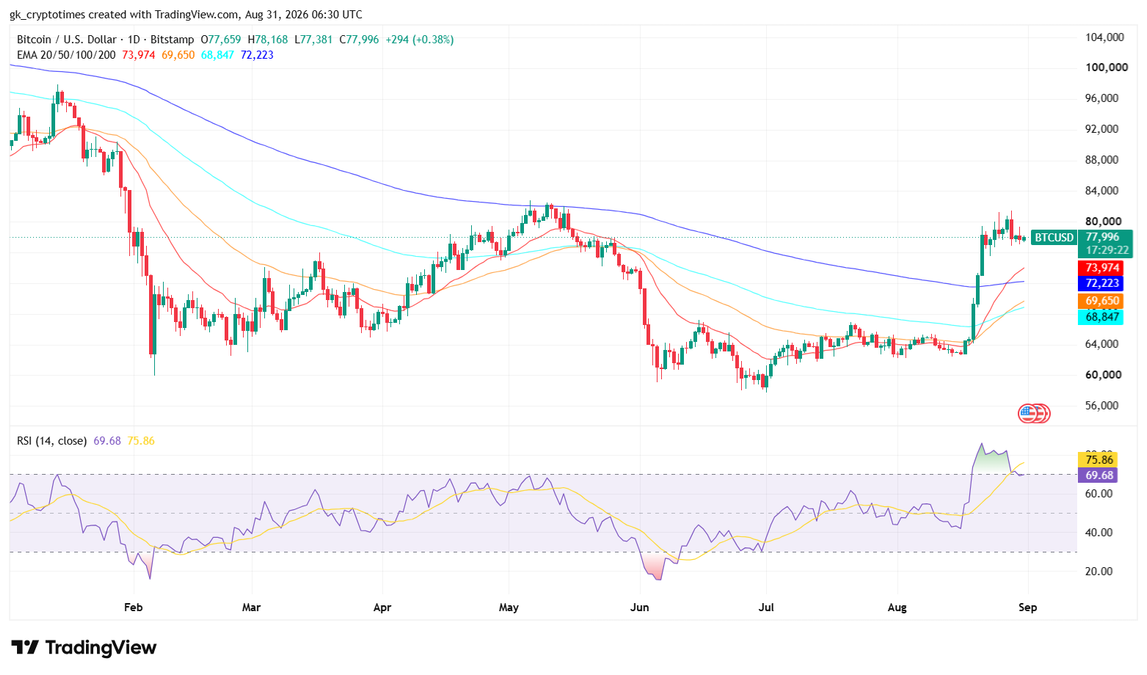
That is a roughly 20% advance in four sessions. Bloomberg analysts reported that the move forced liquidations of leveraged shorts and marked the first print above $80,000 since mid-May.
The catalyst was not an ETF headline. It was the U.S. Treasury. The Crypto Times previously reported that the crypto market and Bitcoin jumped to an expanded Treasury buyback of longer-dated bonds. Yields on the long end fell, the dollar weakened, and investors reached for assets that do not depend on a Treasury coupon.
In an August 26 X post, Eric Balchunas put the flows in that macro frame. Gold and Bitcoin ETFs together took in about $7 billion over five days, “by far a record for a 5-day period as debasement trade steals spotlight from AI,” he wrote, with GLD and IBIT both back in the week’s most-traded funds. He also noted IBIT’s year-to-date flows had turned positive after a long spell in the red.
Technically, the market is now digesting that impulse. The Aug. 28 close near $77,800 left a lower high under the $81,000 spike. The first test of demand is whether $76,000–$77,000 holds. A hold keeps the August breakout intact and gives ETF creations a chance to resume. A break opens the mid-$70,000s and would likely show up first in IBIT redemptions.
Whether $2.8 billion becomes a trend
The open question is durability. Two weeks of $2.8 billion is large against post-halving issuance of about 450 new Bitcoin a day. At $78,000 that is only about $35 million of new supply. ETF creations ran many times that rate. If even part of that bid is strategic — pensions, RIAs, tax-deferred coin swaps — the ceiling is higher than a squeeze to $80,000.
If the bid was only the Treasury headline plus short covering, Friday is the tell. ARK 21Shares’ ARKB led that session with $114.9 million of outflows. Bitwise’s BITB followed. IBIT’s own outflow was a modest $33.4 million. That is profit-taking at the edge of the complex, not a run on BlackRock. It is still a reminder that 2026 has produced several green streaks that died after a macro fade.
Investors will be watching three numbers this week. First, IBIT’s daily print: another $200 million-plus creation day would argue the allocation pulse is intact. Second, whether August finishes above $3 billion of net inflows. Third, whether Bitcoin can reclaim $80,000 without a second wave of leverage. The $2.8 billion is real. The price map now says the next decision is whether that money stays after the first down day.
Also read: Crypto Funds See $3.2B Weekly Inflow, Most Since October 2025: Bank of America