The crypto market advanced sharply on August 20, 2026, with the Bitcoin price soaring above $69,000—up nearly 8% from the prior session’s level near $64,625 as of 7:00 AM UTC. The move marked one of the strongest single-day gains in recent months and brought leading cryptocurrencies to its highest readings since early June.
This latest rally is fueled after three primary factors, including an expansion of the U.S. Treasury liquidity-support buybacks for longer-dated securities, a rapid price acceleration consistent with the covering of leveraged short positions, and a series of pro-innovation signals from U.S. regulators and the White House.
Treasury Expands Long-End Buybacks and Market Liquidity
On August 19, 2026, the U.S. Department of the Treasury announced that it is increasing, by at least double, the size of liquidity support buyback operations for longer-dated nominal coupon securities in the 10-year to 20-year sector and the 20-year to 30-year sector.
The current maximum size of $2 billion per operation will rise to at least $4 billion per operation. The change takes effect September 9, 2026, and remains in force through the remainder of the current refunding quarter ending November 4, 2026.
According to the official statement, the increase reflects Treasury’s desire to provide greater liquidity support in longer-dated nominal sectors where there is consistent strong sponsorship from market participants, as evidenced by the significant volume of high-quality offers routinely received in those operations.
An updated tentative buyback schedule will be released at a later date, with further details expected at the next Quarterly Refunding on November 4, 2026.
The announcement occurred against a backdrop of elevated long-term yields. Market participants observed that the 30-year yield had recently reached levels not seen in nearly two decades before retreating following the Treasury communication. Lower long-end yields reduce the opportunity cost of holding non-yielding assets and ease broader financial conditions, contributing to improved risk appetite across asset classes, including digital assets.
Regulatory Clarity and White House Engagement
One day earlier, on August 18, 2026, the Securities and Exchange Commission (SEC) proposed Regulation Crypto Assets. The proposal creates a tailored securities offering regime for certain investment contracts involving crypto assets. It includes two exemptions from registration under the Securities Act of 1933: a one-time startup exemption permitting offerings of up to $5 million during a four-year period, and a fundraising exemption permitting offerings of up to 75 million dollars during each 12-month period (subject to financial statements and ongoing reporting).
Issuers would provide principles-based narrative disclosures while remaining subject to antifraud provisions. A conditional safe harbor would allow a crypto asset to be deemed no longer subject to an investment contract once essential managerial efforts have permanently ceased.
The Commission stated that the framework is intended to address barriers to responsible capital formation and innovation while preserving core investor protections.
On August 19, 2026, President Trump convened cryptocurrency and financial technology executives at the White House, with CFTC Chairman Michael S. Selig and SEC Chairman Paul S. Atkins also present. In remarks delivered at the Innovation Meeting, Chairman Selig highlighted the administration’s actions to establish clearer distinctions between crypto securities and commodities, protect software developers, and position the United States as a center for digital-asset innovation.
The meeting formed part of broader engagement ahead of the CFTC’s inaugural Innovation Advisory Committee session. Official video of the White House event is available through C-SPAN.
Bitcoin technical analysis and liquidations
Bitcoin’s sharp advance on August 19, 2026, marked a decisive technical breakout from a multi-week consolidation range that had held roughly between $62,000 and $66,000. Price surged through key resistance near $66,500–$67,000, briefly reaching an intraday high around $69,750 before settling near $68,500–$69,500—its strongest levels since early June.
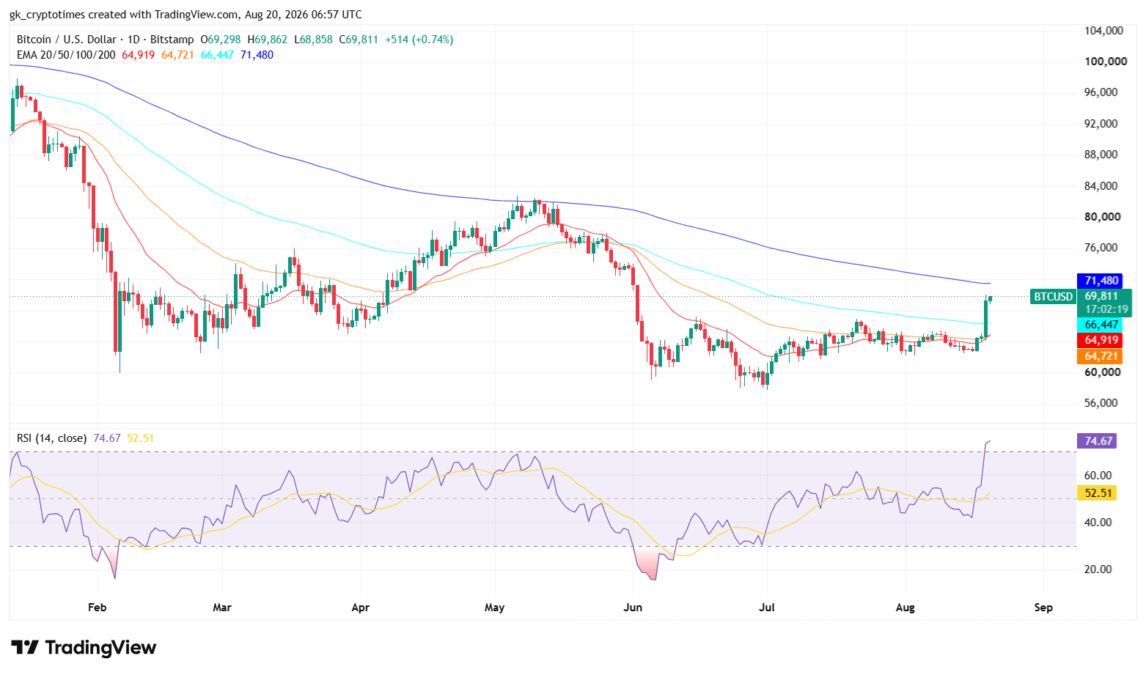
The move cleared prior supply zones and shifted short-term structure higher, with immediate resistance now clustered around the psychologically important $70,000–$70,500 area. On the downside, former resistance in the $66,500–$68,000 zone has flipped to potential support; a sustained hold above this region would keep the breakout intact, while a decisive close back below $66,500 could signal that the rally was primarily squeeze-driven rather than the start of a broader trend reversal.
CoinGlass data showed the rally was heavily amplified by forced liquidations. More than $1.45 billion in Bitcoin short positions were wiped out in roughly one hour as price accelerated higher, contributing to a broader crypto-market short liquidation total that reached a record $3 billion over the 24-hour period. Shorts accounted for the overwhelming majority of the volume (often cited above 90%), reflecting crowded bearish positioning that had built during the preceding low-volatility range.
This cascade of forced buying through successive liquidation clusters helped accelerate the move once key technical levels gave way, underscoring how leveraged derivatives positioning magnified the upward momentum.
These developments reduced near-term policy uncertainty. The rapid price appreciation recorded in the Federal Reserve data—from the mid-$64,000 range to nearly $69,500—is consistent with the forced covering of leveraged short positions that had accumulated during prior range-bound trading.
When prices break higher through clustered liquidation levels, exchange mechanisms require short sellers to repurchase the underlying asset, amplifying upward momentum.
Taken together, the Treasury’s liquidity measures, the SEC’s proposed exemptions, and the White House convening of industry and regulatory leaders created a supportive backdrop for risk assets on August 19. Bitcoin’s documented price rise reflects the combined influence of these official actions and the resulting shift in market positioning.
Also read: Ripple’s Garlinghouse, Coinbase’s Armstrong Back CLARITY Act After White House Crypto Meeting