Four of the most crypto-sensitive U.S. equities rallied on Wednesday, August 19, as easing Treasury yields and a firmer Bitcoin price lifted risk appetite across the group.
Strategy (MSTR), Coinbase (COIN), Circle (CRCL), and Robinhood (HOOD) all closed higher, reversing a decline from the previous session, when Robinhood, Coinbase, and Circle each fell ahead of the release of Federal Reserve meeting minutes. The rebound came on the same day the U.S. Treasury announced a larger bond-buyback program and Bitcoin held above $68,000.
How the four stocks closed
All closing prices are for the regular session at 4:00 p.m. ET on August 19 (20:00 UTC) and are sourced from Yahoo Finance; percentage moves are against the previous session’s close. Overnight quotes are as of 1:38 AM ET on August 20 (05:38 UTC) and, being thinly traded, can differ materially from the next regular-session open.
Strategy (MSTR)
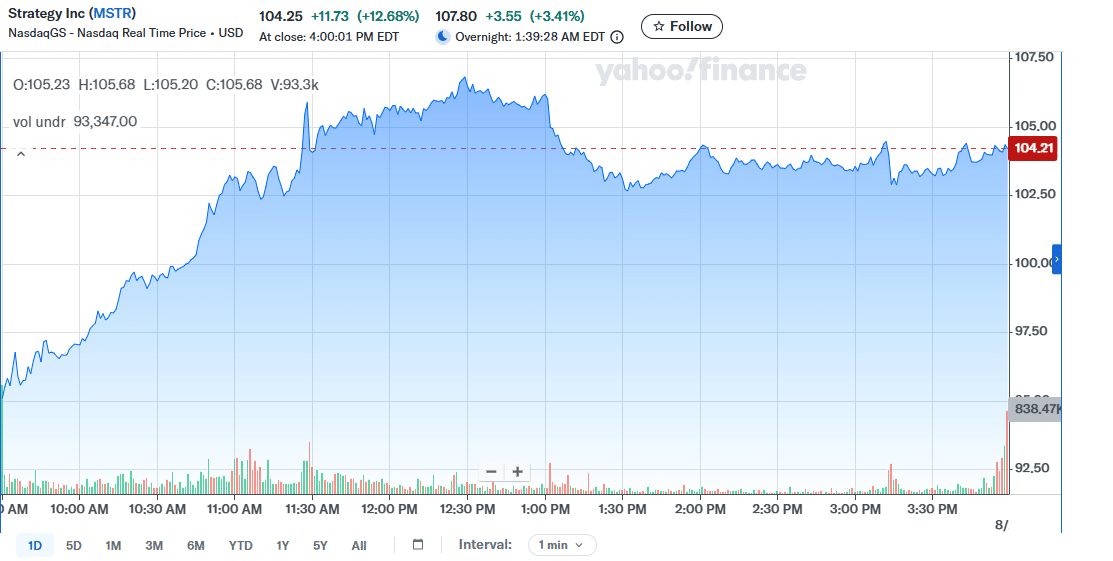
Strategy closed at $104.25, up 12.68% ($11.73), the group’s biggest gainer. As a Bitcoin-treasury company, MSTR trades closely in line with the coin, and its advance tracked Bitcoin’s move back above $68,000. Strategy holds 840,447 BTC and recently raised $333.7 million through MSTR share sales between August 10 and 16, a structure that amplifies its sensitivity to Bitcoin’s price in both directions. In overnight trading, MSTR was quoted at $107.80, up a further 3.41%.
Circle (CRCL)
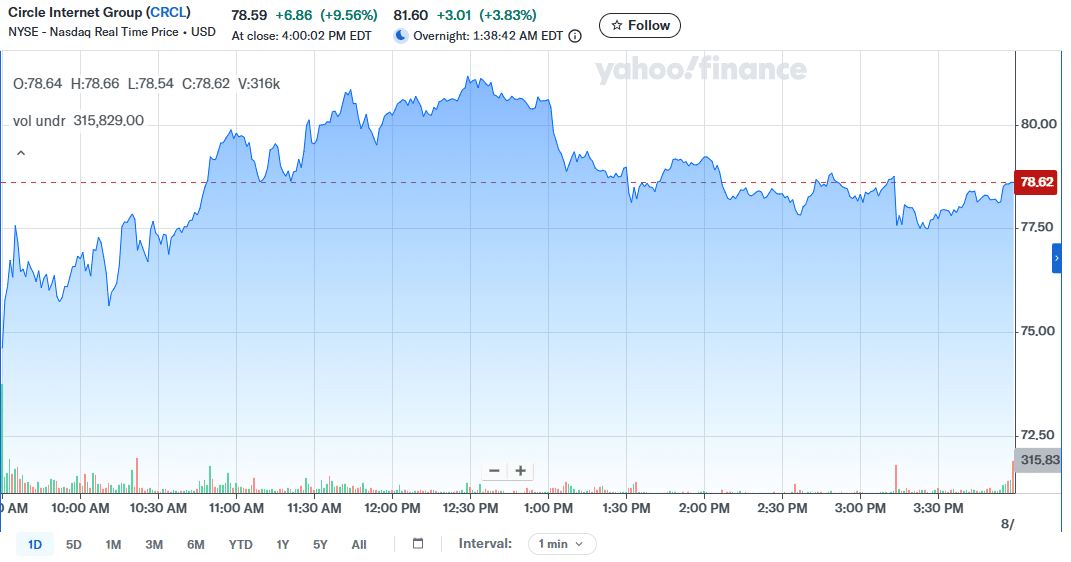
Circle closed at $78.59, up 9.56% ($6.86). As the issuer of the USDC stablecoin, Circle’s business is tied to the reserves backing USDC and to overall crypto activity, so its shares tend to move with broad market sentiment and trading volumes rather than a single company-specific catalyst on the day. In overnight trading, CRCL was quoted at $81.60, up a further 3.83%.
Coinbase (COIN)
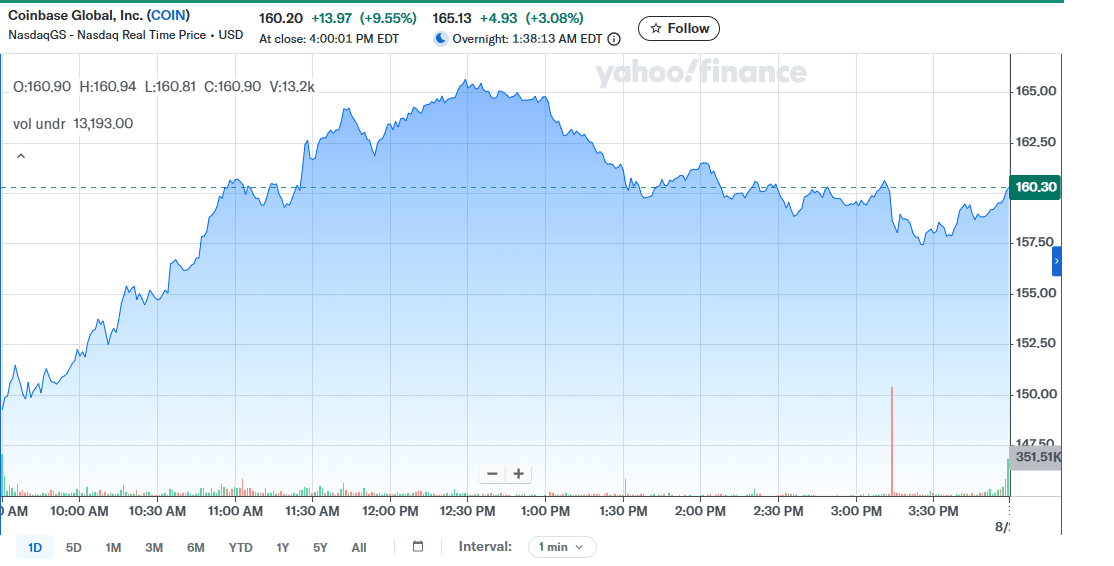
Coinbase closed at $160.20, up 9.55% ($13.97), after trading as high as roughly $165 intraday. Beyond the market backdrop, the exchange’s stock drew attention as its derivatives business expanded following the $2.9 billion acquisition of Deribit, which broadens Coinbase’s revenue beyond spot trading. In overnight trading, COIN was quoted at $165.13, up a further 3.08%.
Robinhood (HOOD)
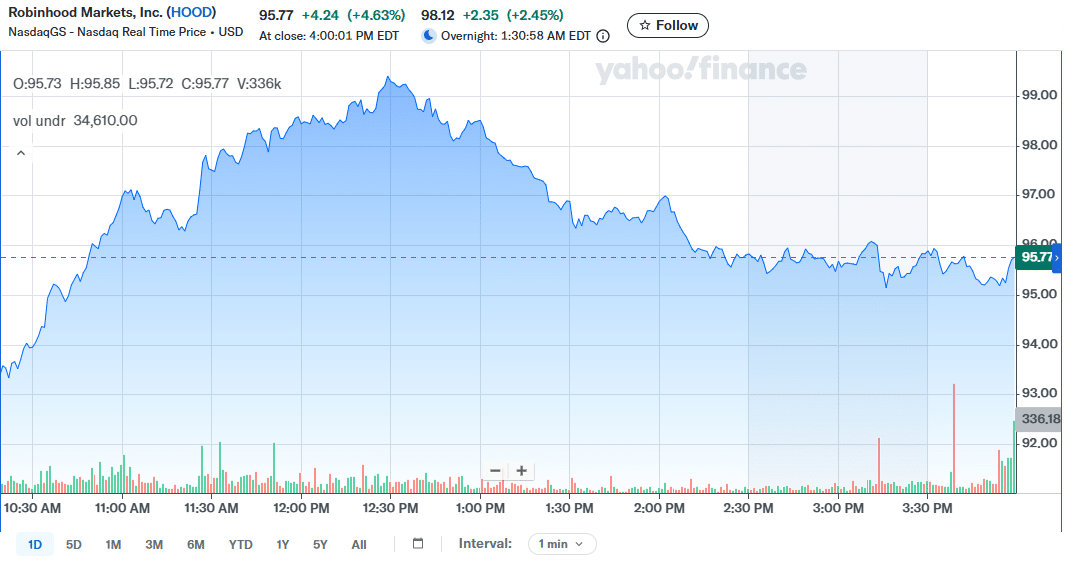
Robinhood closed at $95.77, up 4.63% ($4.24), the smallest gain of the four. The brokerage earns transaction-based revenue across crypto and equities, so risk-on sessions with heavier trading volumes tend to support the stock, though crypto is a smaller share of its business than for the other three names. In overnight trading, HOOD was quoted at $98.12, up a further 2.45%.
Why markets pumped: The Treasury’s larger bond buyback
The main driver behind Wednesday’s rally sat in the U.S. bond market rather than in crypto itself. On August 19, the U.S. Treasury announced it would at least double the maximum size of its liquidity-support buyback operations for longer-dated securities, the 10-to-20-year and 20-to-30-year sectors, raising the cap from $2 billion to at least $4 billion per operation. The larger operations take effect on September 9 and run through November 4, 2026, when the Treasury holds its next Quarterly Refunding.
These are not new stimulus purchases. In a liquidity-support buyback, the Treasury repurchases older, less-frequently-traded “off-the-run” bonds to keep that part of the market functioning smoothly. The program, run under Treasury Secretary Scott Bessent, is broadly cash-neutral rather than an injection of new money.
The mechanism that matters for markets is still simple: when the Treasury steps in as a larger buyer, it adds demand, which lifts bond prices and pushes yields lower, since prices and yields move inversely. Lower long-term yields tend to loosen financial conditions, which is generally supportive of risk assets such as equities and crypto. Following the announcement, yields fell and U.S. stock-index futures moved higher.
The move came after weeks of pressure at the long end of the market. A bond selloff had driven the 30-year Treasury yield to 5.34% on August 18, its highest level since 2007, with the segment seeing what analysts described as a buyers’ strike since late June. Last week’s $25 billion 30-year auction cleared at 5.216%, the highest for that maturity since 2001. Behind the strain is a widening fiscal gap: the July federal deficit reached $432.3 billion, the largest monthly shortfall since March 2021, interest on the debt has passed $1.1 trillion this year, and July consumer prices rose 3.4%, above the Fed’s 2% target.
After the buyback news, the 30-year yield fell roughly 9 basis points to about 5.196%, and the 10-year eased to about 4.65%. (One basis point equals one-hundredth of a percentage point.) Notably, the buybacks themselves do not begin until September 9, so Wednesday’s reaction reflected the signal that the Treasury is willing to act, rather than any purchases already made.
Bitcoin holds above $68,000
The easing in yields landed on a crypto market that was already turning higher, giving the four stocks a second tailwind. On Wednesday, Bitcoin jumped more than $3,000 in a matter of hours, climbing from around $65,000 to above $68,600. CoinGecko data (as of 1:00 PM ET on August 19) showed BTC near $68,611, up about 5.7% over 24 hours, with an intraday high of $68,982.40 and a session low near $64,124, a range of almost $4,900.
The advance carried Bitcoin through its 100-day moving average near $66,195 and up to its 200-day moving average around $68,977, leaving $69,000 as the next technical level traders were watching. Part of the move was mechanical: Glassnode data indicated roughly $500 million of short positions were liquidated as the price spiked toward $69,000, with open interest falling as bearish bets were force-closed, a sign the rally was driven partly by short covering rather than fresh buying.
Because Strategy holds Bitcoin on its balance sheet, and Coinbase, Circle, and Robinhood all earn more when crypto trading is active, a firmer Bitcoin price feeds fairly directly into all four stocks. The wider crypto market also rose, with total capitalization up about 5.13% to roughly $2.32 trillion over 24 hours, according to CoinMarketCap data cited on August 20.
The quantitative easing framing, and the case against it
The move revived a debate over whether expanded Treasury buybacks amount to a form of quantitative easing, or “mini-QE.” That characterization is contested. Unlike Fed quantitative easing, these are liquidity-support buybacks of older, less-traded “off-the-run” securities and are broadly cash-neutral rather than an expansion of the central bank’s balance sheet.
Analysts also cautioned against reading too much into the step. Krishna Guha, head of global policy and central bank strategy at Evercore ISI, said in a client note that the operation “changes almost nothing in terms of the fundamentals,” pointing to the unchanged need to finance large government deficits. President Donald Trump, asked whether Americans should be worried about the bond market, said, “No, I don’t think so.”
For the four crypto-linked stocks, the takeaway is narrower: a lower-yield, higher-liquidity backdrop tends to help rate-sensitive and risk-sensitive equities, and this group is among the most sensitive to crypto prices in particular. Whether the relief in yields persists will depend on upcoming supply, inflation data and the next Quarterly Refunding on November 4.
Also Read: Bitcoin, Ethereum Surge as Crypto Liquidations Reach $1.91 Billion