Key Highlights
- Bitcoin recorded its biggest weekly gain ever in dollar terms, rising $14,775 between August 16 and August 23.
- Bitcoin ETF inflows jumped, with about $3.51 billion flowing into US spot Bitcoin ETFs over the past month.
- Bitcoin is now testing the 50-week moving average near $81,795, a level Galaxy Research says could signal the end of the bear market if BTC closes above it.
Bitcoin has just recorded the biggest weekly rise in its history when measured in US dollars, adding $14,775 between August 16 and August 23, according to Galaxy Research.
In a published report on Friday, the firm said that the cryptocurrency gained about 23.5% during this week as investors poured more funds into the ETFs and market condition changes, which pushed the price towards $80,000.
Bitcoin’s weekly gain sets a new record
The size of the move is what makes the week stand out. According to Galaxy Research, Bitcoin’s 23.5% surge was its 41st-largest weekly percentage gain among 840 weeks of trading history.
Since 2020, only three weeks have produced bigger percentage gains. Bitcoin rose 27.7% in the week of March 19, 2023, 25.9% in the week of January 3, 2021, and 25.2% in the week of February 14, 2021.
The rally did not stop when the week ended. Bitcoin climbed as high as $81,265 on Tuesday, but it then met resistance around its 50-week moving average, which was near $81,795. This level is now an important test for the cryptocurrency as it tries to keep its recovery going.
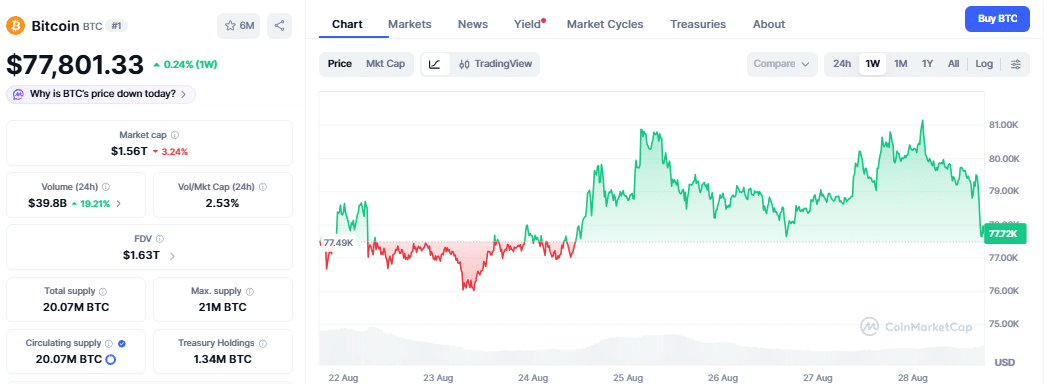
Data from CoinMarketCap also confirms this. The token briefly crossed above $80,000 during early trading hours on the day before pulling back and ended the day around $78,000. At the time of reporting, Bitcoin is trading for $77,801.
ETF inflows show stronger demand
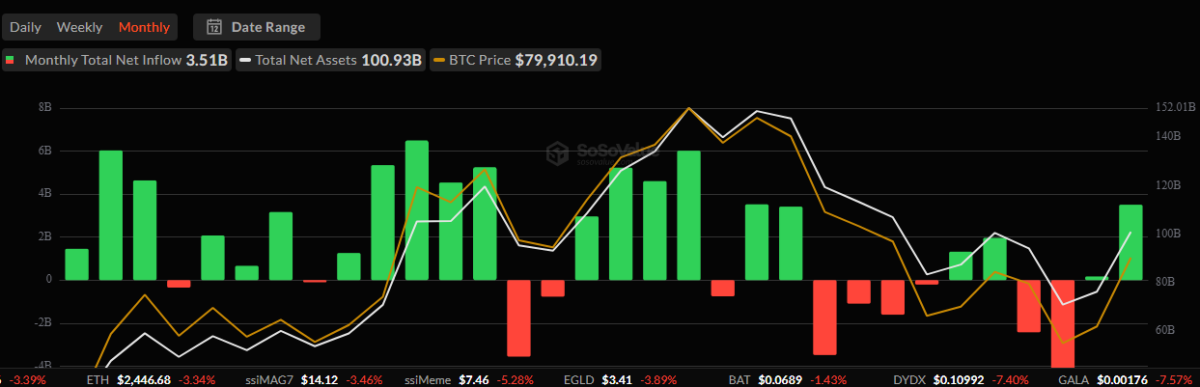
One of the biggest signs of fresh demand came from US Bitcoin exchange-traded funds. Galaxy said Bitcoin ETFs recorded their largest weekly inflows since October 2025, when Bitcoin reached its previous all-time high.
August was also on track to become the biggest month for Bitcoin ETF inflows since October. In fact, data from SosoValue shows that the funds have recorded around $3.51 billion inflow in the last month.
In short, more money is flowing into Bitcoin investment products at the same time that its price is rising.
Bond buybacks bring back the debasement trade
The surge was also helped by a change in the wider financial market. Bitcoin’s realized and expected volatility were near record lows before the rally.
Then, on August 19, US Treasury Secretary Scott Bessent announced an expansion of bond buybacks for longer-term government debt. Bitcoin and gold rose after the announcement as investors returned to what Galaxy called the “debasement trade.”
The idea behind the trade is simple: when investors worry that the value of money could weaken because of debt, inflation or government policy, they may look for assets such as gold and Bitcoin. That helped give the Bitcoin rally another push.
Crypto policy adds to the positive mood
Political developments added to the move. US President Donald Trump recently hosted crypto executives at the White House and called on Congress to pass the CLARITY Act.
Crypto executives also took part in the first meeting of the CFTC’s Innovation Advisory Committee. Galaxy said these events created positive regulatory news around the crypto market.
Bitcoin now looks to the 50-week average
There was more behind the sharp surge. Galaxy said short liquidations, a gamma squeeze and traders chasing the upward move helped push Bitcoin higher. The cryptocurrency had also fallen to around the $64,000 area near its 200-week moving average before climbing toward $80,000.
Now, attention is turning to the 50-week moving average. Galaxy’s review of Bitcoin’s past bear markets found that breaking above this level ended four of five completed bear markets.
If Bitcoin manages to close a weekly candle above the 50-week moving average, Galaxy said history suggests the bear market may be over.
Also Read: CZ Says Bitcoin Could Overtake Gold in Next Bull Run