
Key Highlights
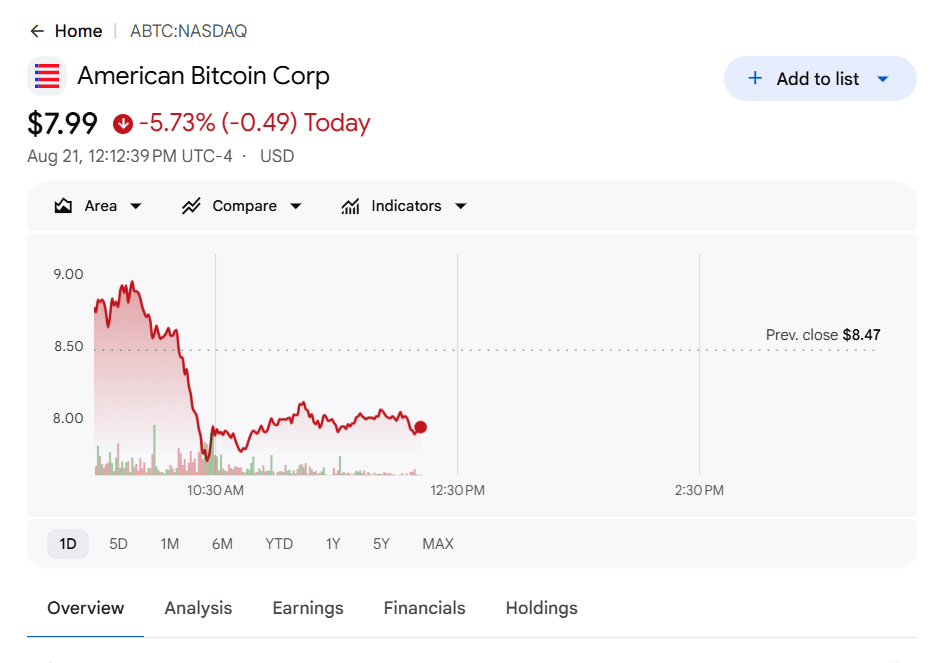
- American Bitcoin fell 5.73% to $8.00 by 11:56 a.m. ET after opening at $8.66 and briefly reaching $8.96.
- ABTC had already gained about 22% over the previous two sessions, making Friday’s drop partly a reversal after a sharp rally.
- A $2.1 billion ATM program, a $57.2 million Q2 loss and recent executive turnover remain company-specific overhangs.
Crypto stocks are surging Friday as Bitcoin pushes toward $80,000, but one Bitcoin-linked company is moving sharply in the opposite direction.
American Bitcoin Corp. (NASDAQ: ABTC), the Bitcoin miner and treasury company co-founded by Eric Trump, fell 5.73% to $8.00 as of 11:56 a.m. ET on August 21. The stock opened at $8.66, climbed as high as $8.96 and then reversed to an intraday low of $7.66. Trading volume had already reached 2.49 million shares, well above its 1.44 million average.
American Bitcoin is majority-owned by Hut 8, while Eric Trump serves as its co-founder and chief strategy officer.
The decline stands out because the rest of the crypto-equity market is rallying. Robinhood was up 12.4%, Coinbase gained 9.5% and Strategy rose 7.4% Friday morning as Bitcoin reached its highest level since late May, according to Reuters.
Bitcoin itself traded near $77,500 after touching $79,426, extending a rally that has also been supported by the Treasury Department’s expanded bond-buyback program and a weaker dollar.
ABTC Rally Reverses After 22% Jump in Two Days
The first explanation for Friday’s divergence is that ABTC had already participated heavily in the crypto-stock rally.
American Bitcoin closed at $6.94 on August 18 before jumping 13.83% to $7.90 on August 19 and another 7.28% to $8.47 on August 20. That amounts to a gain of roughly 22% in only two trading sessions. ABTC rose alongside Coinbase, Circle, BitMine and Nakamoto as the broader crypto market recovered.
Friday initially looked like another continuation of that move. ABTC opened above Thursday’s close and briefly reached $8.96, representing an intraday gain of nearly 6%, before sellers pushed the stock below $8.
That price action suggests the stock’s weakness is at least partly profit-taking after its rapid two-day advance rather than a complete disconnect from Bitcoin.
Share Dilution Remains a Major ABTC Overhang
American Bitcoin also carries an equity-specific issue that Bitcoin itself does not: the company relies extensively on stock issuance to fund its accumulation strategy.
The company established an at-the-market, or ATM, program allowing it to sell up to $2.1 billion of Class A shares.
According to its latest SEC filing, American Bitcoin had issued approximately 12.12 million shares through the ATM from its launch through June 30, raising gross proceeds of about $385.2 million. During the first six months of 2026 alone, it issued about 7.76 million shares for $144.7 million.
Class A shares outstanding increased from about 16.20 million at the end of 2025 to 24.00 million as of June 30 on a post-split basis.
However, the dilution story needs some context. American Bitcoin said its shares outstanding increased only about 3% during Q2 while its Bitcoin holdings increased 14%, lifting its satoshis-per-share metric by roughly 11%.
So the immediate issue is less that ABTC suddenly issued large amounts of stock Friday and more that investors know substantial ATM capacity remains available.
Q2 Loss Still Hangs Over American Bitcoin
American Bitcoin’s latest earnings also leave its equity more exposed to company-specific concerns than Coinbase, Robinhood or Bitcoin itself.
The company reported $67.0 million in Q2 revenue but a $57.15 million net loss, compared with a $3.4 million profit a year earlier. Much of that loss came from changes in the value of its digital assets rather than a collapse in mining production.
In fact, American Bitcoin mined a record 932 BTC during Q2, while its strategic reserve increased 14% to approximately 8,002 BTC.
Its balance sheet nevertheless gives equity investors another factor to price. The company reported $18.35 million in cash at June 30 against $136.67 million of current liabilities, although it also held about $478.9 million of Bitcoin and other digital assets, including Bitcoin pledged against miner purchases.
Calling the company a liquidity crisis would therefore go too far, but its dependence on Bitcoin holdings and capital-market fundraising leaves ABTC more sensitive to financing concerns than Bitcoin’s spot price alone.
Management Change Adds Another Company-Specific Factor
ABTC has also gone through a recent leadership change, President and interim CFO Matt Prusak stepped down effective August 4 to take another position in Austin. American Bitcoin said his resignation was voluntary and was not related to any disagreement over the company’s financial statements, operations or policies.
The board appointed Paul Sacks, previously the company’s head of derivatives, as interim CFO.
The departure does not by itself indicate operational problems, but it adds another layer of uncertainty at a time when investors are already assessing ABTC’s financing structure and recent losses.
Why ABTC Is Falling While Coinbase and Robinhood Rally
Friday’s divergence therefore appears to come from a combination of profit-taking and company-specific equity risks, rather than a bearish signal from Bitcoin.
Coinbase and Robinhood are benefiting directly from expectations for higher trading activity as crypto prices surge. Strategy is gaining as the value of its massive Bitcoin treasury rises.
ABTC has the same Bitcoin tailwind, but investors are simultaneously pricing its ATM issuance program, recent earnings losses and management transition.
The stock’s intraday action makes that distinction particularly clear: ABTC initially followed Bitcoin higher to $8.96 before reversing below Thursday’s $8.47 close.
For the remainder of Friday’s session, the $7.66 intraday low and $8.96 intraday high provide the clearest immediate reference points. A recovery above the opening range would suggest ABTC is reconnecting with the broader crypto rally, while continued selling near $8 would show that company-specific concerns are outweighing Bitcoin’s surge for now.
Also Read: Robinhood Stock Up 13%: What Is Driving the HOOD Rally?