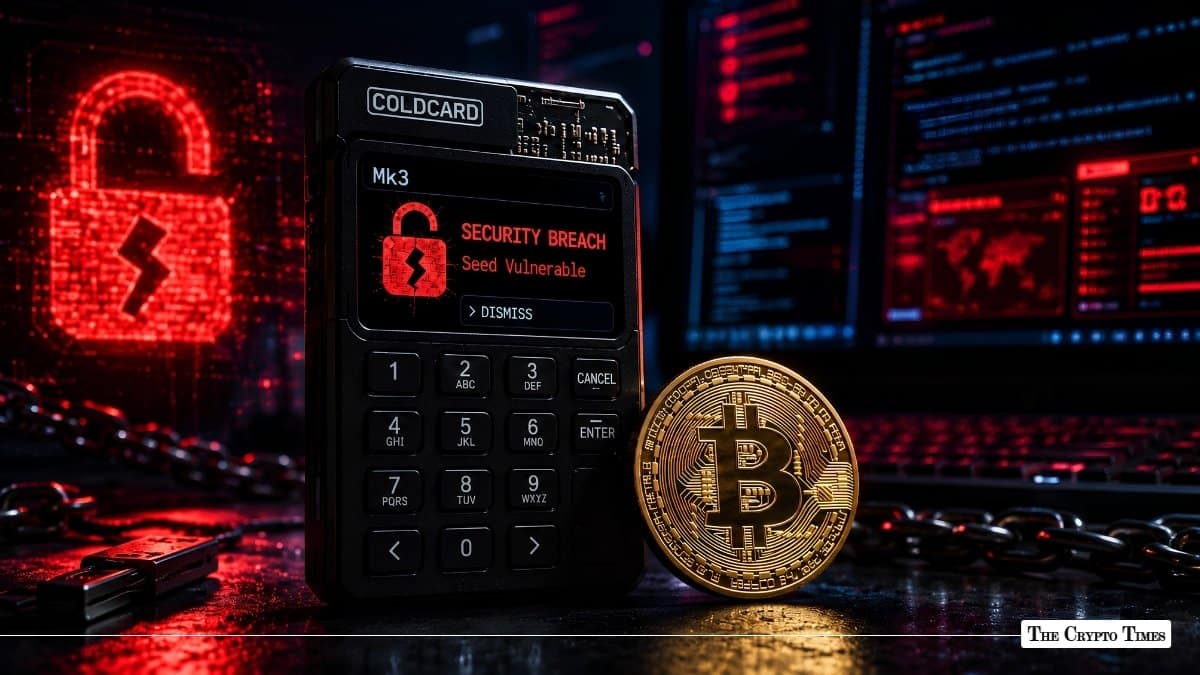
Key Highlights
- Chainalysis said the Coldcard hacker targeted the largest Bitcoin wallets first, stealing over $38 million from around 500 wallets.
- The attacker stole about $30 million in the first 10 minutes and completed the wallet sweep in roughly 25 minutes.
- Coldcard users with affected devices are urged to create a new recovery seed on updated hardware, while Ledger confirmed its wallets were not affected by the vulnerability.
Chainalysis, a blockchain analytics company, said the hacker behind the recent Coldcard wallet attack did not steal Bitcoin at random. Instead, the attacker targeted the largest wallets first, helping steal more than $38 million in Bitcoin.
In a Friday post on X, Chainalysis shared its findings one day after nearly 594 BTC was stolen from about 500 single-signature Bitcoin wallets linked to vulnerable Coldcard devices.
Chainalysis details how the attack unfolded
According to Chainalysis, the attack appears to have been planned before it happened. The hacker likely studied the wallets, identified the ones holding the most Bitcoin, and targeted them first. That strategy allowed the attacker to collect huge amounts of Bitcoin in a very short time.
Chainalysis said the total value stolen jumped to around $30 million within the first 10 minutes of the attack. In about 25 minutes, the hacker had already swept around 500 different wallets. “Our analysis of the $38M+ Coldcard hack reveals that the attacker hit high-value wallets (including a $1.8M victim) early in the sweep,” the firm stated. “This pattern suggests that the attacker studied the victim wallet population before proceeding.”
Using its blockchain investigation tool called Reactor, Chainalysis found that three of the ten largest victim wallets each held at least 10 BTC, worth about $636,000 at the time.
One victim lost around $1.8 million. The company said it is tracking the wallet used by the attacker as well as another address where part of the stolen Bitcoin has been gathered. It also said it is watching for signs that more wallets created with vulnerable Coldcard devices could still be at risk.
Why a simple software update is not enough
The company also warned Coldcard users that installing the latest software update alone will not fully protect them if their recovery seed was created using the affected firmware.
“If you own a Coldcard device, applying the latest hotfix is not enough to protect a seed that was generated on vulnerable firmware,” Chainalysis said. “Users must generate an entirely new seed on patched hardware. Utilizing a strong BIP-39 passphrase provides critical additional protection.”
Coldcard explains the firmware flaw
The warning came after Canadian hardware wallet maker Coinkite issued an urgent security advisory on July 30. The company said some Coldcard Mk3 devices running firmware versions 4.0.1 through 5.0.3 had a serious problem with the way they generated recovery seeds. Recovery seeds are the secret words that allow users to restore access to their crypto wallets. If those words are not created with enough randomness, they become much easier for attackers to guess.
Coinkite explained that the issue was caused by a software bug that stopped the device’s hardware random number generator from working as intended during seed creation. Instead of using enough true randomness, the affected devices relied more on software-generated randomness, making some recovery seeds much weaker than they should have been.
That reduced the number of possible seed combinations and made it possible for a determined attacker to recreate private keys offline and search for wallets holding Bitcoin. The company has released updated firmware that fixes the problem for new recovery seeds created on patched devices.
Ledger says its devices were not affected
Following the incident, Ledger said its hardware wallets were not affected by the vulnerability. The company said its devices use a certified True Random Number Generator built into the Secure Element chip, allowing every 24-word recovery phrase to be created with the full amount of expected randomness.
“Ledger devices use a certified True Random Number Generator (TRNG) built directly into our Secure Element chip, generating full 256 bits of entropy for every 24-word Secret Recovery Phrase,” the company said.
Also Read: WEMIX Hacked Again: $6.25M Stablecoin Exploit Forces Network Shutdown