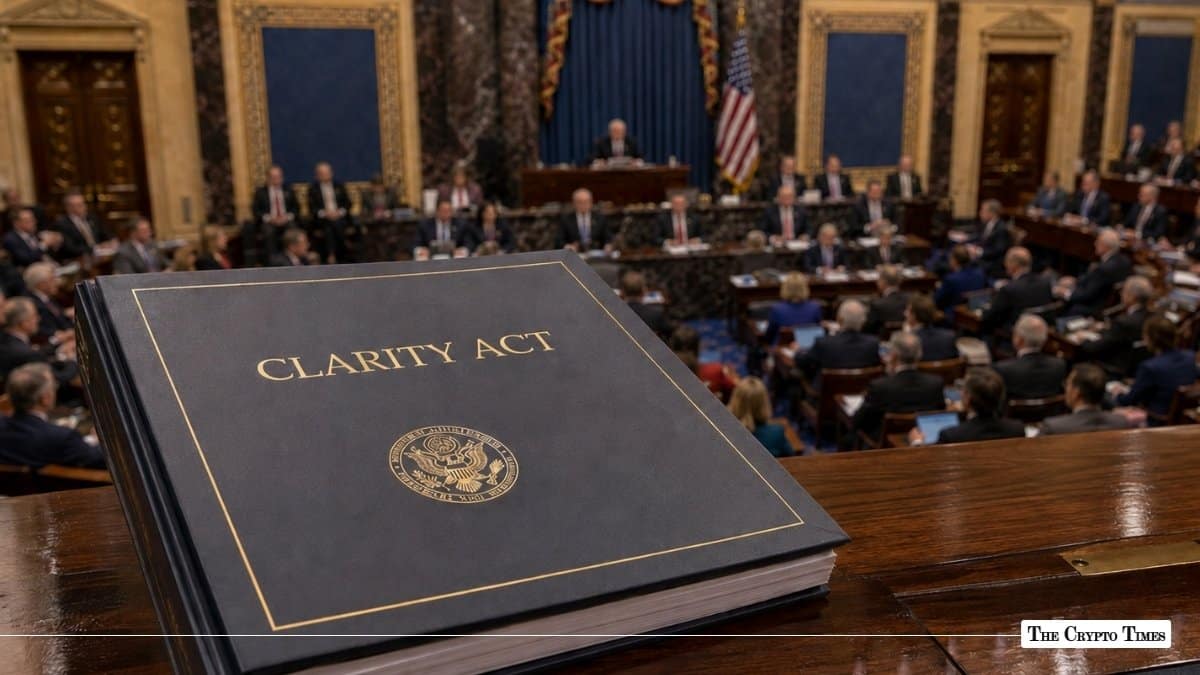
With the Senate racing a narrowing window before its August recess, three of the industry’s most influential trade groups have opened a coordinated pressure campaign on Senate leadership to bring the Digital Asset Market Clarity Act to the floor, even as the bill remains short of the votes needed to clear the 60-vote procedural threshold.
In a joint letter addressed to Majority Leader John Thune (R-SD) and Minority Leader Chuck Schumer (D-NY), first reported by Crypto In America, the chief executives of The Digital Chamber, the Crypto Council for Innovation and the Blockchain Association urged the chamber to begin the floor process without further delay. They praised the newly released 616-page updated draft for strengthening tools to combat illicit finance and for establishing what they described as the first comprehensive federal consumer protection framework for digital asset markets.
“These improvements reflect engagement with policymakers across both parties and demonstrate that a well-crafted market structure framework can promote innovation while also bolstering national security,” the CEOs wrote. Warning of the cost of further inaction, they added: “For the United States to maintain its position as the global leader of financial innovation, there is no substitute for the long-term certainty of durable market structure legislation.”
Democratic holdouts
Momentum from the White House’s ethics package and the newly circulated Senate Republican text has not translated into the votes required to move the bill. Seven Democrats whose support is considered decisive, among them Sens.
Angela Alsobrooks (D-MD), Mark Warner (D-VA), Catherine Cortez Masto (D-NV) and Ruben Gallego (D-AZ), have said the current draft falls short on ethics, illicit finance and consumer protection.
Bipartisan negotiations are expected to continue through the weekend, with Republicans hoping to open the floor process next week. Only nine legislative days remain before the August recess.
The Wall Street split
The industry push landed the same week that a rare Wall Street endorsement broke into public view. Goldman Sachs Chairman and CEO David Solomon said he backs the legislation, breaking with several of his peers at the country’s largest banks. “The CLARITY Act, like all legislation, is not perfect,” Solomon said. “But I think one of the most important things that it does is that it creates a level playing field to enhance market stability and allow these markets to develop appropriately.”
Solomon’s endorsement sharpens the divide with JPMorgan Chase’s Jamie Dimon, who has publicly warned that the bill’s stablecoin yield framework would let crypto firms replicate bank deposits without comparable regulatory obligations.
The banking lobby’s largest voices, including the American Bankers Association, the Bank Policy Institute and the Independent Community Bankers of America, remain aligned in opposition, arguing the text still fails to prevent stablecoin rewards from draining deposits and reducing local lending.
The U.S. Hispanic Chamber of Commerce echoed those concerns in a letter this week. Banking advocates are also flagging language they say would weaken the application of Bank Secrecy Act and anti-money laundering requirements to certain DeFi platforms.
The DeFi Education Fund, which represents developers and users of decentralized finance, welcomed the updated draft for preserving the Blockchain Regulatory Certainty Act and for adding new law enforcement tools to combat crypto-related crime.
Support also arrived from state law enforcement. Matthew Hogan, a Connecticut State Police detective who leads the agency’s crypto working group, praised the bill’s new grants, financial sector liaisons and mechanisms for freezing stolen funds, though he cautioned that it falls short on returning assets to victims and on streamlining how crypto scams are reported. “Overall, this is an improvement from the previous versions,” Hogan told Crypto In America.
The ethics fight
Sen. Thom Tillis (R-NC) is leading bipartisan talks on the ethics framework after Democrats rejected a White House-backed package that would place enforcement authority with the Justice Department rather than state attorneys general. Tillis called the White House proposal “a step in the right direction,” but has signaled that his support depends on stronger guardrails preventing government officials from profiting off crypto.
The revised Republican draft, released July 22, would bar the president, vice president, members of Congress, federal judges and other covered officials from issuing or sponsoring digital assets for compensation while in office, though Democrats argue the language would not meaningfully constrain President Trump’s existing crypto ventures. Sen. Elizabeth Warren (D-MA), the top Democrat on the Banking Committee, has declared the draft “dead on arrival.”
A parallel legal front
The lobbying blitz coincides with an escalation on another front. On July 21, The Digital Chamber filed suit in the Circuit Court of Sangamon County against the Illinois Department of Revenue, seeking to void the state’s newly enacted Digital Asset Tax Act before it takes effect in January 2027.
The 32-page complaint argues that the 0.2% levy on digital asset transactions violates the uniformity and due process clauses of the Illinois Constitution, the Commerce Clause of the U.S. Constitution, and the federal Internet Tax Freedom Act. Trade group CEO Cody Carbone said the levy would “impose an unfair tax burden” on Illinois users and businesses and singles out digital assets based on the technology used to record ownership.
The measure, tucked into an omnibus revenue bill and signed by Gov. J.B. Pritzker on June 16, carries Class 3 felony penalties for non-compliance and is projected to raise roughly $60 million per year. CFTC Chair Michael Selig has separately criticized the statute, saying Illinois lawmakers had “slammed the brakes on technological progress.”
What comes next
It remains unclear whether Senate leadership can lock down the votes required to open the floor process next week. The funeral of Sen. Lindsey Graham, which many Senate Republicans are expected to attend, could disrupt the schedule early in the week and leave the timing of any cloture vote uncertain.
Should the bill fail to advance before recess, industry analysts warn that comprehensive federal crypto legislation would likely slip past the November midterms and into a Congress of unknown composition, an outcome the industry’s coordinated pressure campaign is expressly designed to prevent.
Also Read: CLARITY Act Slips: Democrat Gallego Says Ethics Deal ‘Not a Serious Effort’