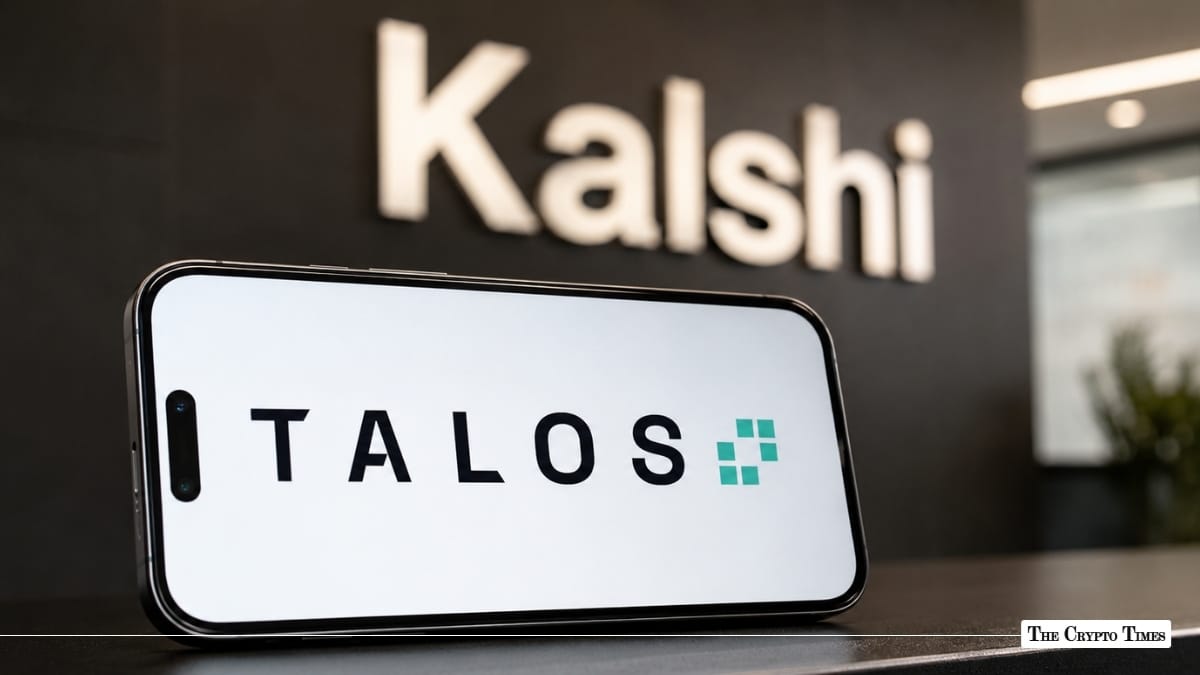
Talos, an institutional digital asset trading infrastructure provider, has integrated Kalshi’s prediction markets and crypto perpetuals into its platform, giving institutions a route to trade event contracts through the same systems they use for digital assets.
What Talos Built
The integration, announced Tuesday, lets select institutional clients trade Kalshi’s event contracts and crypto perpetual futures from within the existing Talos interface, with no separate integration required. It brings professional execution tooling to a market that has been dominated by retail participation.
For on-exchange trading, clients such as market makers and hedge funds gain access to Talos’s algorithmic suite, including Iceberg, Pegged, Sniper, TWAP, and POV order types, designed to work large orders while minimizing market impact. The platform’s multi-leg execution supports spread trading, letting clients construct perpetual-to-perpetual and perpetual-to-spot spreads within a single order to run basis and funding-rate arbitrage strategies.
Alongside that, Talos’s request-for-quote platform, the same system its ETF issuer clients use for creating and redeeming workflows, provides a block-trading interface for large off-exchange sizes, connecting to a network of OTC liquidity providers. Cantor, the investment bank within the Cantor Fitzgerald group, advised Talos on the build-out.
Why Regulation Is the Whole Point
Every element of the announcement rests on a single fact: Kalshi is regulated. As a CFTC-supervised exchange, Kalshi offers institutions a federal framework comparable to the one they already use for traditional options and futures — the precondition for most professional capital to participate at all.
“Kalshi’s regulatory standing as a CFTC-regulated exchange makes it a natural venue for that demand,” said Andy Ross, Head of Institutional at Kalshi. Talos CEO Anton Katz framed the integration around a broader shift, arguing that trading is moving to 24/7, prediction use cases are growing rapidly, and “every asset class is migrating to digital rails.”
That framing is a company’s characterization of its own market, and the claims about accelerating institutional interest come from the firms building the product. But the underlying regulatory structure is real, and it is what separates this from the retail prediction-market boom that preceded it.
The Regulated Divide Is Widening
The integration lands at a moment when prediction markets are splitting along regulatory lines, and the split is producing opposite outcomes for the two largest platforms.
Kalshi, regulated by the CFTC, is being wired into Wall Street execution infrastructure. In the same period, Polymarket, which operates as a crypto-native, non-custodial exchange settling in USDC, has been blocked at the internet-service-provider level in France, where the regulator cited its unregulated status, and faces restrictions across more than 30 jurisdictions. The Crypto Times reported in June that CBOE entered the sector specifically through the regulated door that the crypto-native platforms have struggled with.
The contrast captures the market structure taking shape. Regulatory standing, once a compliance detail, has become the determinant of which platforms institutions can touch and which they cannot. Talos choosing Kalshi as its prediction-market venue is a direct expression of that logic.
Kalshi’s Institutional Momentum
The deal fits a trajectory Kalshi has been building all year. The CFTC approved its BTCPERP Bitcoin perpetual contract in May, the first perpetual futures product on a US-regulated exchange, and Kalshi has since recorded $16.1 billion in perpetuals trading volume, with much of that activity reported to come from institutional players.
The platform has approached $10 billion in monthly trading volume, is in talks with the CFTC to extend perpetual futures into metals, forex, and energy, and has been reported to be raising capital at a valuation approaching $40 billion. The broader institutional pull is visible elsewhere too: Intercontinental Exchange, the parent of the New York Stock Exchange, made a roughly $2 billion commitment to Polymarket, and Polymarket has filed for its own margin-trading license.
Talos plans to extend the offering further, with intentions to let brokers and trading platforms offer Kalshi event contracts to their own customers later this year, subject to jurisdiction, and to build a harmonized market-data feed across prediction-market venues. Those capabilities are planned rather than live.
The Contested Ground
Kalshi’s regulated status, central as it is to the integration, is not uncontested. The exchange remains locked in state-level legal fights, including a case before the Sixth Circuit in which Tennessee regulators argue its sports-related event contracts amount to gambling under state law. CME Group has separately sued the CFTC over its approval of Kalshi’s crypto perpetuals.
Those cases will help determine how durable the federal framework underpinning this integration proves to be. For now, the direction is set: the infrastructure institutions use to trade digital assets is being extended to prediction markets, and it is being built on the venue that regulators have approved rather than the ones they are moving to block.
Whether prediction markets become the institutional asset class Talos and Kalshi describe will depend on demand that has yet to fully materialize. What the integration establishes is that the plumbing is now being laid for it.
Also Read: House Hearing Reopens Debate Over Rules for Sports Prediction Markets