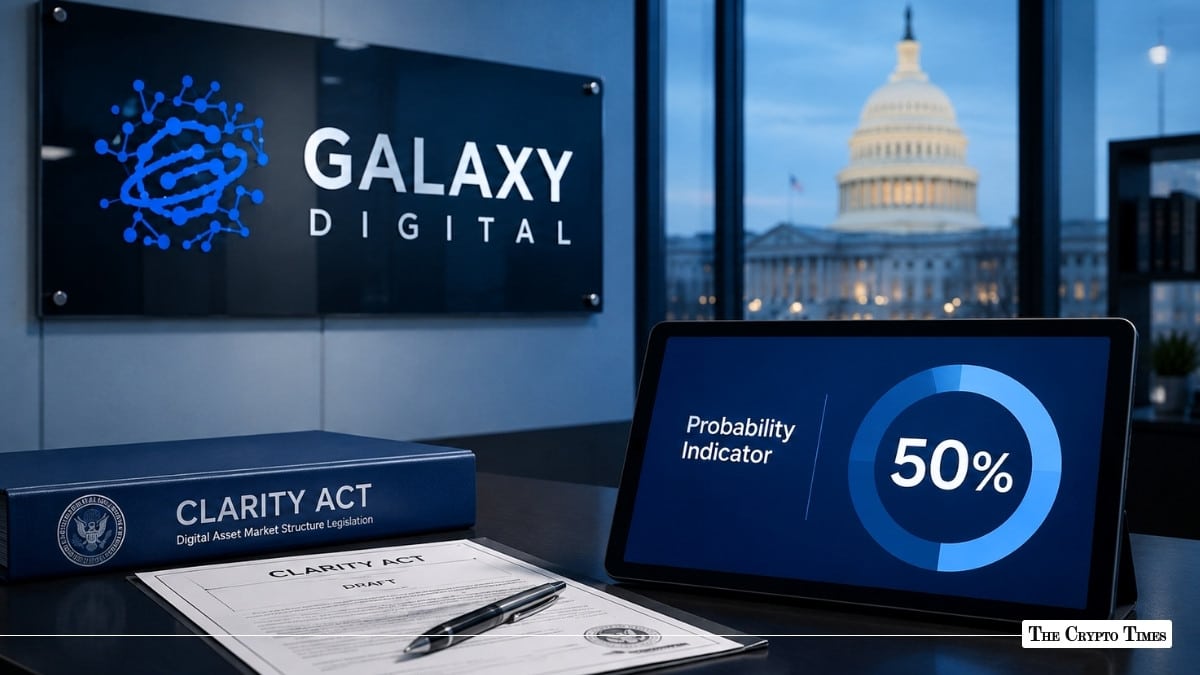
Galaxy Research has lowered its odds of the CLARITY Act becoming law in 2026 to roughly 50-50, down from 60% earlier this month, warning that the crypto market-structure bill is being squeezed out by a Senate calendar that shrinks every week.
A coin flip, and a calendar problem
The downgrade came in a June 26 note from Alex Thorn, head of firmwide research at Galaxy Digital, who had pegged the bill’s chances at 60% as recently as June 5. His framing was pointed: “The downgrade is primarily related to the calendar, not the substance of the bill,” he wrote, adding that “the absence of news is itself the news.”
That distinction matters. The CLARITY Act is not stuck because it failed a vote or lost its backers; it cleared the Senate Banking Committee 15-9 on May 14 and has sat on the Senate Legislative Calendar as item No. 423 ever since. What it lacks is movement — no merged text between the Banking and Agriculture committees, no scheduled floor vote, no motion to proceed, and no public commitment from leadership. “Floor time is the scarcest resource in the Senate right now,” Thorn wrote, “and crypto market structure is not first in line for it.” With the Senate adjourned until July 13 and the August recess looming, he warned, “the runway is quickly declining into just a matter of weeks.”
Floor time is the scarcest resource
The competition for that runway intensified sharply this week. On June 24, President Donald Trump declined to sign a bipartisan housing bill—which had passed the House 358-32 and the Senate 85-5—conditioning his signature on Congress first passing the SAVE Act, a proof-of-citizenship elections measure that Majority Leader John Thune has said lacks the votes to clear the chamber. Thorn described the move as another leadership-consuming fight injected into an already crowded queue.
It is not the only one. The Senate must also find floor time for a bipartisan effort to restore Section 702 surveillance authorities and for the annual National Defense Authorization Act before the recess. Each is a time-sensitive priority competing with a crypto bill that, for all its industry support, is not at the front of the line.
The substance still isn’t settled either
Even setting the calendar aside, the bill’s hardest questions remain open. The central one is ethics: a conflict-of-interest amendment from Senator Chris Van Hollen failed 11-13 in committee, and Senators Ruben Gallego and Cory Booker continue to make enforceable ethics standards, addressing conflicts tied to the president’s crypto interests, a condition of their support.
Separately, law-enforcement-aligned senators are still pressing for changes to the developer-protection language in Section 604, the Blockchain Regulatory Certainty Act, the provision shielding non-custodial developers from money-transmitter rules.
The math makes those concessions unavoidable. Thorn noted that at least two Republicans, Josh Hawley and Rand Paul, are expected to vote no, which means the bill cannot reach the 60-vote threshold without Democratic crossover support that the ethics impasse has so far blocked. There has been some movement on the margins: the Justice Department this week pushed back on a letter from four law-enforcement groups, stating that CLARITY would not weaken prosecutors’ ability to investigate crimes involving digital assets. But the core Democratic conditions remain unmet.
What would move the odds
Thorn was explicit about what could reverse the slide. A public agreement on combined Banking-Agriculture text, a credible resolution of the ethics or BRCA disputes that locks in a durable Democratic bloc, and, “above all,” a floor commitment from leadership for July would push the estimate back toward 60% or higher. A scheduling announcement within two weeks would help; continued silence into mid-July would push the odds lower still.
There is a near-term marker to watch. Senator Cynthia Lummis has said the Senate expects to release the final CLARITY text around July 4 for public review, ahead of possible floor consideration later in the month, and has warned that missing this year’s window could delay meaningful market-structure legislation until 2030.
Galaxy’s 50-50 call is not a prediction of failure so much as a measure of how narrow the path has become: a bill with bipartisan support and industry momentum, waiting at No. 423 on the calendar, in a chamber that keeps finding other things to do.
Also Read: Kristin Smith Says CLARITY Act Can Still Pass Before Recess