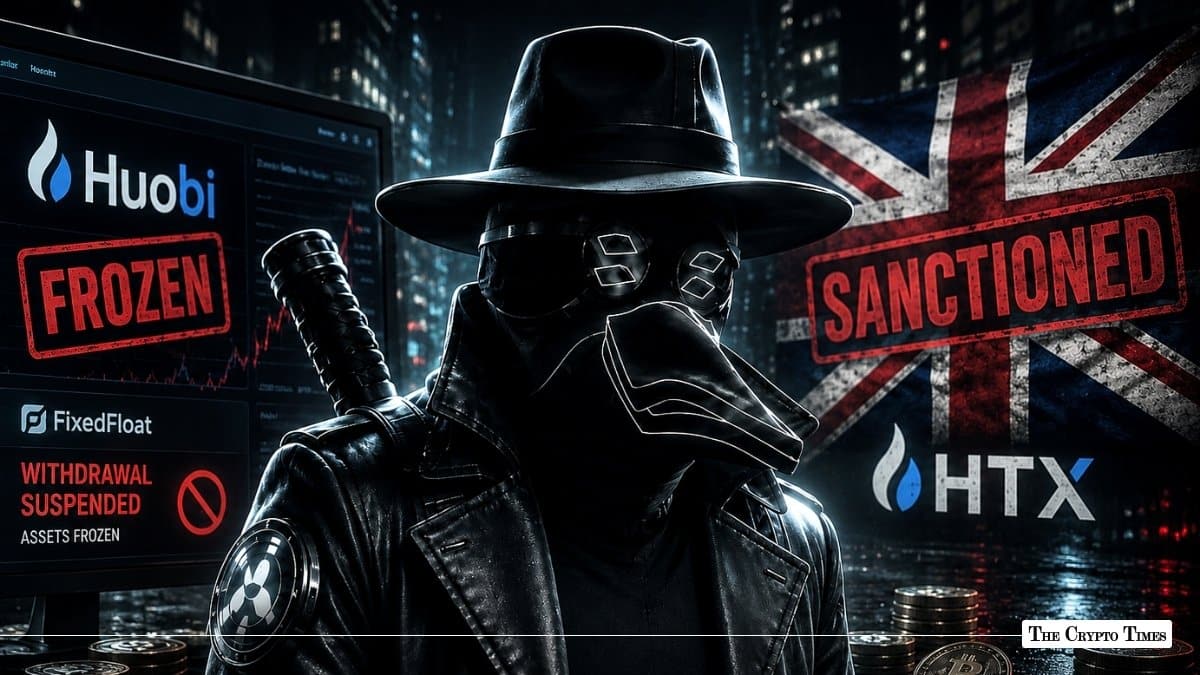
Instant exchange service FixedFloat has become one of the first major crypto platforms to publicly enforce the United Kingdom’s May 26 sanctions designation of HTX/Huobi, announcing that all funds originating from the sanctioned exchange will be suspended pending additional verification.
Following which, on-chain investigator ZachXBT publicly criticized the UK sanctions framework as “a bit of an overreach” with broadly damaging consequences for legitimate crypto users.
The combination — concrete enforcement action by a crypto service, paired with substantive professional pushback from one of crypto’s most credible on-chain investigators — represents the first major test of how the UK’s first-ever application of Regulation 17A to crypto exchanges will play out across the global crypto ecosystem.
The FixedFloat Action
In a public announcement, FixedFloat updated its users: “Due to recent sanctions-related developments involving Huobi/HTX, our compliance procedures have been updated accordingly. As a result, funds originating from Huobi will be suspended by our service and will be subject to additional verification.”
The platform “strongly recommended ensuring that the source of funds and originating addresses are not associated with sanctioned entities or addresses before initiating a transaction.” Crypto exchange aggregator OrangeFren amplified the warning to its users, advising them to “be careful if your coins previously touched Huobi/HTX as sanctions were imposed against them.”
For HTX users, the practical implication is significant. Any wallet that has interacted with HTX, whether for legitimate trading or routine deposits and withdrawals, now carries potential downstream compliance friction across the crypto services ecosystem.
FixedFloat’s action is notable because the platform is not UK-regulated. It is choosing to enforce UK sanctions preemptively, presumably to avoid future correspondent banking restrictions or to maintain compatibility with UK liquidity providers. This is the compliance cascade ZachXBT is publicly worried about.
ZachXBT’s Specific Critique
In a post reposting OrangeFren’s warning, ZachXBT made his concerns explicit.
“Recent UK crypto sanctions seem to be a bit of an overreach,” he wrote. “Wonder if it will ever get to the point where it’s ignored because HTX address tainting onchain has been catastrophic.”
The critique unpacks into four distinct concerns.
First, the historical precedent. ZachXBT noted that previous crypto sanctions targeted entities with overwhelming illicit activity profiles: “In the past sanctions were done and those crypto businesses typically had a high % of illicit activity (Huione, Blender, Hydra, etc).” HTX, by contrast, has “a decent number of Asia retail users,” meaning the address tainting affects a substantial population of users who had no involvement in the sanctioned activity.
Second, the impact on on-chain tracing. ZachXBT wrote that the sanctions have effectively broken one of the categories he uses in his investigative work: “Basically now I’ve had to ignore the sanctions category when tracing cases by exposure since ‘risk’ itself has become meaningless.”
The point matters because on-chain investigators rely on sanctions exposure as a signal of illicit activity. When sanctions begin covering large exchanges with predominantly legitimate retail use, every flagged wallet’s “risk” score becomes noise rather than signal. The same compliance tools that should help separate real bad actors from ordinary users now produce false positives at scale.
Third, the compliance tool limitations. ZachXBT specifically called out a structural gap: “Compliance tools are a bit flawed and do not differentiate pre & post sanctions activity well.” A user who deposited to HTX in 2023 — before any sanctions were considered, when HTX was a normally functioning exchange — now carries the same flagged status as a user who interacts with HTX after the May 26 designation. The tools cannot distinguish between the two cases meaningfully.
Fourth, the comparison to actual undetected criminal activity. ZachXBT pointed to a contrasting case: “Meanwhile I have a legit $1.25B laundering case by an illicit actor the UK completely failed to detect.” His implication: the UK is sanctioning HTX while missing a separate $1.25 billion laundering operation. “Given UK incompetence historically in crypto cases it’s not surprising to see them sanction HTX and miss the actual violations.”
The framing positions the HTX sanctions not as targeted enforcement against verified illicit activity, but as institutional theater that misses the more significant criminal violations occurring elsewhere.
How the UK Sanctions Actually Work
To assess ZachXBT’s critique, it helps to understand the specific structure of what the UK imposed.
Regulation 17A, applied for the first time to crypto exchanges, prohibits UK financial institutions from acting as correspondent banks or processing payments for sanctioned entities. The restrictions extend downstream — they apply even when transactions are between non-sanctioned accounts but appear headed to or from a sanctioned account. UK financial institutions and Virtual Asset Service Providers (VASPs) are also required to freeze assets linked to sanctioned entities and to trace transactions across blockchain networks.
On June 3, the UK’s Office of Financial Sanctions Implementation (OFSI) published FAQ 186, clarifying explicitly that the designation of Huobi Global S.A. also applies to HTX exchange because Huobi owns HTX. This counters HTX’s initial public response, which had argued that “the listed entity Huobi Global S.A. is distinct from the online HTX exchange.” HTX’s legal filings, however, state that Huobi Global “owns and operates HTX,” undermining the entity-separation argument.
The practical effect is that any UK-regulated VASP or financial institution must now treat HTX-originating funds as sanctioned. Non-UK services like FixedFloat are not technically bound by UK regulations, but many are choosing to comply preemptively to avoid future correspondent banking restrictions or to maintain access to UK liquidity providers. This is the compliance cascade ZachXBT is describing.
The Address Tainting Problem
ZachXBT’s “address tainting” concern is specific and worth unpacking. In the crypto compliance industry, “tainting” refers to the practice of assigning risk scores to wallet addresses based on their historical interactions with flagged entities. A wallet that received funds from a sanctioned exchange even years before that exchange was sanctioned would carry a “tainted” status under most current compliance tools.
For HTX users, this creates an asymmetric burden. Users with no connection to the alleged Russia sanctions evasion — including users who deposited to or withdrew from HTX for entirely legitimate trading purposes — now face the same compliance friction as users who actually moved funds through A7 or Garantex. Crypto services using third-party compliance tools (Blockaid, Chainalysis, TRM Labs, Elliptic) will increasingly flag these wallets when they interact with downstream protocols.
The pattern is structurally similar to what TCT recently documented in the Hyperliquid 2-cent dust transfer case, where a user was banned from a major DEX because his wallet passively received a 0.000001 ETH transfer from an address flagged in compliance tools. The HTX case is the same problem at orders of magnitude greater scale—millions of users potentially affected by sanctions exposure they neither chose nor participated in.
The Broader Compliance Reckoning
The HTX sanctions are forcing crypto services worldwide to make rapid policy decisions about how to handle the cascade.
Three approaches are emerging. The first is FixedFloat’s approach: explicit suspension of HTX-originated funds with additional verification requirements. This is the most cautious and most compliance-friendly response, but it imposes friction on a large user base.
The second is selective enforcement — applying restrictions only to transactions that fall within UK jurisdictional reach. Most non-UK crypto services would prefer this approach but find it operationally complex given how decentralized blockchain settlement networks distribute compliance obligations.
The third is ignoring the sanctions entirely, which is functionally what most non-UK retail-focused crypto services have done for previous sanctions designations. ZachXBT’s “wonder if it will ever get to the point where it’s ignored because HTX address tainting onchain has been catastrophic” suggests he sees this third option as increasingly likely — and as a structural failure of the sanctions framework rather than a defensible compliance position.
For HTX itself, the response has been to maintain that user funds are safe and operations continue normally. The exchange has reassured customers via support announcements that “HTX’s global operations remain unaffected, and all user funds are safe.”
Why This Matters
The structural question ZachXBT raises is whether the UK sanctions, even if technically justified by HTX’s alleged Russia-linked activity, are net-positive for the crypto ecosystem’s compliance integrity.
If sanctions framework execution begins producing more noise than signal—millions of legitimate users flagged alongside actual sanctioned actors—the framework loses its informational value. Compliance teams begin ignoring the category. Genuine sanctioned activity becomes harder to detect because it’s buried in false positives. The framework’s intended purpose (separating clean from dirty money) becomes its opposite (rendering the distinction meaningless).
This is the same structural critique that ZachXBT has been making about centralized exchange listing standards and about the broader DeFi AML stack. The compliance and enforcement infrastructure that crypto has built — and that traditional finance is increasingly extending to crypto — only works if it can credibly distinguish legitimate from illicit activity. When it cannot, the entire framework’s authority erodes.
The UK government has not publicly responded to ZachXBT’s critique, and there is no indication that the OFSI is reconsidering the HTX designation. Whether other major crypto services follow FixedFloat’s lead in publicly suspending Huobi-originated funds — or whether the broader industry quietly ignores the sanctions to avoid the compliance burden — will be the practical test of which scenario ZachXBT’s commentary points to.
For now, HTX users worldwide carry a new structural risk: their wallet history may begin generating compliance friction across crypto services they have never directly interacted with. The cascade has begun. How far it spreads, and whether it produces useful enforcement or only widespread friction, is the next chapter.