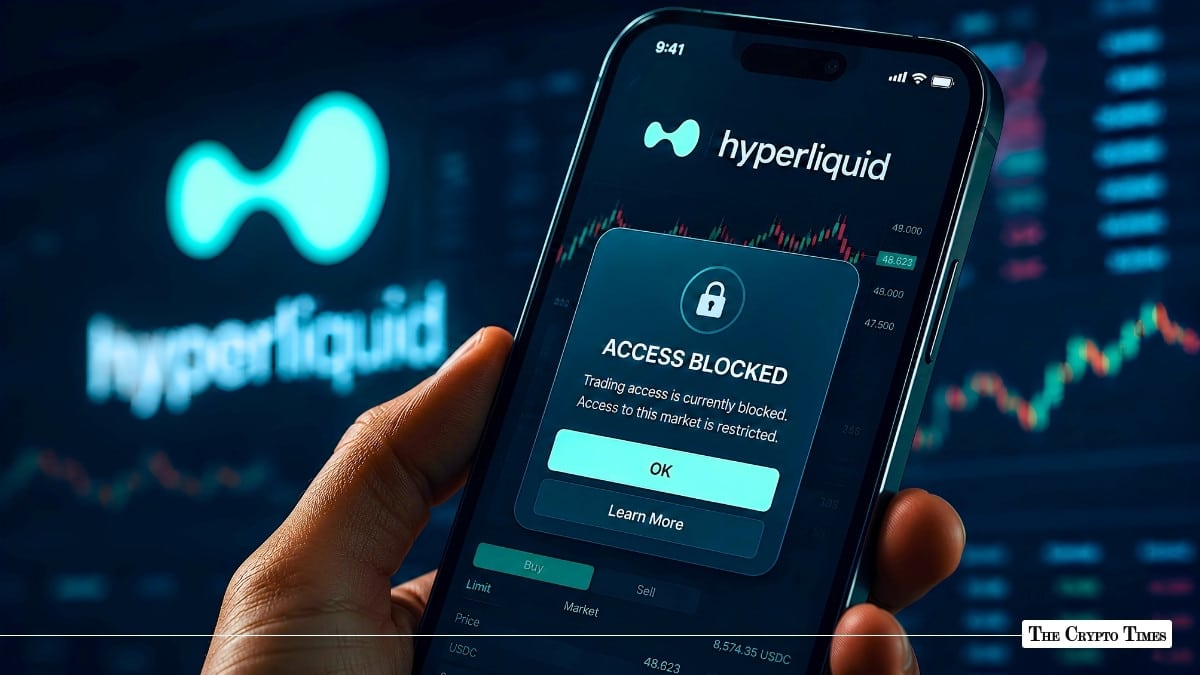
When trader Maxime was banned from Hyperliquid on March 29, 2026, after his wallet was flagged as “high risk” by a third-party screening tool, the incident was widely reported as a frustrating but isolated false positive. A two-month investigation by the trader and the on-chain analytics community has now revealed what actually triggered the ban—and the answer points to a much larger problem with how decentralized finance manages user access through opaque private AML systems.
The cause: a single unsolicited 0.000001 ETH transfer worth approximately two cents, sent to Maxime’s wallet on March 6, 2026.
The 2-Cent Trigger
Maxime’s wallet had been active for over four years across more than a dozen blockchains, with more than 9,000 transactions and approximately $750,000 in trading volume on Hyperliquid alone. He had never been flagged on any platform before.
On March 6, his wallet received a tiny ETH transfer from address 0xAB55337Aab7f253aC6923ec2aA8C702754D08151 — what on-chain analysts call an “address poisoning” or “dusting” attack. The transfer was unsolicited, worth roughly $0.02, and required no action from Maxime to receive.
Three weeks later, on March 29, he was locked out of the Hyperliquid frontend. The platform’s official Discord moderators informed him that an independent blockchain analytics provider had flagged his wallet as high risk, blocking access to the protocol via app.hyperliquid.xyz. When Maxime protested, his Discord account was muted for four days, preventing him from seeking further clarification through the platform’s official support channels.
Hyperliquid Confirms It Was a False Positive
On April 1, 2026, Hyperliquid co-founder Iliensinc posted an update directly to Maxime’s case:
“Based on discussion with the independent analytics provider, it looks like this was a false positive flag from an address poisoning attack. The analytics provider will share updates on handling this situation, but I would expect the flag to be lifted in time.”
That confirmation matters. It establishes that Hyperliquid’s own founding team agrees the ban was triggered by passive exposure to a single unsolicited transfer, not by any action Maxime himself took. The platform did not dispute that his trading history was clean. The flag came entirely from the dust transfer.
The Dusting Address and Its CSAM Allegation
The investigation into the source address began after several community members started digging into the on-chain history. Most prominently, on-chain analyst Tay (@tayvano_) and security researcher TobyFrei4 (@TobyFrei4) reported that the source address 0xAB55337Aab7f253aC6923ec2aA8C702754D08151 is tagged in some analytics systems with extremely serious illicit content classifications, including alleged links to child sexual abuse material (CSAM).
According to the public analysis, the address received only four transactions from three sender addresses for approximately $10 to $50 total in August and September 2025. One of those sender addresses also reportedly sent funds to a destination labeled “Loliporn” in some analytics tools—a label associated with CSAM content.
What happened next is the structural problem. The address remained inactive for months, then began sending 0.000001 ETH transfers—worth fractions of a cent—to approximately 3,000 wallets that had previously sent funds to addresses beginning with 0xab. The transfers required no engagement from recipients. They simply arrived, automatically dragging recipient wallets into analytics-driven risk classification systems that treat any inbound connection to a flagged address as potential contamination.
Community analyst TobyFrei4 documented at least ten other Hyperliquid users in situations similar to Maxime’s, suggesting that the same dusting campaign created a wider pattern of false positives. The dusting pattern itself — many tiny outbound transfers to wallets that previously interacted with a target prefix — is widely recognized as adversarial behavior, not legitimate transaction activity.
The Broader AML Layer Problem
In a follow-up post published this week, Maxime extended the case into a broader analysis of how private AML firms have come to function as an unaccountable gatekeeping layer across DeFi.
“This episode also raises a much bigger issue about the role of private AML analytics firms in crypto,” Maxime wrote. “Today, a flag coming from one of these companies, whether fully justified or simply mistaken, can have extremely broad consequences across the ecosystem. A single private actor can effectively influence whether a wallet is treated as suspicious by serious protocols that rely on these providers as an external trust layer.”
The firms named in the post include Blockaid, Chainalysis, TRM Labs, and Elliptic — the dominant providers of blockchain risk analytics that DeFi platforms increasingly integrate to manage regulatory compliance and reduce exposure to sanctioned or illicit funds.
The structural problem Maxime identifies is that these classifications cascade across the ecosystem. A flag at one provider can affect a user’s access to multiple unrelated protocols, sometimes without the user even knowing which firm made the initial call. And there is often no clear path to challenge the decision, no visible explanation of what triggered it, and no reliable appeal process—particularly when the flag results from passive exposure rather than active conduct.
When Maxime contacted Blockaid, it reviewed the case quickly and confirmed the wallet showed no malicious flags on its end — suggesting the original flag may have come from a different analytics provider entirely.
A Pattern That’s Still Happening
In a separate post published on June 3, Maxime confirmed the issue is ongoing rather than isolated. “I’ve received more and more DMs recently from people saying they are facing a situation similar to what happened to me a while ago,” he wrote, referencing the recent case of trader @0xasrequired who experienced a similar Hyperliquid frontend ban.
“This can happen to anyone. The recent situation with @0xasrequired is another reminder that even serious, active and well-known users can suddenly face issues without fully understanding why.”
Maxime was careful to position his critique as constructive rather than antagonistic. “Hyperliquid remains one of the best projects of this cycle, and one of the strongest DeFi products in years. But the AML process feels too opaque from the user side. There should be a clearer way to understand a restriction, appeal it, and resolve false positives. Strict compliance is fine. Opaque bans are not.”
What the Case Reveals
The Maxime investigation is significant for three reasons that extend beyond his individual ban.
First, it documents the specific technical mechanism — passive exposure to a 0.000001 ETH dust transfer from a flagged address — by which a long-standing clean wallet can be effectively de-platformed from major DeFi protocols. This is not a theoretical concern. It happened, was confirmed by the platform’s co-founder, and may be affecting roughly ten other Hyperliquid users from the same dusting campaign.
Second, it surfaces the role of private AML firms as an unaccountable trust layer in DeFi. Protocols including Hyperliquid integrate these screening tools to manage compliance risk, but the resulting decisions are made by external private companies whose risk models, classification heuristics, and appeals processes operate without external visibility.
Third, it raises a question about contamination thresholds. As Maxime put it, “a single incoming transfer worth only a few cents to a 4-5-year-old wallet with a long and otherwise normal history should not, by itself, be enough to make that wallet effectively lose access to major DeFi interfaces.”
The case arrives at a particularly sensitive moment for Hyperliquid. In a Wall Street Journal interview published this week, founder Jeff Yan defended the platform’s transparency against criticism following the October 10 liquidation event, arguing that Hyperliquid was singled out for negative coverage because its on-chain data was more visible than that of competing platforms. The transparency argument is harder to sustain when the same platform’s user access decisions are made by undisclosed third-party providers using opaque risk models.
For users, the practical takeaway is uncomfortable: wallet hygiene now means defending against unsolicited inbound transfers that the recipient cannot block. For the broader DeFi ecosystem, the case suggests the industry will need clearer appeals processes, more realistic contamination thresholds, and meaningful transparency from the AML providers whose classifications increasingly determine who gets to participate.