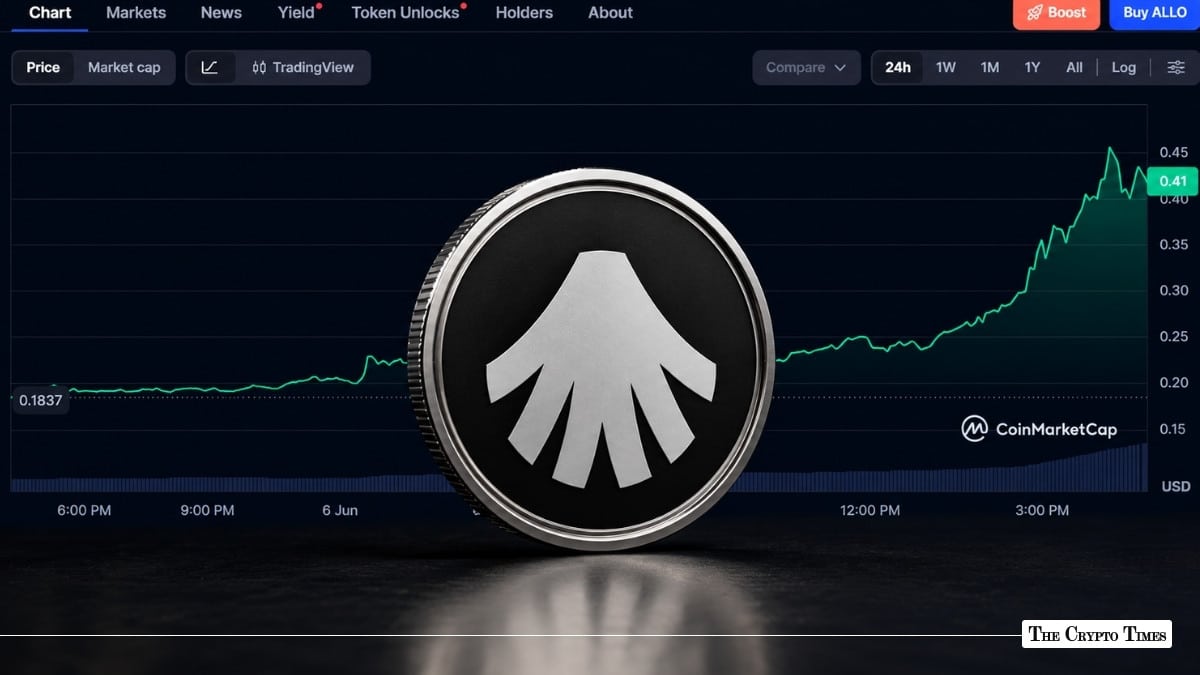
Allora Network’s ALLO token has surged 118.14% in the past 24 hours, reaching $0.4075 amid record trading volume, after autonomous trading agents using the network’s decentralized AI inferences began executing trades on Kalshi prediction markets through integration partner Cobot.
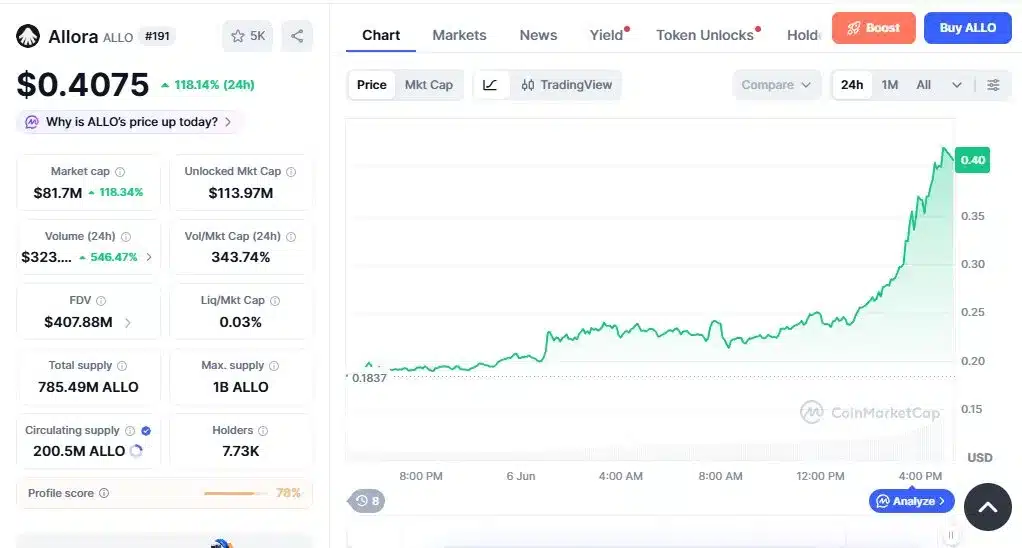
According to CoinMarketCap data, ALLO is trading at $0.4075 with a market capitalization of $81.7 million. The token’s 24-hour trading volume has surged 546.47% to approximately $323 million, with the volume-to-market-cap ratio reaching 343.74%—indicating extreme trader rotation rather than passive holding.
The Cobot-Kalshi Integration Driving the Move
The structural catalyst is Cobot, an AI-powered trading product launched on May 18 that is the first major application built on Allora’s decentralized inference layer. On June 1, Cobot announced that its Kalshi integration was live, with autonomous trading agents for Kalshi prediction markets set to launch within days.
“Allora inferences now being used to execute trades on Kalshi,” the Allora team confirmed in reposting the Cobot announcement. The framing matters technically: Allora itself has not integrated directly with Kalshi. Rather, Cobot — the AI-powered trading application that consumes Allora’s decentralized inferences — has integrated with Kalshi, meaning Allora’s inference layer now serves as the predictive intelligence behind live trades on a CFTC-regulated prediction market exchange.
The structure represents the kind of real-world utility flow that AI-themed crypto tokens have struggled to demonstrate at scale. Allora’s inferences feed into Cobot’s autonomous agents, which then place real-money trades on Kalshi based on the network’s collective intelligence outputs. The chain converts a previously speculative AI infrastructure narrative into a concrete, measurable revenue and demand pathway.
Why the Timing Matters
The launch arrives at a particularly active moment for the Kalshi ecosystem. On June 4, Moomoo Financial announced its partnership with Kalshi to launch regulated event contracts, expanding Kalshi access to Moomoo’s retail trading user base. Two days earlier, Galaxy Digital launched its institutional OTC prediction markets desk covering Kalshi and Polymarket, with its first executed trade being a $10 million CLARITY Act outcome position with hedge fund Arca.
The pattern is consistent: institutional and infrastructure plumbing is converging rapidly around Kalshi as the dominant U.S.-regulated prediction market venue. AI-powered trading agents are the natural next layer—they bring algorithmic decision-making to a sector that has historically been dominated by individual retail traders and political observers.
The competitive context also benefits Allora. As TCT recently reported covering Galaxy Research’s June 5 weekly, the Polymarket UMA oracle dispute over the $375 million Strategy Bitcoin sale contract has raised structural questions about how prediction markets should resolve. Galaxy explicitly contrasted Polymarket’s discretionary resolution model with Hyperliquid’s deterministic HIP-4 framework. Kalshi, as a CFTC-regulated DCM with pre-committed resolution methodologies, sits structurally on the cleaner side of that debate—making it a more durable foundation for AI-powered trading infrastructure than competing prediction venues.
The Technical Setup
The 24-hour price chart shows ALLO carving out a sharp ascent from approximately $0.18 to $0.40 between the morning of June 5 and the afternoon of June 6, with the most aggressive buying concentrated in the final hours of the move. The breakout coincided with the rapid expansion in trading volume—$323 million in 24 hours represents activity equivalent to roughly four times the token’s market capitalization.
The volume-to-market-cap ratio of 343.74% is among the most extreme readings recorded for any mid-cap altcoin in 2026. For context, large-cap tokens typically trade at volume-to-market-cap ratios in the 5% to 15% range; ALLO’s 343.74% indicates that the entire market capitalization turned over multiple times within a single 24-hour window.
The expansion in volume coincides with new exchange visibility. ALLO has gained traction on Binance, OKX, KuCoin, and WEEX in recent days, with promotional campaigns and trader-signal services amplifying the move. The combination of fundamental catalyst (live Kalshi utility), narrative tailwind (AI sector rotation), and structural triggers (exchange visibility, open interest growth) produced a textbook breakout-driven rally.
The Structural Caveats
The rally carries meaningful structural risks that any holder or prospective buyer should weigh.
The most immediate concern is supply distribution. Only 200.5 million ALLO is currently circulating out of a 1 billion maximum supply — meaning only 20% of the token is in the market. According to publicly available tokenomics, approximately 31.05% of total supply is allocated to backers and 17.50% to the team, with vesting schedules releasing those holdings over the next one to three years. The unlocked market cap is already $113.97 million, against $81.7 million currently circulating, indicating significant scheduled supply expansion ahead.
The fully diluted valuation of $407.88 million puts the token’s implied “fair value” assuming full circulation at roughly 5x the current market cap. Whether the Kalshi-driven adoption thesis can sustain that valuation depends on whether autonomous trading agent volume on Kalshi grows fast enough to absorb the scheduled token unlocks.
The second concern is competitive positioning. The decentralized AI inference category includes established players such as Bittensor, Render Network, and Theta Network, each with larger market capitalizations and longer track records. Allora’s differentiated value proposition — collective intelligence for prediction-based applications — is unproven at the scale required to compete with these incumbents on developer adoption and infrastructure usage.
The third concern is the typical post-rally behavior of small-cap altcoins. A 118% move in 24 hours with 546% volume expansion is the kind of breakout that historically attracts late entrants chasing momentum, with subsequent retracements often retracing a significant portion of the move within days. ALLO’s 7,733 holders (per CoinMarketCap) suggest a relatively concentrated holder base in which exits by larger positions could produce outsized price impact.
What Comes Next
The signals worth monitoring are concrete. The first is whether Cobot’s autonomous trading agents go live on schedule, with measurable trading activity routing through Kalshi via Allora’s inference layer. Volume data from both Cobot and Kalshi will indicate whether the structural utility thesis is producing real fee generation for Allora’s inference network.
The second is whether ALLO holds above current support levels as the initial euphoria subsides. The token’s previous range between $0.18 and $0.22 is the most likely retracement zone if profit-taking accelerates; sustained trading above $0.30 would suggest the rally has structurally re-rated the token rather than producing a transient spike.
The third is whether additional AI-powered trading agents follow the Cobot model—building on Allora’s inference layer to address other prediction markets or financial products. A second major application launching on Allora would significantly de-risk the single-product dependency that currently underpins the network’s adoption thesis.
For now, ALLO is among the strongest-performing AI-themed cryptocurrencies of 2026’s early June rotation, with a concrete utility catalyst that distinguishes it from purely narrative-driven AI tokens. Whether that distinction translates into sustained value capture depends on what happens in the next two product cycles, not what happened in the past 24 hours.