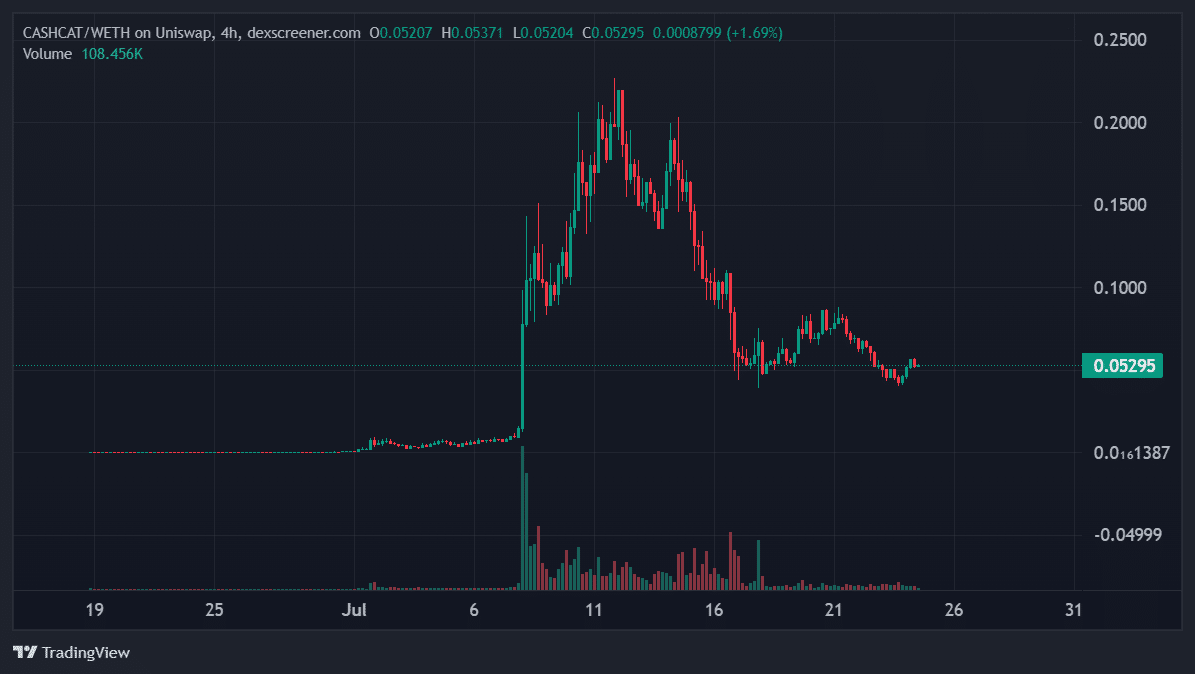
Cash Cat (CASHCAT), the breakout meme coin that defined the early days of Robinhood Chain, has suffered a steep correction, falling roughly 75–77% from its all-time high. The token, which briefly pushed past a $200 million market cap in mid-July, now trades around $0.052 to $0.053, leaving its market capitalization near $52 million.
The sharp decline has sparked debate across crypto circles about whether the intense meme coin frenzy that accompanied the launch of Robinhood’s new Layer 2 network is already winding down.
Robinhood Chain went live on its public mainnet around July 1, 2026, positioned primarily as infrastructure for tokenized real-world assets and on-chain finance. Yet speculative meme trading quickly dominated activity, with CASHCAT emerging as the flagship token.
Inspired by lore that “Cash Cat” was an early branding concept considered by Robinhood’s founders, the coin rode a wave of narrative-driven hype, CEO comments, and rapid ecosystem growth to deliver multi-thousand-percent gains for early buyers in its first two weeks.
Cashcat’s Sharp Correction Amid Cooling Hype
CASHCAT reached its peak of approximately $0.226 to $0.229 on July 11, 2026, before sellers stepped in. The subsequent rundown has been classic meme-coin volatility: parabolic upside followed by a deep retracement.
Recent data shows the token trading with 24-hour volumes still in the $5-10 million range, primarily on Uniswap V3 and V4 pools on Robinhood Chain, alongside listings on exchanges such as KuCoin and MEXC.
The broader Robinhood Chain meme category has also cooled. According to CoinGecko figures, the sector’s total market capitalization stands at about $152 million as of July 24, down from earlier peaks when CASHCAT alone commanded a large share of a $220–233 million meme market.
While CASHCAT remains the clear leader, accounting for roughly one-third of the category, the overall decline reflects profit-taking after the initial surge and a natural cooling of the first wave of speculation.
This correction coincides with reports of reduced intensity in some launchpad activity and the typical post-hype fatigue that follows rapid price discovery on new chains.
Broader Ecosystem Activity Suggests Season Not Fully Over
Despite CASHCAT’s pullback, on-chain metrics for Robinhood Chain itself continue to show resilience. Total value locked in DeFi stands near $318 million, according to DeFiLlama data, with bridged TVL significantly higher. The network has sustained hundreds of thousands of daily active users and multi-billion-dollar cumulative DEX volumes since launch. Memes coins have historically accounted for 80–85% of trading activity on the chain, underscoring their outsized role in early adoption.
Other tokens in the ecosystem are still generating notable moves. Names such as TENDIES have posted strong 24-hour gains in the 60% range, while smaller coins have recorded triple-digit percentage pumps, indicating that speculative interest has not vanished.
An array of Robinhood-themed memes, including Cash Dog in Hood, Little John, and various others, continue to trade with meaningful liquidity and community attention. New token launches persist, and the chain’s infrastructure, including Uniswap deployments and wallet integrations, supports ongoing experimentation.
The distinction between the end of one parabolic wave and the close of an entire meme season is important. Robinhood Chain remains only a few weeks old. Its original focus on tokenized stocks and real-world assets is still developing, yet the meme activity that drove initial traction has left a lasting footprint in liquidity, user growth, and narrative attention. Whether a second wave emerges will depend on fresh catalysts, sustained volume, and broader market conditions.
Also read: Ethereum DeFi Protocol Lien Finance Hacked for $542K in USDC Exploit