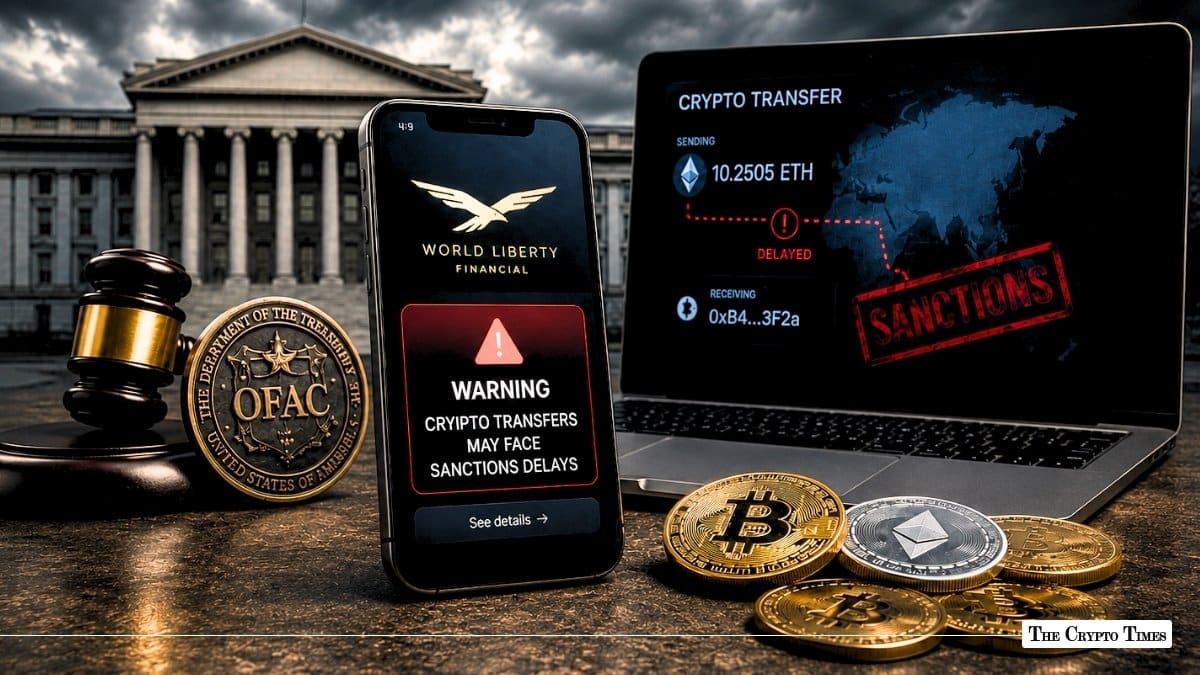
World Liberty Financial (WLFI), a crypto venture linked to U.S. President Donald Trump, has cautioned users that some digital asset transfers may be delayed, restricted, or rejected if they involve individuals, organizations, or wallet addresses flagged under sanctions rules. The company said the measures are meant to comply with regulatory requirements around prohibited transactions.
The notice, shared on X, came as U.S. regulators increase scrutiny of digital asset transactions linked to sanctioned entities and jurisdictions. The U.S. Treasury Department sanctioned several Iranian cryptocurrency exchanges, including Nobitex, the country’s largest trading platform.
WLFI said it will continue reviewing transactions for sanctions-related risks and urged users to check that their funds and wallet addresses are not connected to prohibited activity before making transfers.
The compliance trap: Enforcing sanctions on public ledgers
The advisory emphasizes that while underlying smart contracts execute on public, decentralized rails, the financial application layer remains bound by federal prohibited-transaction rules. WLFI explicitly urged users to perform rigorous due diligence on the origin of their funds before initiating on-chain movements.
This enforcement stance is more than simple corporate posturing; it reflects the deep, native control mechanisms built directly into the project’s smart contracts.
The reality of these centralized enforcement backdoors recently made waves across the industry following highly publicized legal friction with anchor investors like Justin Sun, who alleged the protocol possesses unilateral, hard-coded capabilities to freeze, restrict, or burn wallet balances to isolate toxic or non-compliant capital flows.
The geopolitical catalyst
The immediate trigger for the compliance warning was the Treasury Department’s sweeping sanctions against the core of Iran’s digital asset infrastructure.
On Tuesday, the Office of Foreign Assets Control sanctioned Iranian exchanges Nobitex, Wallex, Bitpin, and Ramzinex, along with several executives linked to those platforms. The company said the move highlights the growing compliance risks facing crypto users.
“While Iran’s economy is in free fall, the regime has chosen to co-opt digital asset technologies for its own corrupt agenda, including evading sanctions and transferring wealth out of the country. Iran’s current economic chaos is proof that President Trump’s maximum pressure campaign has been a success,” Treasury Secretary Bessent said.
Officials also said Nobitex handled transactions connected to Iran’s Islamic Revolutionary Guard Corps and other sanctions evasion activities. They added that the platform helped move funds even after U.S. military operations disrupted communications in the country earlier this year.
WLFI’s ongoing political scrutiny
Despite deploying aggressive compliance warnings, WLFI remains a major political lightning rod in Washington. The project’s handling of its early presale environments has drawn intense scrutiny from opposition lawmakers.
In 2025, Senators Elizabeth Warren and Jack Reed called on U.S. authorities to review whether non-compliant addresses—including entities tied to Russia, North Korea, and the blacklisted privacy mixer Tornado Cash—had bypassed early presale screenings.
WLFI rejected the allegations and said it applies strict anti-money laundering and identity checks. The company also said it turned away millions of dollars during its presale screening process. The project has also defended its due diligence in recent partnerships, including its USD1 stablecoin integration with AB DAO. However, questions surfaced after reports linked a previously promoted project to individuals connected with Cambodia’s sanctioned Prince Group network.
Also Read: CLARITY Act Reaches Senate Calendar as Crypto Awaits Verdict