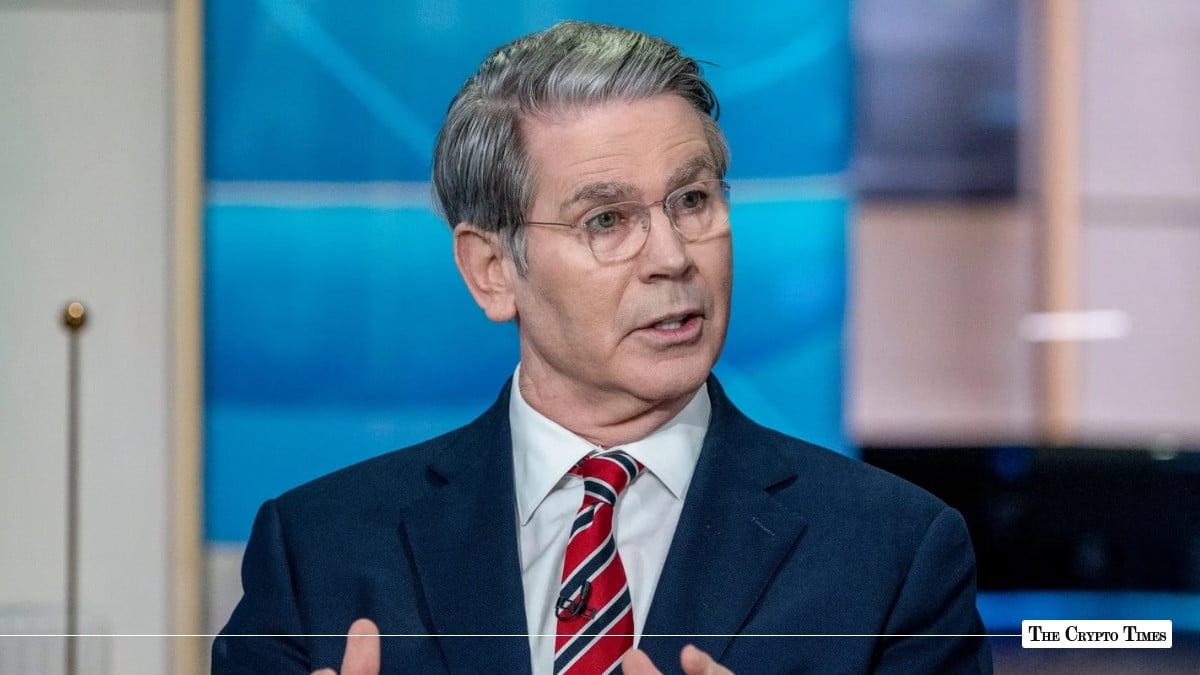
U.S. Treasury Secretary Scott Bessent used a White House briefing on Thursday, May 28, 2026, to double down on the Trump administration’s pro-crypto stance, backing stablecoin regulation while firmly rejecting the idea of a U.S. central bank digital currency (CBDC). He used the same briefing to formally launch the Trump Accounts app — the long-awaited tool for managing the federal government’s $1,000 child investment accounts.
According to the White House press briefing, the administration continues pushing for clearer digital asset rules through bipartisan stablecoin legislation and the proposed “Clarity Act,” which would build on the GENIUS Act stablecoin legislation that President Trump signed into law on July 21, 2025. The CLARITY Act aims to establish a broader regulatory framework for crypto markets and define oversight responsibilities between the SEC, CFTC, and Treasury.
Bessent says U.S. must bring crypto “onshore”
During the briefing, Bessent argued that most problems associated with digital assets stem from offshore markets operating outside U.S. oversight.
“When you look at digital assets, all the nonsense that happens, all the things you read about, that’s because it’s the wild, wild west offshore,” Bessent said. “So we got to bring it on shore. So I would encourage the House and the Senate to get CLARITY done.”
The Treasury Secretary said the administration views regulation as a way to strengthen industry standards rather than restrict innovation, positioning the U.S. as a global hub for digital assets.
Bessent also urged Congress to move quickly on the proposed CLARITY Act, which he said has bipartisan support on Capitol Hill. That framing matches the bill’s recent trajectory: on May 14, 2026, the Senate Banking Committee advanced the CLARITY Act in a 15-9 bipartisan vote, with Democrats Ruben Gallego (D-Ariz.) and Angela Alsobrooks (D-Md.) crossing over to join all 13 Republicans. The bill now heads to the full Senate floor, where it would need 60 votes, meaning seven Democratic crossovers in addition to all 53 Republicans, to overcome a filibuster.
Trump administration rules out CBDC
A major focus of the briefing centered around concerns over government-controlled digital currencies and financial surveillance.
When asked about digital payment systems potentially being used to monitor spending or limit personal freedoms, Bessent made it clear that the Trump administration opposes launching a U.S. CBDC.
“This administration has been very clear — there will be no central bank digital currency,” he said. He went further, calling a CBDC “the first step toward tracking;” explicit framing that the administration views CBDCs primarily as a privacy and surveillance concern.
His comments reinforce the administration’s broader position that privately issued stablecoins and market-driven digital asset infrastructure are preferable to a government-controlled digital dollar.
Bessent’s anti-CBDC position is not new. He took the same line during his January 2025 Senate Finance Committee confirmation hearings, telling lawmakers, “I see no reason for the U.S. to have a central bank digital currency. In my mind, a central bank digital currency is for countries who have no other investment alternatives.” He reiterated the stance on February 4–5, 2026, during testimony before the House Financial Services Committee and the Senate Banking Committee. The May 28 briefing reaffirms an already-well-established administration position rather than announcing new policy.
The remarks are likely to resonate with parts of the crypto industry that have long criticized CBDCs over privacy and surveillance concerns.
Stablecoin push comes amid wider economic agenda
While crypto regulation emerged as a key topic, Bessent also used the briefing to defend President Donald Trump’s broader economic agenda, highlighting tax cuts, GDP growth, and consumer spending.
He claimed the administration delivered “the largest tax cuts in American history” and pointed to strong consumer activity despite inflation concerns.
Bessent additionally promoted the administration’s new “Trump Accounts” initiative, which would provide children born during Trump’s presidency with a $1,000 Treasury-backed investment account.
AI, Iran, and financial markets
The Treasury Secretary also touched on artificial intelligence, describing the United States as an “AI superpower” and confirming that the administration is working closely with major AI labs to balance innovation and safety concerns.
On geopolitical tensions, Bessent outlined the administration’s conditions for any future agreement with Iran, including free navigation through the Strait of Hormuz and restrictions on Iran’s nuclear program. The comments came amid reported progress on a 60-day U.S.-Iran memorandum of understanding to extend a ceasefire and continue nuclear negotiations.
He also argued that oil markets remain well supplied and predicted prices could ease once regional tensions stabilize. Meanwhile, Bessent denied pressuring Federal Reserve Chair Jerome Powell to lower interest rates after recently meeting with him.
The briefing concluded with questions surrounding proposed legislation that could place President Trump’s image on a $250 bill, though Bessent stressed that any such move would ultimately require congressional approval.
Also read: CLARITY Act Shields Crypto Developers, But One Criminal Line Could Gut It