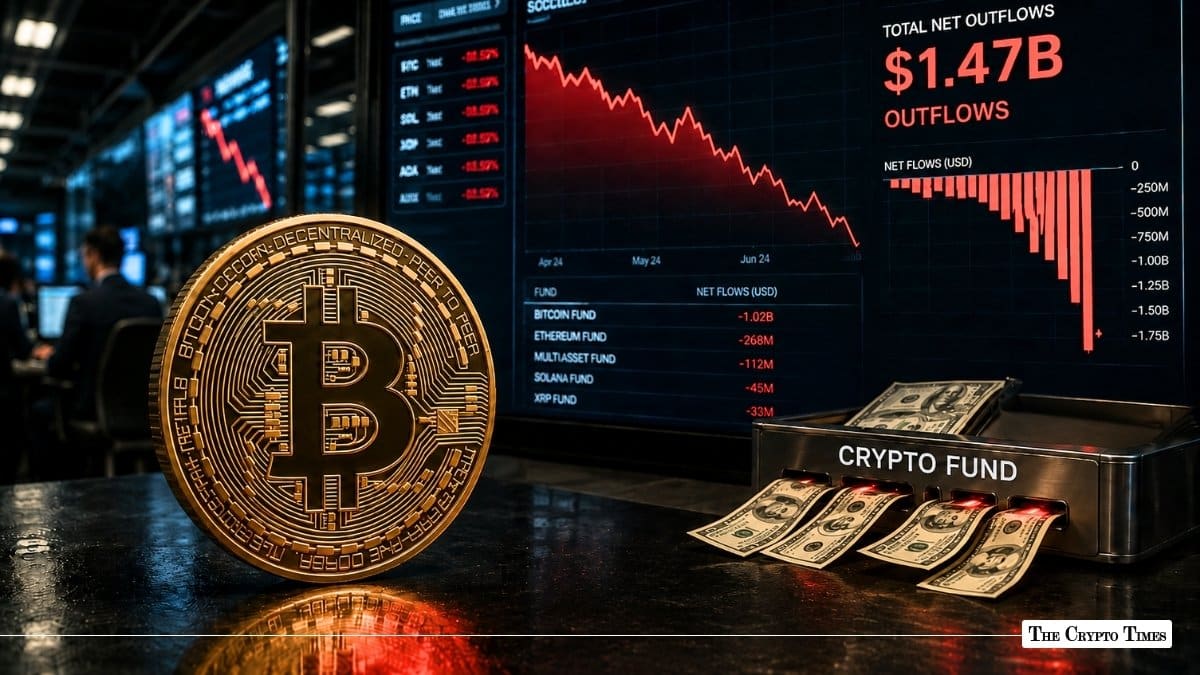
Digital asset investment products experienced another significant wave of capital withdrawals last week, as global investors continued to move away from risk assets amid rising geopolitical tensions and broader macroeconomic uncertainty.
According to the latest weekly report published by CoinShares, crypto investment products recorded total outflows of approximately $1.47 billion. This marks the second consecutive week of negative flows and the third-largest weekly outflow seen in 2026 so far.
The report notes that cumulative outflows over the last 14 days have now reached nearly $2.54 billion, signaling that institutional risk appetite across crypto markets has weakened considerably despite ongoing progress around U.S. crypto legislation.
Bitcoin records largest weekly outflow of 2026
Bitcoin remained the primary source of investor withdrawals, with the asset recording approximately $1.315 billion in outflows during the week.
CoinShares described the figure as the largest single-week Bitcoin outflow recorded in 2026, surpassing even the heavy liquidation period seen during late January market volatility.
Bitcoin’s year-to-date cumulative inflows have now dropped sharply to around $2.6 billion, down from nearly $3.9 billion just one week earlier.
The latest correction comes only weeks after institutional optimism had improved following regulatory developments tied to the proposed U.S. CLARITY Act framework.
Earlier in April, crypto investment products had recorded strong inflows exceeding $1.2 billion as Bitcoin recovered from earlier lows near $60,000 and attempted to reclaim the psychologically important $80,000 level.
Ethereum and altcoin participation also weakens
Ethereum also faced continued selling pressure, registering approximately $222.8 million in weekly outflows.
While some alternative cryptocurrencies still managed to attract selective inflows, participation across the broader altcoin market moderated significantly compared to previous weeks.
XRP recorded $31.8 million in inflows, NEAR saw $9 million in inflows, Solana attracted $7.7 million, Sui posted $2.9 million in inflows, and multi-asset crypto products brought in roughly $4.7 million.
Despite these isolated inflows, CoinShares noted that overall altcoin participation has slowed materially as institutional investors reduce exposure across the broader digital asset sector.
U.S. dominates outflows as global capital flight broadens
Regionally, the United States accounted for the overwhelming majority of crypto investment outflows, with approximately $1.425 billion existing U.S.-based products.
However, CoinShares noted that the latest wave of selling pressure expanded beyond the U.S. market this week, unlike earlier periods where European inflows had partially offset American weakness.
Switzerland recorded $16.2 million in outflows, Canada and Hong Kong saw $12.5 million and $12.2 million in outflows, respectively. Meanwhile, Germany remained largely flat.
CoinShares researchers stated that the “risk-off broadened globally,” reflecting a wider shift in investor sentiment across traditional and crypto markets alike.
Macro strains overpower policy milestones
The latest capital flight is partly due to rising geopolitical concerns surrounding Iran-related tensions, which have contributed to broader volatility across financial markets.The latest wave of outflows also comes as global financial markets remain on edge due to escalating geopolitical tensions in the Middle East, particularly surrounding Iran-related developments. Investors have increasingly shifted capital toward safer assets such as gold, U.S. Treasury bonds, and cash positions as fears of broader regional instability continue to grow.
Analysts say that during periods of geopolitical uncertainty and potential military escalation, institutional investors often reduce exposure to volatile assets like cryptocurrencies, leading to sharp selloffs across digital asset markets. The broader risk-off environment has also weighed on equities, commodities, and emerging market assets over the past two weeks.
Analysts noted that institutional investors continue treating digital assets as high-risk instruments during periods of macroeconomic instability, even as regulatory clarity around crypto markets gradually improves.
The latest selloff highlights how quickly institutional positioning in crypto can reverse during periods of uncertainty, particularly after strong inflow periods earlier in the year.
CoinShares added that while long-term structural interest in digital assets remains intact, short-term sentiment has become increasingly defensive as investors reassess global market risks.
The latest fund flow data comes as Bitcoin continues struggling to reclaim higher price levels after recent volatility. Bitcoin was trading near $76,618 at press time, down approximately 0.20% over the last 24 hours, according to CoinMarketCap data.